ARTS / CULTURE & LEISURE
Why more young Chinese footballers should embrace overseas challenges
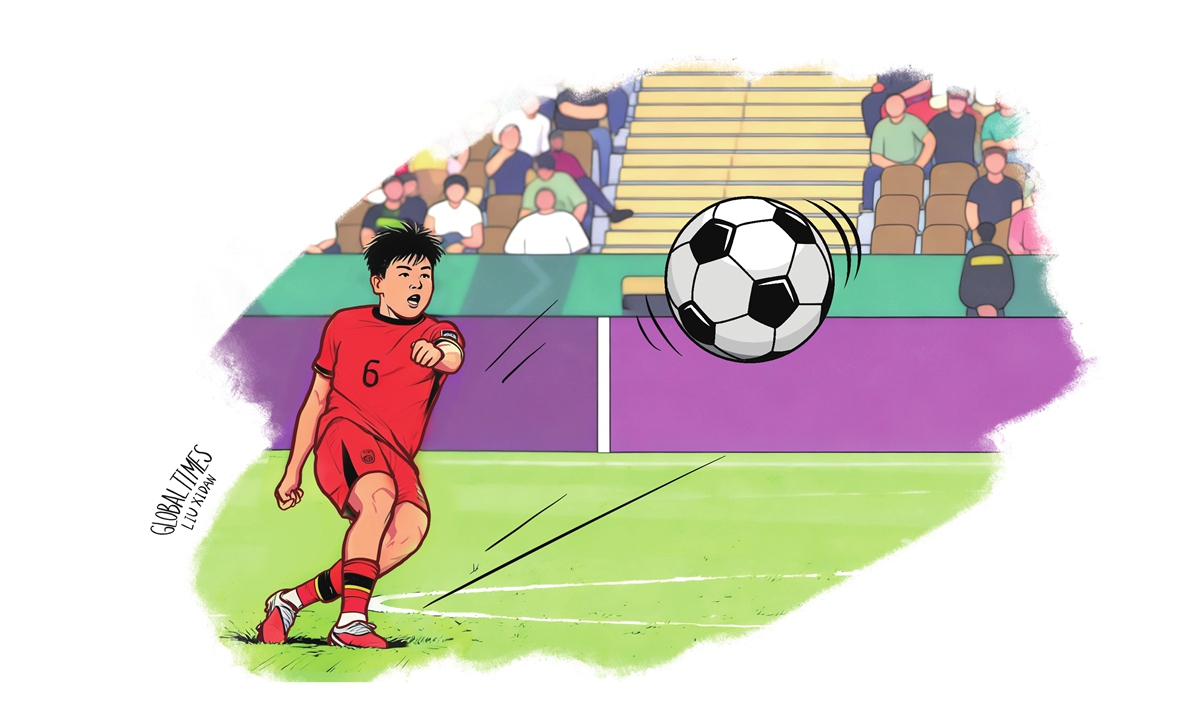
Illustration: Liu Xidan/GT
The news that 21-year-old defensive midfielder Xu Bin joined the Premier League side Wolverhampton Wanderers last week took many Chinese fans by surprise. This makes Xu, who captained the China U23 side throughout the U23 Asian Cup, where the Chinese team made history by finishing as runners-up, one of the few Chinese footballers to play in Europe. While Xu's current capability may not yet secure him a spot on the Wolves' first team, the club has arranged for him to be loaned for the remainder of the 2025-26 season, providing him with valuable exposure to English football's competitive intensity.Xu's journey to the Wolves wasn't a spur-of-the-moment decision after the U23 team's breakthrough. Reports indicate that the deal was finalized late in 2025, following the conclusion of Qingdao West Coast's Chinese Super League (CSL) campaign. The U23 Asian Cup, held in Saudi Arabia, served as a catalyst for Xu, reinforcing his resolve to seek higher-level challenges.
China's best-ever result in the U23 Asian Cup highlighted both the progress of the young squad and the gaps that remain when facing Asian powerhouses like Japan. Xu has been praised domestically for his passing range, ability to contribute in both defensive and attacking phases and leadership qualities. His move abroad represents a deliberate step to bridge the gap between domestic comfort and international demands.
This contrasts with 19-year-old forward Wang Yudong, another bright spark from China's youth setup. Wang, currently with CSL club Zhejiang FC, shone during the 2025 U20 Asian Cup and continued his form in the 2026 U23 edition, where he featured in six matches and scored once. He was also the top domestic scorer in the CSL last season, netting goals that underscored his potential as a clinical finisher. Rumors of interest from European clubs have swirled, yet no concrete move has materialized post-U23 Asian Cup. However, in the final against Japan, Wang's struggles with intense physicality and pace exposed areas for improvement, much like the rest of the team.
Some argue that at his young age, Wang should solidify his position in the CSL before venturing abroad. However, this perspective overlooks a critical flaw in domestic leagues: The league's relatively slow pace and rhythm compared to top international competitions. Staying put risks spoiling talents like Wang in subpar environments, where skills stagnate rather than evolve.
This dilemma isn't unique to Wang; it's a recurring theme for many promising Chinese players. The CSL has been plagued by corruption scandals and a focus on short-term gains over youth development. National team players often appear underprepared on the global stage, as evidenced by China's men's team languishing at 90th in the FIFA rankings.
Xu's decision to go abroad exemplifies a path that could revitalize Chinese football. China's neighboring countries like Japan and South Korea, with more expatriates in top leagues, enjoy higher national team rankings. Japanese and Korean talents spend longer stints abroad and advance to elite clubs, gaining exposure that sharpens physical attributes, tactical acumen and mental resilience.
For Chinese players, immersion in environments, even in Europe's lower-tier or reserve team confrontation with shortcomings, is beneficial, be it for their speed, strength, or decision-making under pressure. Even if Xu starts on loan, the daily grind against seasoned professionals will accelerate his development far beyond what the CSL offers.
Historical precedents bolster this view. Zheng Zhi, former captain of the Chinese national team, thrived at Charlton Athletic in the 2007-09 seasons, honing skills that elevated his international play. More recently, Wu Lei's stint at RCD Espanyol from 2019 saw him score crucial goals in La Liga, including against Barcelona, before returning home wiser and more versatile. Even less successful cases, like Dong Fangzhuo at Manchester United from 2004 to 2008, provided lessons in adaptation, though his limited minutes highlight the risks.
Yet, overseas moves are not a panacea for all problems. Challenges like language barriers and the uncertainty of playing time can erode benefits. Foreign players in Europe often face short contracts and risks of injury. For young talents, consistent matches matter more than prestige; languishing in reserves or low-level loans might hinder progress as much as staying in the CSL. Naturalized players in China have faced skepticism over their motives, with some viewed as chasing high paychecks. Leaving one's comfort zone demands immense personal drive, something Xu has demonstrated through his proactive transfer.
The real point isn't playing abroad, but playing in environments that relentlessly push Chinese players to improve. For those with potential like Wang, remaining in the CSL risks stagnation amid its slower pace and tactical limitations. Xu's trailblazing step could inspire a wave of departures, much like how South Korea's Son Heung-min or Japan's Shinji Kagawa elevated their national teams.
Not every player will succeed, but the alternative, stagnation in a league grappling with its own problems, offers even less promise. Embracing discomfort overseas might turn their potential into prowess for Chinese football on the international stage.
The author is a reporter with the Global Times. life@globaltimes.com.cn
RELATED ARTICLES