Exclusive: Singapore's Ministry of Trade and Industry spokesperson highlights constructive roles of new national space agency, regular exchanges with China
By Published: Feb 04, 2026 11:18 PM

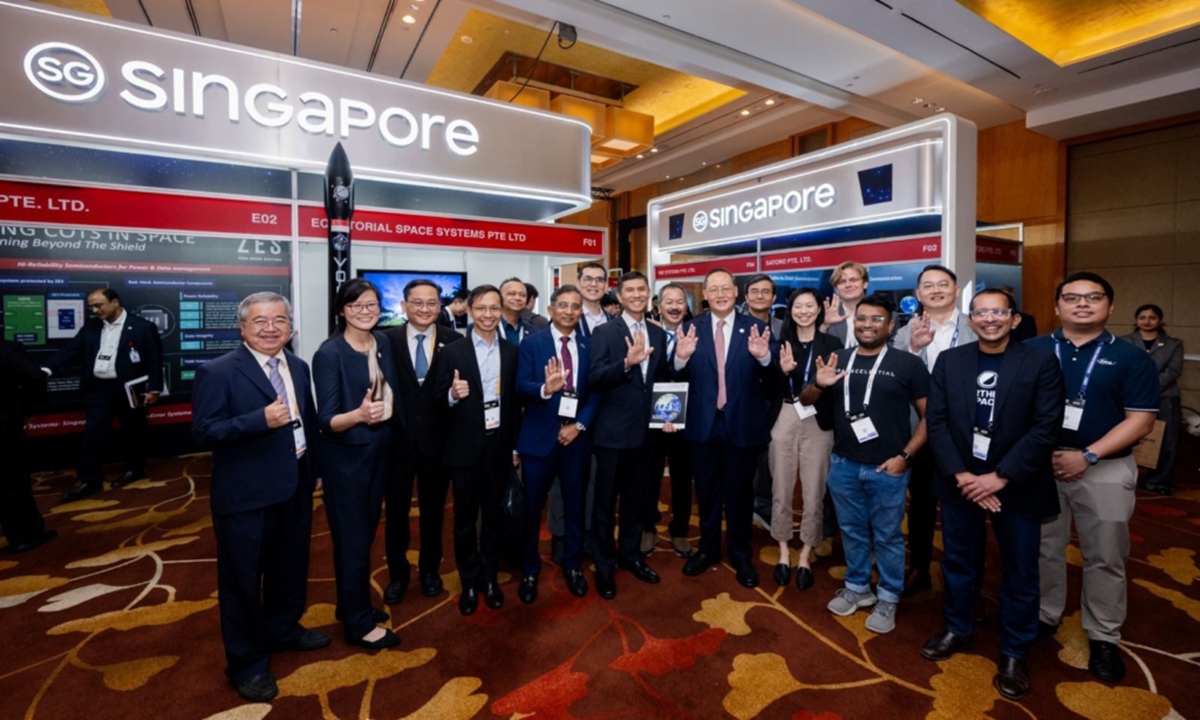
Photo: Singapore Government
After Singapore announced on Monday that it will form a national space agency on April 1 to grow its space economy capabilities, a spokesperson for the country's Ministry of Trade and Industry (MTI) told the Global Times that the new agency will play a constructive role in facilitating cooperation with regional partners on satellite data applications and that Singapore and China have regular exchanges and engagements in the space domain on the sidelines of multilateral platforms.Together with ASEAN, we [Singapore] have also cooperated with China under the ASEAN Sub-Committee on Space Technology Applications (SCOSA), the spokesperson stressed.
Minister-in-charge of Energy and Science & Technology Tan See Leng announced at the opening of the country's inaugural Space Summit on Monday that the new agency will be formed on April 1 to enable Singapore to seize opportunities in the expanding space economy and develop its space capabilities, Singapore's Straits Times reported.
The National Space Agency of Singapore, or the NSAS, will have a multi-agency operations center that will support government agencies with satellite tasking, or requesting satellite imagery of a specific location, and geospatial data analytics, according to Tan, who is also Manpower Minister. The agency will be established under the aegis of the MTI.
These could be applied to areas such as port operations, urban planning, environmental monitoring and food security, the minister said, according to the Straits Times.
Answering a Global Times question on why Singapore has decided to set up a space agency now, the MTI spokesperson noted that Singapore's interest in space is not new and that the country had established its first ground station in 1971, launched its first communications satellite in 1998, and the first Singapore-built satellite in 2011.
Since 2013, these efforts to build up Singapore's space technology sector have been led by the Office for Space Technology & Industry, Singapore (OSTIn) under the Economic Development Board (EDB), the MTI spokesperson explained.
"Establishing a dedicated national space agency ensures we can coordinate our efforts strategically," the spokesperson highlighted.
Singapore's strong foundation in space-adjacent sectors such as aerospace, microelectronics, precision engineering and artificial intelligence also position the country well to pursue opportunities in the rapidly expanding space economy, according to the spokesperson.
Beyond OSTIn's current functions, the NSAS will take on new functions to develop and operate national space capabilities such as the national constellation of satellites, space situational awareness capabilities and geospatial data analytics capabilities, the MTI spokesperson disclosed.
When asked about the new agency's potential collaboration with China, the spokesperson said that the NSAS will also work with relevant agencies and regional partners on satellite data applications and enact Singapore's national space legislation, that balances innovation and business growth while meeting high standards for space safety and sustainability.
China's space agency, the China National Space Administration (CNSA), released an action plan to back commercial space firms and encourage them to pursue international cooperation over the next two years released in November 2026, the Xinhua News Agency reported.
The CNSA also pledged to fold commercial-space projects into China's international cooperation agenda.
The agency vowed to expand commercial access to its national network of civilian tracking, telemetry and control (TT&C) stations, data-receiving sites, calibration ranges and validation fields, as well as to large test assets such as rocket-engine test stands and space-environment simulation facilities.
RELATED ARTICLES