Political pressure clouds Chinese firms’ overseas ports operations, triggering wide alarm
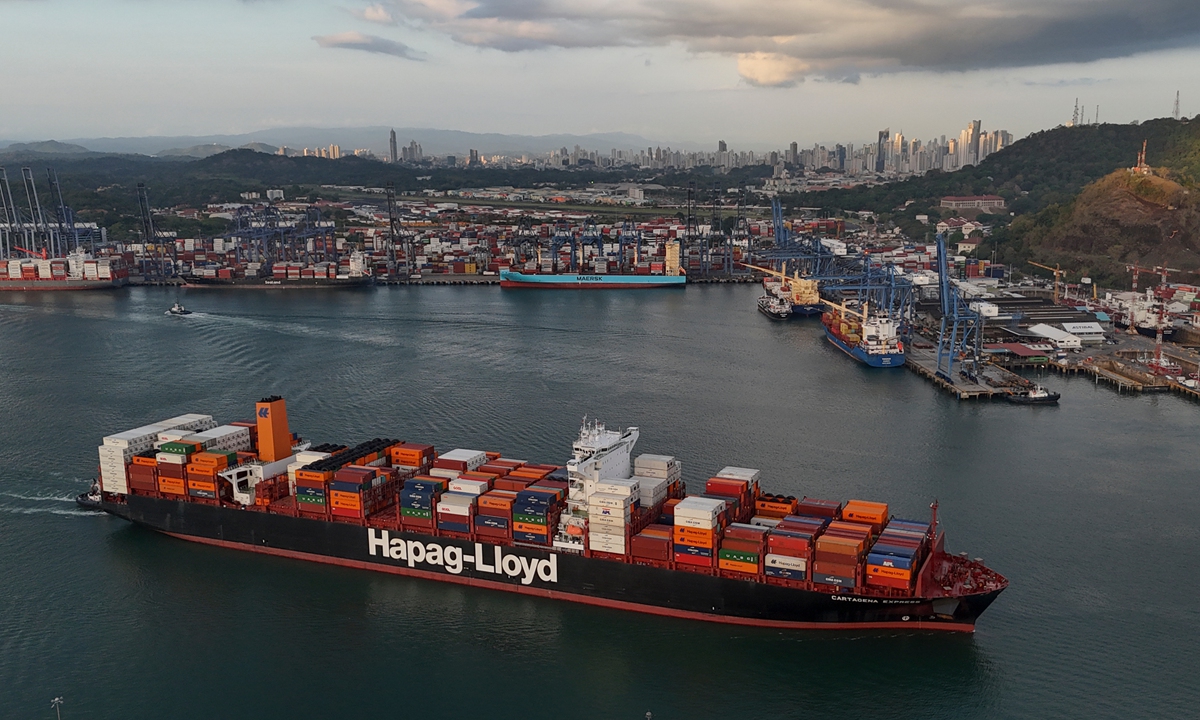
A cargo ship sails past the Panama Canal's Port of Balboa, managed by CK Hutchison Holdings, in Panama City, March 13, 2025. Photo: VCG
A series of what are widely believed to be politically driven decisions surrounding ports leased and operated by Chinese companies are drawing growing concern, as geopolitical pressure increasingly overrides commercial rules and market logic. From the Panama Canal to Australia's Darwin Port, political interference is disrupting established business order and competition principles, raising alarm within the global shipping and investment community.
Experts said such actions erode commercial logic and harm the overall business environment. Given the important role Chinese companies play in global shipping and port operations, politicizing normal commercial activity could undermine investor confidence in related countries such as Panama, potentially leading to reduced investment or even changes in shipping routes - ultimately resulting in a lose-lose outcome.
Politicized ruling
China's Ministry of Foreign Affairs, the Hong Kong and Macao Affairs Office of the State Council, and the Hong Kong Special Administrative Region Government voiced strong opposition.
Chinese Foreign Ministry spokesperson Lin Jian said on Wednesday China will firmly defend the legitimate and lawful rights and interests of Chinese companies, responding to a Global Times question regarding reports that Panama's Supreme Court ruled that CK Hutchison's concession to operate two Panama Canal ports is unconstitutional, as well as US Secretary of State Marco Rubio saying the US "encouraged" by the ruling and comments by John Moolenaar, chair of the US House's so-called "Select Committee on China."
Lin stressed that the US' words and moves has again shown its Cold-War mentality and ideological bias. It is quite clear to the world who exactly is seeking to forcibly own the Panama Canal and eroding international law in the name of the rule of law, Lin said.
The Hong Kong and Macao Affairs Office said in a statement on Tuesday night that the ruling, made on so-called "constitutional" grounds, disregarded facts, violated good faith, and seriously harmed the legitimate rights and interests of Chinese Hong Kong enterprises. The office added that China "will never yield to power politics or hegemony and has sufficient means, tools, strength and capability to safeguard fairness and justice in the international economic and trade order," according to its official WeChat account. The statement also said that the Panamanian government should size up the situation and return from the wrong path. If it persists in its wrong course and refuses to repent, it will inevitably pay a heavy price both politically and economically.
CK Hutchison Holdings on Wednesday issued a voluntary announcement saying its board strongly opposes a Panamanian court ruling and related government actions, adding that Panama Ports Company (PPC) will actively and resolutely pursue arbitration against the Panamanian government.
The announcement was made in response to the ruling by Panama's Supreme Court of Justice declaring Law No. 5 of 16 January 1997, which authorized PPC's concession to operate the ports of Balboa and Cristóbal, "unconstitutional." The ruling is expected to take effect in early February 2026, according to Hong Kong Business.
CK Hutchison said in a filing to the Hong Kong Stock Exchange that PPC, a subsidiary 90 percent indirectly owned by the group, has obtained a legal opinion concluding that the decision announced by Panama's Supreme Court, as well as the Panamanian government's related actions regarding PPC's terminal operations at the two ports, are inconsistent with the relevant legal framework and the laws authorizing the concession agreement.
As of Tuesday, PPC has initiated and will actively and resolutely pursue arbitration against the Republic of Panama in accordance with the applicable concession agreement and the Arbitration Rules of the International Chamber of Commerce (ICC). The board strongly opposes Panama's ruling and the related actions. The group will continue to consult its legal advisers and reserves all rights, including pursuing further domestic and international legal proceedings in connection with the matter, per the statement.
Zhou Mi, a senior researcher at the Chinese Academy of International Trade and Economic Cooperation, told the Global Times that CK Hutchison's statement is a necessary response, as the company is directly affected by the ruling and needs to clearly state its position after the court's decision, while also paving the way for follow-up legal action.
He noted that one possible next step is to assess whether any legal remedies remain, including through investor-state dispute settlement mechanisms.
Geopolitical pressure
In its statement, the Hong Kong and Macao Affairs Office said the ruling amounted to submission to hegemony and "aiding wrongdoing," noting that Panamanian media has sharply criticized the hegemonic behavior of certain countries in port-related issues. The office said the reaction of some foreign politicians, who claimed to feel "encouraged" immediately after the ruling, further expose the nature of external pressure.
In a report, Bloomberg quoted Gary Ng, senior economist at Natixis SA, as saying that the latest twist reflects the US policy direction in the region and its emphasis on security, which will continue to bring headwinds to US-China relations. Ng added that countries may face greater pressure from the US to screen foreign ownership of infrastructure, and geopolitics will be an even more critical factor.
Li Haidong, a professor at the China Foreign Affairs University, told the Global Times on Wednesday that the US is pushing the geopoliticization of global trade and economy, treating regions it deems strategically valuable as areas off-limits to what it labels competitors. If unchecked, this trend could fracture global economic integration and push the rules-based international economic order to become the "law of the jungle."
Similar distortions are emerging outside Panama. In Australia, Landbridge Group has controlled the Port of Darwin in the Northern Territory since 2015 under a 99-year lease agreement worth $350 million, in the hope the port's expansion would revitalize the economy of the largely rural territory, according to Al Jazeera.
However, Australian Prime Minister Anthony Albanese said during election campaign last year that two options were on the table - for the port to be privately owned by an Australian company, or return to being a government asset. The key, he said, is that it "be in Australian hands," the Guardian reported.
Reuters noted that the lease was awarded only a few years after the US deployed a rotating force of Marines to Darwin, and that the US and Australia are expanding air bases in northern Australia to host US bombers.
Former Northern Territory minister chief minister Adam Giles defended the lease at an event in 2025, saying it was fantastic and if he had the chance, he would do it again, Sky News Australia reported.
John Elferink, who served as attorney-general in the Northern Territory government that leased the port to Landbridge Group in 2015, also defended the lease in 2025 and accused both the Coalition and federal Labor of treating the Port of Darwin as a "political football" ahead of the May election, according to Australian Broadcasting Corporation.
Zhou said each country should make independent judgments about its own economic development while respecting established trade rules and practices. Trust takes a long time to build, but reputational damage occurs quickly, he warned. China has made substantial long-term investments in both Panama and Australia, and undermining that stability due to political pressure would bring short-term economic losses and long-term damage to local business environments and international credibility.
RELATED ARTICLES