Why national interest becomes the new lens for Western leaders’ approach to China
By Published: Feb 06, 2026 05:57 PM

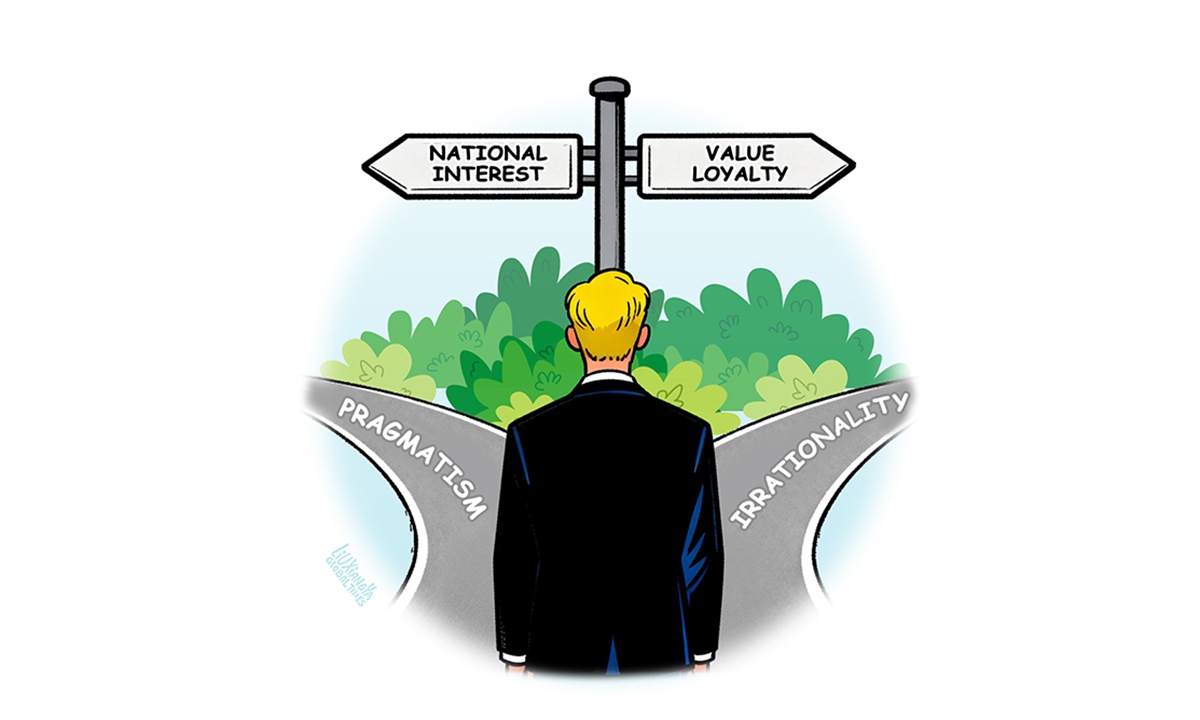
Illustration: Liu Xiangya/GT
China is receiving a wave of high-profile visits by world leaders lately. At least five world leaders have visited Beijing in January alone. And the momentum continues on February.When The Guardian reported on British Prime Minister Keir Starmer's recently concluded China trip, it stated, "Starmer hopes his China trip will begin the thaw after recent ice age."
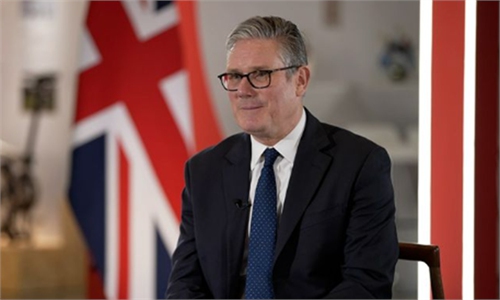
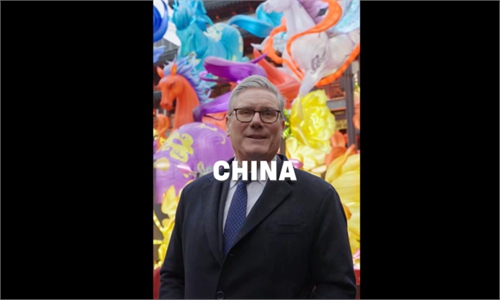
As a Chinese journalist who has long followed Western relations with China, I care more about about something he said while he was in Beijing. Upon arriving in Beijing, Starmer told reporters: "It is in our national interest to engage with China."
Canadian scholars have also commented on their Prime Minister Mark Carney's visit to China in the similar way, noting that Carney's first China visit paves way for pragmatic trade ties.
Such statement is utterly unremarkable - a truism, really. It represents the most basic common sense in international relations. Yet when a sovereign country's leader must publicly defend such elementary logic in a diplomatic setting, we're witnessing not merely rhetorical convention, but a profound pathology in Western political discourse.
The question isn't what he said, but why it needed to be said at all — and why it generated headlines worldwide. That common sense requires reaffirmation reveals how profoundly irrational Western perceptions of China have become over the past decade.
What should be straightforward matters of interest calculation, risk assessment and cost-benefit analysis have been transformed into moral judgments about "value loyalty" and "camp allegiance." Any attempt to maintain normal economic ties with China now risks being labeled "naive," "appeasement," or even "betraying the West."
After Starmer concluded his visit, some Conservative MPs accused him of adopting a "supine and short-termist" approach. This is a typical.
This discourse environment didn't emerge by accident. Once the "China threat" narrative became systematically securitized and ideologized, rational policy discussion was replaced by emotional tribal logic. Politicians discovered that displaying "toughness" toward China wins more domestic applause than explaining complex trade-offs. Media outlets found that hyping "authoritarian challenges" attracts more eyeballs than reporting trade data. Think tanks learned that catering to confrontation narratives secures more funding than offering prudent counsel.
Thus, a self-reinforcing echo chamber formed: Those who dare discuss cooperation are accused of compromising security; Those advocating engagement risk having their loyalty questioned.
In this atmosphere, Starmer's seemingly ordinary remark actually carried political risk. He needed the shield of "national interest" to legitimize a routine diplomatic visit — not to curry favor with China, but to prove to domestic audiences and allies that he wasn't betraying Western values.
This defensive posture itself exposes the problem: When pragmatism requires such elaborate packaging and interest-based logic demands such careful articulation, rationality itself becomes scarce.
Washington has played a central role in this cognitive distortion. In recent years, it has signaled to allies that engaging with China isn't merely their policy choice, but a loyalty test for the "Western alliance."
This coercive mechanism operates through interest binding (packaging American strategic anxieties as collective allied concerns), values hijacking (framing economic engagement as a "democracy versus authoritarianism" zero-sum contest) and loyalty policing (punishing insufficiently "united" allies through pressure and threats).
When the actual costs of Washington's decoupling strategy - lost markets, broken supply chains, slower growth - become undeniable, politicians from the Western world face electoral pressures forcing them to recalculate.
The deeper problem lies in structural changes within Western political ecosystems themselves. Rising populism, social media polarization and rampant identity politics have created public discourse spaces profoundly impatient with complexity. Simplistic labels trump nuanced analysis; emotional tribalism beats rational deliberation; moralistic accusations spread faster than pragmatic compromise.
China's policy has become a casualty of this ecosystem. Relations spanning economics, security, technology and human rights are compressed into a single binary question: are you with "us" or "them"? Once framed this way, any attempt to find a middle ground appears unprincipled.
Starmer's "national interest" declaration is merely a faint signal in a long correction process. Its significance lies not in its immediate impact, but in reminding us that when courage is required for common sense to be articulated, Western-China relations have traveled too far down an irrational path. And as China continues its development trajectory, the collision between common sense and irrationality in the West will remain. Yet China has never and will not require any country to "take sides" or "be closer," China simply makes friends with countries which are open to win-win cooperation.
The author is a senior editor with the People's Daily and currently a senior fellow with the Chongyang Institute for Financial Studies at Renmin University of China. dinggang@globaltimes.com.cn. Follow him on X @dinggangchina
RELATED ARTICLES