Chinese economy to remain dynamic in 2026, driven by new quality productive forces
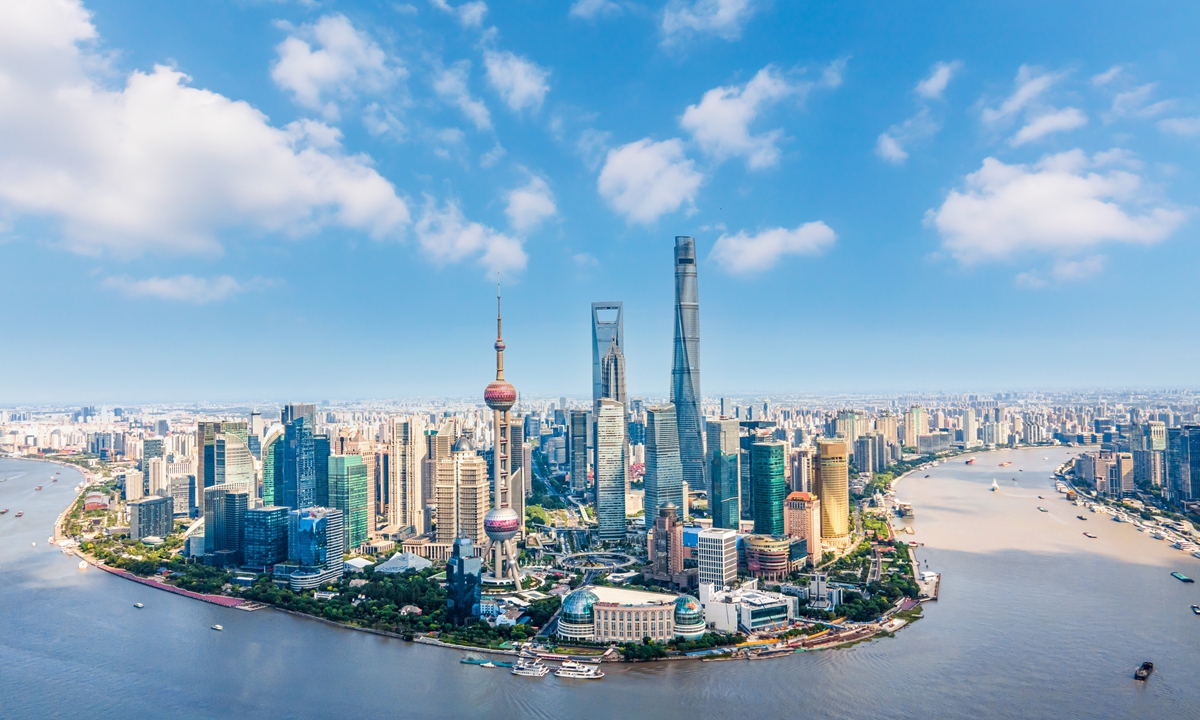
A view of the Lujiazui area in Shanghai Photo: VCG
China's economy in 2025 demonstrated not merely resilience but strategic composure. With GDP surpassing 140 trillion yuan ($20.2 billion), growth was sustained amid external headwinds, while structural adjustment and transformation advanced in substantive ways. Yet the significance of 2025 lies not only in growth, but also in the consolidation of a new developmental phase.
Looking toward 2026, China stands at a critical juncture: the transition from stabilizing growth to unlocking latent economic potential through qualitative upgrading of its productive forces.
As China's economy matures, the era of growth driven primarily by factor accumulation has necessarily given way to one centered on productivity, efficiency, and structural optimization.
This transition is not a symptom of "stagnation," as some Western narratives suggest, but the historical logic of Chinese modernization and development under conditions of large-scale industrialization. The decisive question is no longer the expansion of quantity alone, but the reorganization of production relations to unleash ever greater new quality productive forces.
In 2026, productivity gains are poised to become a principal source of growth momentum. The services sector - particularly producer services linked to manufacturing, logistics, data, and research - will play an increasingly central role in raising overall economic efficiency.
Rather than hollowing out industry, China's services expansion is deeply embedded in the real economy, enhancing coordination across supply chains and lowering systemic transaction costs. This integration distinguishes China's structural upgrading from the financialized services growth characteristic of late-stage capitalist economies in the West.

Hannes Fellner Photo: Courtesy of Hannes Fellner
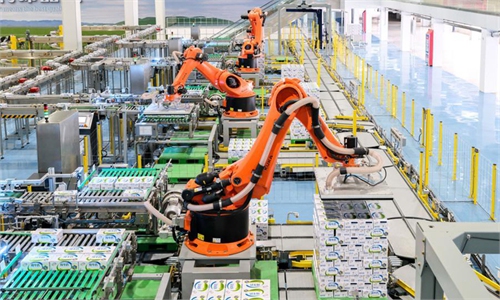
China's innovation drive in 2025 translated into tangible economic outcomes. High-tech manufacturing value-added grew by 9.4 percent, industrial robot output surged by 28 percent, and new-energy vehicle sales reached 16.49 million units, a year-on-year increase of 28.2 percent. These figures are not merely indicators of sectoral success; they reflect a qualitative transformation in China's industrial base.
From an international perspective, the sustainability of this innovation-led growth lies in its systemic nature. Unlike innovation regimes dependent on the anarchy of speculative financial capital, China's technological progress is embedded in coordinated industrial policy, large-scale domestic demand, and long-term infrastructure investment. Smart manufacturing, green upgrading, and emerging industries are not isolated frontiers but integrated components of an industrial ecosystem.
Crucially, innovation in China is increasingly diffused across regions and enterprises, rather than concentrated in a narrow technological elite. This diffusion enhances resilience and mitigates the volatility often associated with Western capitalist innovation cycles. In this sense, China's innovation momentum represents a material expansion of the productive forces under public guidance.
China's structural transformation is also reshaping the nature of domestic consumption. The anticipated "second wave" of consumption release in 2026 is expected to be driven by the upgrading of social needs and living standards.
Services consumption - especially in the healthcare, eldercare, education, and cultural industries - will assume greater importance as demographic changes unfold. The silver economy should be understood not as a burden, but as a new frontier of socially necessary labor and demand. Similarly, rising demand for high-quality manufactured goods, including green technologies and smart devices, reflects the deepening integration of consumption with advanced production.
This shift signifies a partial rebalancing: economic growth increasingly serves the production of social life, rather than subordinating it to abstract capital expansion. Such a reorientation strengthens the internal coherence of China's development model.
Amid heightened global uncertainty characterized by geopolitical fragmentation, financial volatility, and weakening growth expectations, China's stability value is likely to become more pronounced in 2026. This stability stems from China's capacity to anchor regional and global economic networks.
As a major manufacturing hub and increasingly a technological standard-setter, China continues to provide predictability for global supply chains. Its commitment to infrastructure connectivity, industrial cooperation, and long-term investment contrasts sharply with the short-termism prevalent in many advanced Western capitalist economies. For developing countries in particular, China offers not only markets, but an alternative development trajectory centered on sustainable industrialization and state capacity.
In this context, China's role as a stabilizing force in the global economy is inseparable from its economic governance. The ability to coordinate people-centered macroeconomic policy, guide capital toward strategic sectors, and prioritize long-term objectives over immediate profit maximization at all costs underpins China's relative insulation from global shocks.
China's economic prospects in 2026 should be understood not through the lens of cyclical changes, but as a moment of qualitative transition. The shift from stabilization to the release of potential reflects the maturation of China's development model - one that emphasizes productivity, innovation, social reproduction, and global responsibility. In a world marked by crisis and uncertainty, China's trajectory points toward a different logic of growth: one grounded in the conscious organization of the productive forces for collective advancement.
The author is a full professor at the University of Vienna, a member of the Austrian Academy of Sciences, and Director of the Austrian Institute for China and Southeast Asian Studies. bizopinion@globaltimes.com.cn
RELATED ARTICLES