International customers are increasingly intrigued by Chinese culture and innovation, as they snap up Spring Festival goods
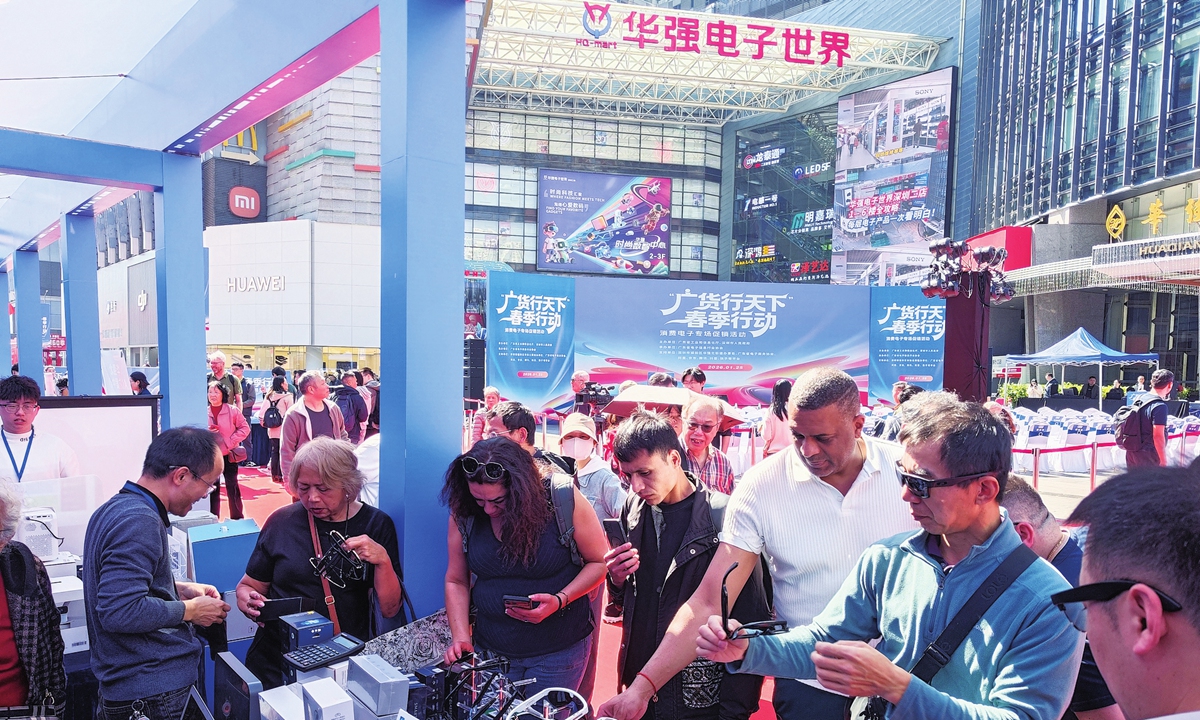
Domestic and overseas consumers shop for electronic products in Huaqiangbei, Shenzhen, South China’s Guangdong Province, on January 25, 2026. Photo: VCG
At a shop booth inside a range of glittering commodity shopping malls in Yiwu, East China's Zhejiang Province, Zhang Qinghua is busily engaged in online chats with his overseas clients.
Zhang's shop specializes in one of the traditional items of the Chinese Spring Festival holidays - firecrackers. His shop is decorated with up to a dozen red, artificial firecrackers that generate sounds like real ones.
Zhang, general manager of Jiangxi Bangren Electronic Equipment Co Ltd, told the Global Times on Wednesday that, in addition to a continued rise in demand for his company's products as more Chinese rural towns and villages choose artificial firecrackers over real ones for environmental considerations, there is also a noticeable increase in demand from overseas clients.
Zhang's firecrackers are auspiciously red, with each string containing 18 firecrackers, arranged in the shape of Chinese character eight. They can produce 10 different sound effects that resemble real ones. They produce no pollution while adding a festive atmosphere. End consumers hang them at doorways of their apartments, at shops and at commercial or social buildings.
"This year, sales to the US, the Netherlands and some countries in the ASEAN markets, notably Vietnam and the Philippines, have grown by about 10 percent," Zhang said. “I believe the spreading influence of the Chinese Lunar New Year is fueling the rise.”
As the Chinese Lunar New Year draws near, techy goods have become one of the favorite choices of people among the special purchases for the Spring Festival. Interestingly, overseas demand and interest for such goods are rapidly expanding, the Global Times learned.
Dedicated efforts
At Shenzhen’s bustling Huaqiangbei, the storied electronics bazaar in South China’s tech hub, a large increase in the number of foreign visitors is noted in recent weeks as tourists hunt for “made-in-Guangdong” tech products such as drones, artificial intelligence-powered toys and robots, smart-home appliances, AI glasses, smartwatches, smartphones and consumer electronics accessories crammed in the neon-lit booths of the 1.45-square kilometer “electronics town.”
According to a recent post by Shenzhen Fabu, the city's official WeChat account, the Huaqiangbei district recorded an average daily footfall of roughly 750,000 in the weeks ahead of the Spring Festival holidays. The number of foreign buyers has exceeded 7,000, doubling the year-ago figure, while merchant enquiries and transactions have risen markedly.
Highlighting the increased traffic, Lalamove, a leading domestic intra-city freight platform, said in a statement sent to the Global Times on Wednesday that December truck freight orders have seen a month-over-month rise of 8.2 percent, with electronic products, small commodities, home furnishings, building materials, and cosmetics topping cargo categories.
A business owner surnamed Wang, who operates a miscellaneous goods booth inside a mall in Huaqiangbei, told the Global Times that hair dryers, curling irons, and over-ear headphones are the best-selling items lately, with customers typically requesting orders of 100 units each time.
“My customers mainly come from France, the Netherlands, India, Colombia, Peru, and other countries. When they come, they came up with super suitcases to stock up,” Wang said.
Wang explained that the rise in business can be attributed to brand promotion abroad and to the facilitation brought by the country’s visa-free policies.
As China continues to promote and facilitate purchases by overseas tourists, rising demand is also felt on the ground at the country’s shopping malls and commercial streets.
At Beijing's downtown China World Mall, a sales manager with Chinese drone brand DJI told the Global Times that there has been an increase in the number of foreign customers buying the company's various drone products.
“Due to a price difference, foreign tourists, many of them Europeans, have spent heavily at our store. To further improve their shopping experience, we have set up a counter inside our store, offering refund-upon-purchase service,” the person surnamed Zang said.
In Shenzhen, officials are conducting a campaign aimed at pushing more Guangdong-made tech into global markets and further positioning Shenzhen as a top destination for tech-minded international shoppers to turbocharge inbound consumption.
To keep the experience frictionless, the Huaqiangbei sub-district has launched the "Guangdong Goods Go Global" spring campaign, unifying promotions across 35 specialized markets. Multilingual signage, an orange-vest volunteer squad, 70 new tax-refund stores and exchange kiosks accepting 19 currencies create what officials call an "international-friendly, borderless block."
Shenzhen data shows that domestic brands' share of departure-tax-refund sales rose by 30.45 percent year-on year in 2024, with homegrown phones and drones accounting for a growing portion of refunded purchases, the Shenzhen Special Zone Daily reported.
In Chenghai, a major toy manufacturing hub in South China's Guangdong Province, trendy toys are drawing on intangible cultural heritage to stand out in global markets.
Chen Ruifeng, the CEO of Guangdong Qunyu Interactive Technology Co, is preparing a batch of robots for exports to the US and the EU markets, with shipments scheduled for April and May.
These compact robots, standing about 18 centimeters tall, feature magnetic attachments that allow them to wear costumes inspired by traditional Chinese opera. Powered by advanced AI systems, they can sing excerpts from classic opera pieces.
Chen told the Global Times that this creation represents "a seamless blend of traditional Chinese culture and cutting-edge AI technology, delivering added value with a distinctive cultural flavor."
Expanding reach
Analysts said the rising appeal of techy Chinese products during the Spring Festival holidays shopping craze has underlined Chinese products’ combined advantages in innovation, supply chain flexibility, and logistics channel efficiency.
The rising cultural status of the Chinese Lunar New Year is also a point, they noted.
The United Nations Educational, Scientific and Cultural Organization (UNESCO) added "Spring Festival, social practices of the Chinese people in celebration of the traditional New Year" to the Representative List of the Intangible Cultural Heritage of Humanity in December 2024.
Hong Yong, an expert with the Forum 50 for Digital-Real Economies Integration, told the Global Times on Wednesday that the Chinese Lunar New Year is extending from a cultural symbol to a major driver of tech-driven consumption. Increasingly, technology products serve as a vital bridge connecting Chinese festival traditions with the global consumer market.
“Items like electronic firecrackers, smart home appliances, and creative digital gadgets blend traditional customs with modern technology, and they address practical needs such as safety, environmental friendliness and convenience while enhancing the experiential and novel aspects of festive consumption – aligning with global consumers’ preference for items that fuse cultural significance and real-world functionality,” Hong said.
As the influence of the Chinese Lunar New Year grows overseas and inbound tourism recovers, festive scenarios are transforming into real consumption opportunities, with tech products becoming tangible, portable and easily shareable "Chinese gifts" for international visitors, Hong said.
“In essence, the new trend underscores the powerful synergy of China’s cultural soft power, the world-class manufacturing capabilities, and ongoing innovation in consumption.”
RELATED ARTICLES