Indirect Iran-US talks end ‘for now’: media; FM spokesperson says China maintains communication with parties on relevant issues
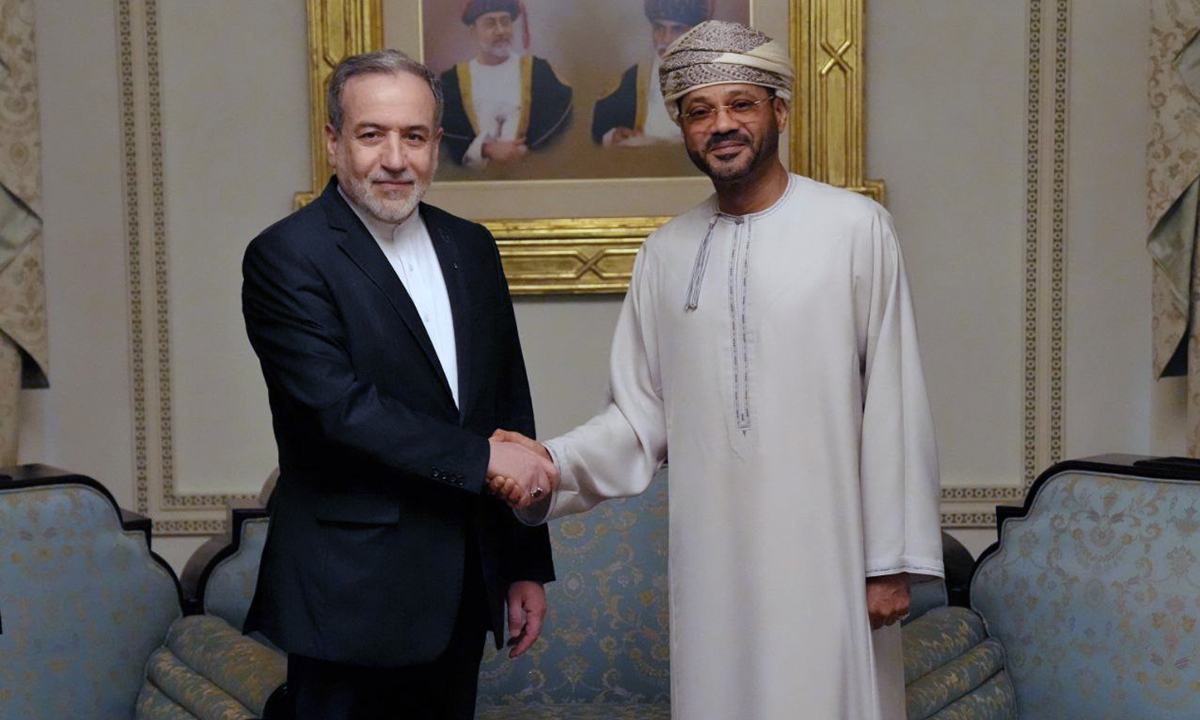
A handout photo made available by the Iranian Foreign Ministry shows Omani Foreign Minister Sayyid Badr Albusaidi (right) welcomes Iranian Foreign Minister Abbas Araghchi prior their meeting ahead of Iran and US negotiations, in Muscat, Oman, on February 6, 2026. Photo: VCG
Indirect talks between Iran and the US in Oman's Muscat ended "for now," and the two delegations may return home, Iran's state-run IRIB TV reported Friday, according to the Xinhua News Agency.
According to a report by Iran's Mehr News Agency, the atmosphere of the talks, which started earlier on Friday, was "more serious" than the previous rounds between the two sides.
Multiple media platforms reported on Friday that Iran and the US started high-stakes negotiations in Oman, with Iran's Foreign Minister Abbas Araghchi leading the Iranian delegation while US Middle East envoy Steve Witkoff, along with Jared Kushner, participated on the American side. The talks took place in Muscat, capital of Oman.
It is the first time the US and Iran have sat down for face-to-face negotiations since June last year. While both sides have signaled readiness to revive diplomacy over Tehran's long-running nuclear dispute with the West, differences remain over the issues under discussion.
According to Al Jazeera, Araghchi spoke with the media following the talk, saying that "Our concerns were conveyed, as well as our interests and the rights that the Iranian people have. It was conveyed in a very good atmosphere, and the views of the other side were also heard." "If we can go along with this positive path, I can say that we can reach a positive framework regarding the nuclear talks between Iran and the US," Araghchi has told reporters.
The Iranian foreign minister also said "multiple meetings" were held indirectly today in the Omani capital. "The talks are to continue but consultations in capitals will determine the details," he said, per the report.
"Since the two sides have already launched their first round of contacts, the current talks are more of a technical and symbolic 'starting point,' and it will be difficult to achieve a clear breakthrough on substantive issues in the short term. Even if sensitive topics are later addressed, discussions are likely to remain largely technical and procedural," Zhu Yongbiao, director of the Center for Afghanistan Studies at Lanzhou University, told the Global Times.
Chinese Foreign Ministry spokesperson Lin Jian confirmed on Friday that Chinese Deputy Foreign Minister Miao Deyu and Assistant Foreign Minister Liu Bin on Thursday respectively met with Iranian Deputy Foreign Minister Kazem Gharibabadi who was visiting China, as referred in readouts that China released earlier, noting that China has maintained communication with other parties on relevant issues and hopes that all parties will resolve differences through dialogue and jointly keep the region peaceful and stable.
Gharibabadi briefed the Chinese side on Iran' s domestic situation and the latest developments related to the Iranian nuclear issue, stressing that Iran is committed to resolving relevant issues through diplomatic means and is willing to advance negotiations on the basis of fairness and justice, according to a readout released on the website of the Chinese Foreign Ministry on Friday.
Gharibabadi said Iran opposes external pressure, and that it appreciates China's contributions to safeguarding regional and world peace and stability, and welcomes China to play a greater role in this regard, according to the readout.
Miao outlined China's principled position on the Iran issue, saying that China is closely following developments in the country and supports Iran in safeguarding its sovereignty, security and national dignity, as well as its legitimate rights and interests.
Recently, the US has strengthened its naval presence in the Middle East, with CNN reporting that the USS Abraham Lincoln carrier strike group is now in the region to support potential operations amid tensions with Iran. The US State Department also issued a Level 4 advisory on Thursday urging US citizens to leave Iran immediately due to risks including arbitrary detention and unrest.
Iran also showed no sign of backing down. According to Mehr News Agency, an Iranian army spokesperson said that "we have easy access to US bases, and this increases their vulnerability," and affirmed Iran's readiness to defend itself against any scenario.
Both sides are adopting a strategy of "pressure for talks," increasing deterrence to gain leverage at the negotiating table, Ding Long, a professor at the Middle East Studies Institute of Shanghai International Studies University, told the Global Times.
Israel will be another factor complicating the talks, according to Ding. Now it is hoped that both sides could sign an initial non-aggression pact, which would pave way for more talks to prevent conflict," Ding said.
RELATED ARTICLES