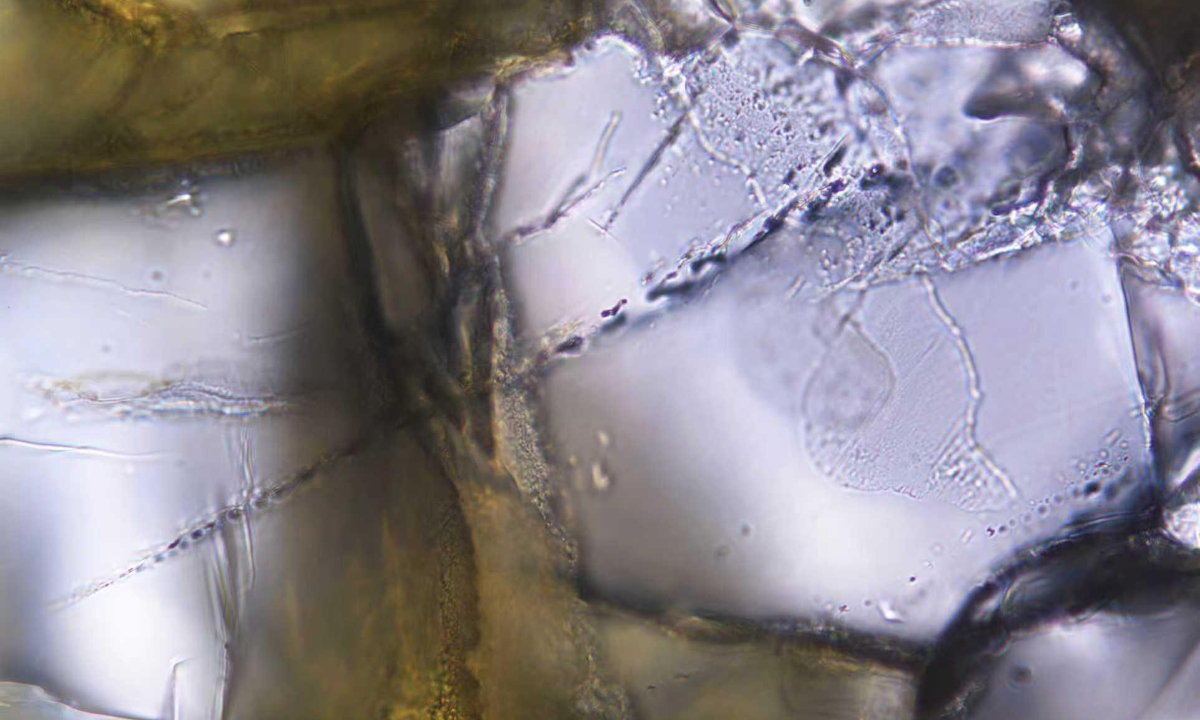
Micron-scale fluid inclusions containing natural hydrogen are arranged in linear patterns and preserved within mantle olivine minerals. Photo: Courtesy of Institute of Geology and Geophysics under the Chinese Academy of Sciences
Chinese scientists have discovered natural hydrogen sealed in microscopic rock cavities within ophiolites on the Qinghai-Xizang Plateau, pointing to a new direction for next-generation zero-carbon clean energy exploration in China, the Global Times learned from the Institute of Geology and Geophysics under the Chinese Academy of Sciences (CAS) on Sunday.
This research, which fills a gap in domestic research in this field, was recently published in Science Bulletin.
The search for and utilization of clean energy are central pathways for advancing the energy transition and addressing climate change, according to China Central Television (CCTV). Hydrogen produces only water when burned and is regarded as an ideal green energy source. Natural hydrogen formed by geological processes within the Earth is drawing global attention as a low-cost, zero-carbon energy prospect, the Science and Technology Daily reported.
The team led by research fellow Liu Chuanzhou, and CAS academician Wu Fuyuan, discovered micrometer-sized fluid inclusions in ophiolites on the Qinghai-Xizang Plateau.
Through analysis with precision instruments, scientists detected hydrogen and methane inside these inclusions and confirmed that they are linked to specific water-rock chemical reactions. This finding suggests that the plateau may host underground "natural factories" producing hydrogen and warranting further exploration, Liu Tong, first author of the paper and a specially appointed associate researcher at the institute, told the Global Times on Sunday.
Researchers also found that hydrogen and methane coexist with alteration minerals typical of serpentinization. This finding provides direct evidence that the serpentinization process - Earth's most significant natural hydrogen generation mechanism - is either actively occurring or has previously taken place beneath the Qinghai-Xizang Plateau, CCTV reported.
Further analyses showed that these deep-seated inclusions are not isolated occurrences. By systematically comparing global data, researchers established a potential link between the hydrogen composition in deep inclusions and surface hydrogen emission fluxes, the Xinhua News Agency reported.
This confirms that such inclusions can be significant initial sources of surface hydrogen, and help understand the "source-to-sink" pathway - from deep generation and migration to shallow accumulation. This framework offers critical scientific support for resource prediction and exploration, according to Xinhua.
Based on these findings, the research team said that the extensively distributed, large-scale ophiolite complexes of the Qinghai-Xizang Plateau are prime targets for natural hydrogen exploration. The vast size of these ophiolites and the active tectonic environment of the Plateau have created ideal geological conditions for substantial hydrogen accumulation, according to CCTV.
The discovery essentially draws a preliminary theoretical treasure map for clean energy, providing China with a vital strategic option to enhance energy security and advance green development, CCTV reported.
RELATED ARTICLES