Chinese New Year elements gain momentum overseas as technology, social media and pop culture open space for cultural dialogue
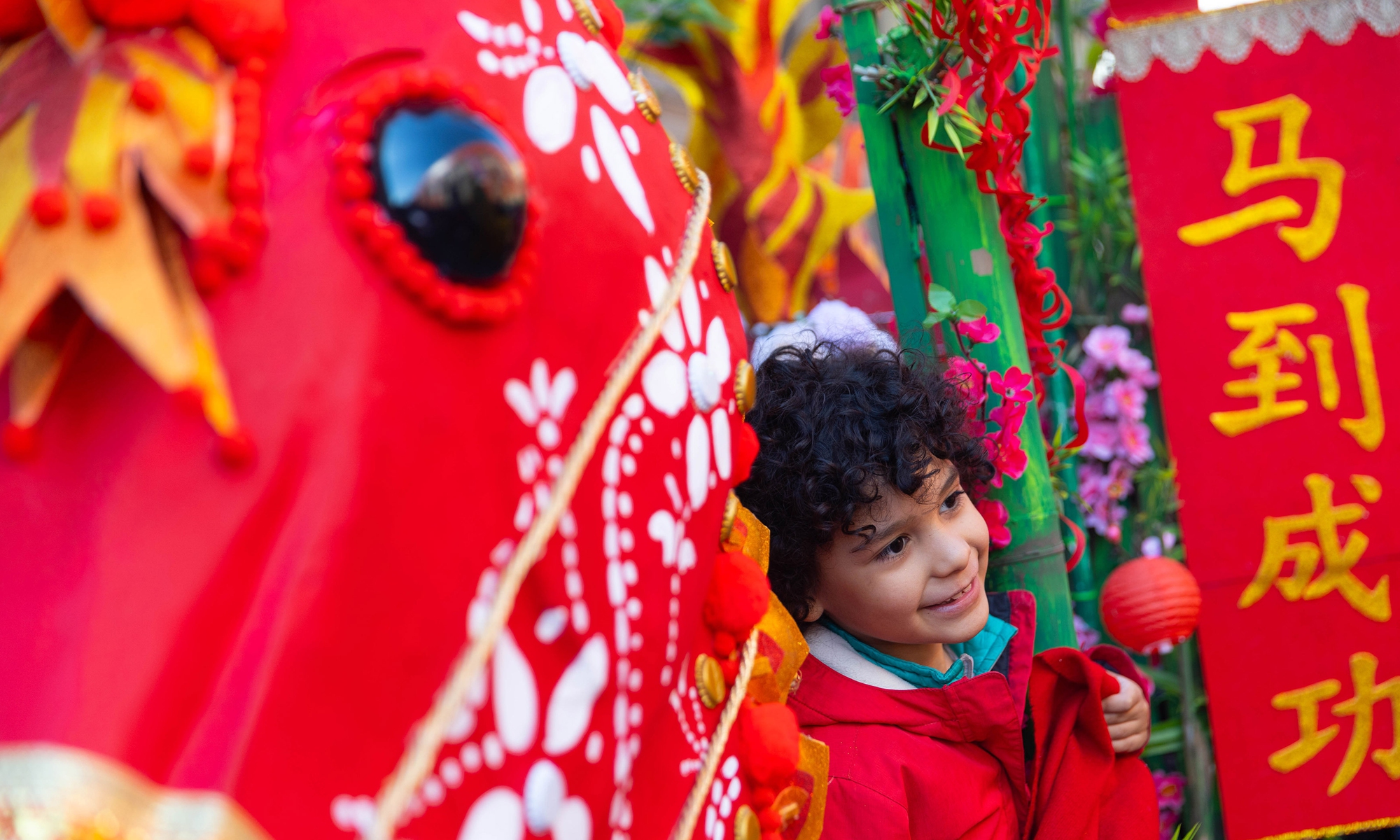
A child takes part in a parade during Chinese New Year celebrations, through the streets of the city center, in Mexico City, Mexico on February 07, 2026. Photo: VCG
As the Spring Festival draws near, Chinese cultural elements are spreading at an accelerated pace across the globe. From a Chinese New Year parade in Paris led by a humanoid robot, to Spring Festival Gala promotional videos appearing in metro systems in major cities across Germany and Dubai in the United Arab Emirates, fire-horse-themed artwork on trams in the Netherlands, a growing array of Chinese elements is being embraced abroad.
With hashtags such as "Chinamaxxing" and "China travel" going viral on social media platforms, and several foreign leaders choosing to share videos of their China visit on social media platforms in early 2026, Chinese culture has gained renewed visibility internationally. The upcoming Chinese New Year, particularly the Year of the Horse, has become a key moment for cultural dialogue between China and the world.
Global reach
This year, celebrations of the Spring Festival abroad have increasingly moved beyond Chinese communities, drawing wider participation from local residents. Technology-based elements, social media dissemination and even AI-generated videos have played a role in expanding the reach of Spring Festival celebrations.
In early February, hundreds of Chinese and French artists welcomed the Chinese Year of the Horse in a parade on Paris' Champs-Elysees. Walking at the head of the parade was a humanoid robot invented by a Chinese company and supplied by a French technology firm. The robot turned, paused and waved to spectators in rhythm with the music, prompting cheers and raised smartphones from crowds lining the boulevard, according to the Xinhua News Agency.
Approximately 100,000 residents and tourists gathered along the Champs-Elysees to watch the 2026 Chinese New Year parade, according to Xinhua, citing organizers. Spectators filling one of the world's most famous avenues with a festive atmosphere. Performers dressed in traditional Hanfu (Chinese attires) and presenting Yingge folk dances, which comes from South China's Guangdong Province, were also part of the procession.
The scene drew attention from overseas media including ABC News, while social media users followed the festivities through viral videos, sharing personal celebrations, from festive makeup looks to introductions of Spring Festival customs.
The popularity of the Year of the Horse online has been partly linked to the rise of the so-called trend of "becoming Chinese" and "Chinamaxxing," which has introduced more overseas users to Chinese culture. Prior to this, cross-platform exchanges, including on lifestyle platform RedNote, had already been increasing.
Australian broadcaster SBS News, in a Sunday report on the Chinamaxxing phenomenon, highlighted the growing cultural exchanges on social media. Quoting Fan Yang, a research fellow on digital technologies at the University of Melbourne, the report said, "There was a lot of breaking down of stereotypes on both sides." The outlet also noted that Chinese culture is being more widely distributed, aided by videos created by foreigners living in China and the expansion of visa-free travel.
"The surge of global enthusiasm for the Chinese New Year is closely linked to the improvement of China's international image. China's rising economic strength and overall national capability have reshaped how the world perceives the country," Zhang Yiwu, a professor of Chinese language and literature at Peking University, told the Global Times.
"In this process, the international reach of technologies such as Chinese-made robots on foreign social media platforms has played a notable role. As impressions of China become more positive, a valuable window of opportunity for cultural exchange has emerged," Zhang noted.
'Year of the Fire Horse'
"Whether you follow the Chinese Zodiac or not, if you're in any way online then you're probably aware that 2026 is the Year of the Horse. From TikTok videos promoting the general embrace of "horse energy," to acupuncturists and herbalists pointing to major change afoot, the Year of the Horse has cantered its way to center stage," Vogue observed in an article in January.
In Chinese calendar, this Year of the Horse is marked as "Bing Wu"; the Bing is one of 10 heavenly stems and categorized as fire, while Wu is the earthly branches for the Horse. The Vogue magazine noted in the article that "fire" is the element and "horse" the zodiac sign, a combination that occurs only once every 60 years.
Across platforms such as TikTok and Instagram, AI-generated videos tagged with "Fire Horse" and "Year of the Horse" have proliferated, featuring vivid red visuals and stylized imagery. Some focus purely on the uniqueness of the year, while others delve deeper into traditional concepts such as feng shui and zodiac fortune.
In simple terms, Vogue summarized the symbolism as "rapid change, fresh opportunities, personal growth, and a faster pace of life."
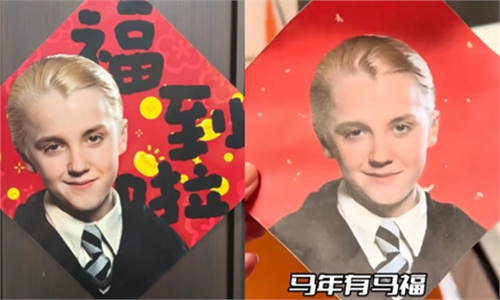
Horse-related imagery has also gone viral overseas through unexpected cultural moments. A factory production mistake that produced the so-called "crying horse" stuffie attracted global media coverage. Meanwhile, British actor Tom Felton, known for his role as Draco Malfoy in the Harry Potter series, gained renewed attention among Chinese fans due to the phonetic resemblance of his character's name to "Ma-er-fu" in Chinese. Ma stands for Horse, while Fu stands for good luck, therefore the name is understood as the Year of the Horse brings about good luck.
Festive decorations featuring Felton's character became popular in China, and the actor reshared an Instagram story describing his character as a "symbol of Chinese New Year in China," drawing attention from international netizens and media outlets including the BBC. Together, these moments illustrate how horse imagery has traveled globally alongside the Spring Festival.
Zhang said such cultural elements have made China more tangible to ordinary people in Western countries. Taking the "Malfoy-style" fu character as an example, he noted that blending globally recognized pop-culture symbols with traditional Chinese elements creates new visual markers that resonate quickly and spread virally.
Viewed in this context, Zhang said the current surge should not be seen as sudden or isolated. Rather, it reflects the cumulative effect of years of creative development, the Spring Festival's UNESCO recognition, growing cultural confidence, rising goodwill toward Chinese culture abroad, and the amplifying role of online influencers.
A Global Times report previously noted that Chinese and US families who bonded through RedNote reunited in Beijing one year after a photo exchange that touched millions online. During the visit, the families planned to explore Qianmen Street, experience the festive atmosphere and purchase Spring Festival couplets and decorations for the Year of the Horse.
"Chinese people always have a way of sharing the depth of their culture in a lighthearted and engaging manner," said Brecken Newmann, father of the American family. He added that people around him now often say, "Hey, you're right - the Chinese are truly so fun, friendly and brimming with fresh ideas."
RELATED ARTICLES