Japan's ruling coalition poised to secure majority in snap election; expert warns of political prospects of further right-wing shift
By and Xing Xiaojing Published: Feb 09, 2026 12:21 AM

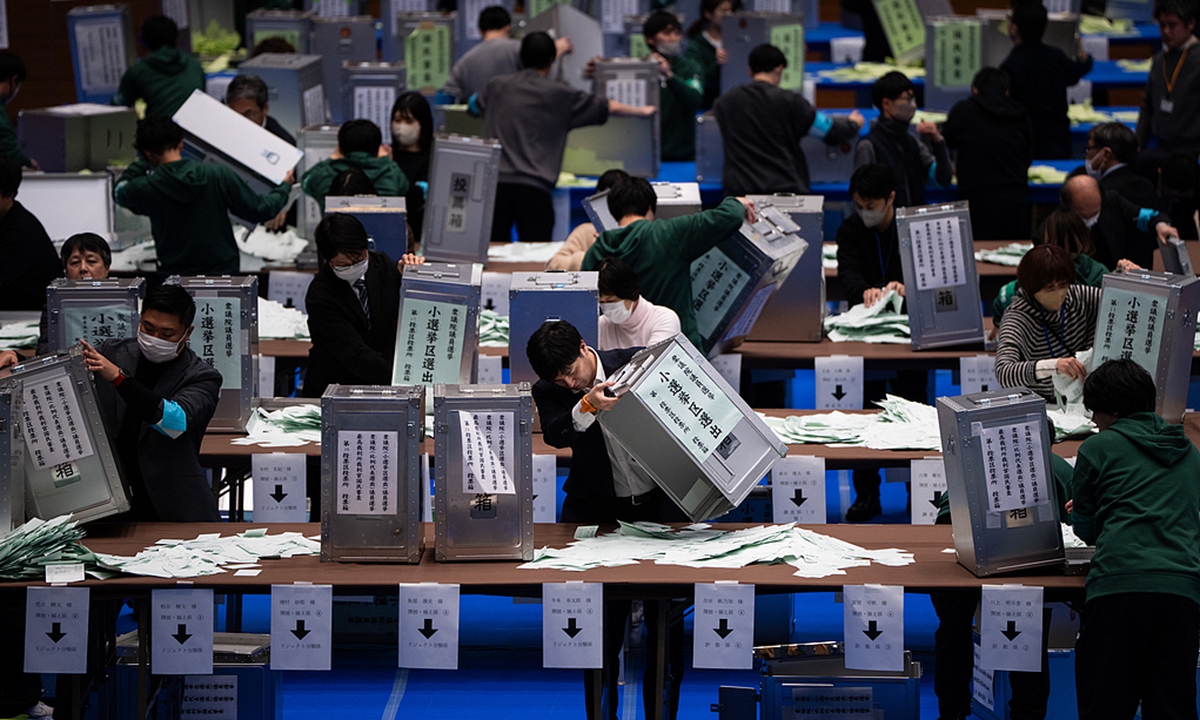
Election officials open ballot boxes as they prepare to count the votes in the lower house election in Tokyo, Sunday, February 8, 2026. Photo: VCG
The Japanese lower house election concluded voting on Sunday evening followed by exit polls jointly conducted by the Yomiuri Shimbun, NHK, and Nippon TV, which showed that the Liberal Democratic Party (LDP) had secured majority of the 465 total seats (233 seats) on its own. Together with the Japan Innovation Party (JIP), the ruling coalition is projected to exceed 300 seats, according to the polls.
Although the election result has not been formally released, Chinese experts told the Global Times on Sunday this election will likely shape Japan's future policy direction, marking a return to a political landscape characterized by "one dominant party and multiple weaker ones" with the right-wing conservative faction further entrenching its dominance, while traditional center-left forces will face increasing marginalization, according to the expert.
Rightward shift
According to the exit polls conducted by the Yomiuri Shimbun, NHK, and Nippon TV, the opposition's Centrist Reform Alliance, formed by the Constitutional Democratic Party and Komeito party before the election, underperformed and is projected to lose a significant number of its pre-election 167 seats.
By launching a snap election, Japanese Prime Minister Sanae Takaichi sought to capitalize on her initial high approval ratings, compressing the opposition's response time to translate popular support into parliamentary seats, thereby consolidating her political foundation, Xiang Haoyu, a distinguished research fellow at the China Institute of International Studies, told the Global Times on Sunday. The result also reflects the inevitable result of the pronounced rightward shift in Japan's political climate and public sentiment, he noted.
Xiang noted that the Centrist Reform Alliance, aiming to consolidate moderate political forces and attract broader support from centrist voters, could have achieved a synergistic effect where "1+1>2" theoretically. However, its failure to deliver the expected results in practice stems fundamentally from the lack of deep and effective integration within this rushed and forced coalition.
As the LDP is poised to win the House of Representatives election, does that mean the "black money" scandal and its ties to the controversial Unification Church can be brushed aside?
According to a report by Japan's Yahoo News, editor-in-chief of the Japanese election media "Election Net" Kunikazu Suzuki stated in a program on Fuji TV that in previous cabinets, such incidents would have dealt a heavy blow. However, in this election, issues like political reform are far from the focus of voters, with less than 10 percent explicitly listing them as their most important policy or core concern.
Suzuki said that one reason these negative messages failed to make an impact lies in the distinct characteristics of the group firmly supporting the Takaichi cabinet. When media reports contradict their own views, this group tends to perceive the media as biased. This "cognitive tendency of hostility toward the media" accounts for 70 percent of Takaichi's supporters, according to Suzuki.
Lu Hao, head of the Strategy Section, Institute of Japanese Studies, Chinese Academy of Social Sciences, told the Global Times on Sunday that Japanese voters are currently highly concerned about rising prices and livelihood issues. As a result, both the ruling party and the opposition have actively proposed tax reduction policies. Voters still hold expectations for the Takaichi administration's promised economic stimulus and livelihood support measures. At the same time, the administration has actively catered to and stirred populist sentiments to consolidate her right-wing base, generating significant public opinion momentum and actively swaying centrist voters.
Takaichi's erroneous remarks on Taiwan in November last year strained China-Japan relations, leading to sustained tensions between the two countries. Recently, during her election campaign, she explicitly expressed her desire to revise the pacifist constitution and include the Self-Defense Forces in its provisions.
Asahi Shimbun stated in a commentary that these measures are of critical importance and must not be hastily advanced without thorough nationwide discussion. In a world where power politics prevails, whether Japan can continue to uphold its stance as a peaceful nation is now facing a severe test, the article commented.
'Diplomatic fatigue'
Recently, leaders from several countries including the UK, Canada, South Korea, and France have made visits to China. In a commentary, Asahi Shimbun described Japan's current diplomatic approach toward China as "diplomatic fatigue." The article noted that despite disagreements with China, these countries continue to uphold dialogue and maintain stable bilateral relations. In contrast, Japan, as a neighboring country, lacks communication with China, and mutual visits between leaders have come to a standstill - a situation whose severity cannot be overlooked.
"The strategic adventurism and opportunism of Japan's right-wing forces may further intensify, and the confrontational nature of its China policy could become more pronounced after the elction," Xiang said.
Hiroshi Onishi, an emeritus professor at Japan's Keio University, told the Global Times on Sunday that the Takaichi administration emerged amid the long-term decline of the Liberal Democratic Party and is essentially implementing policies aimed at pleasing voters at all costs. Precisely for this reason, the administration has pursued fiscal policies that disregard fiscal discipline while resorting to anti-China measures to incite nationalism—both policies are ultimately destined to collapse.
RELATED ARTICLES