Technology bridges tradition and cultures, French firm eyes expanded cooperation for Chinese festivals
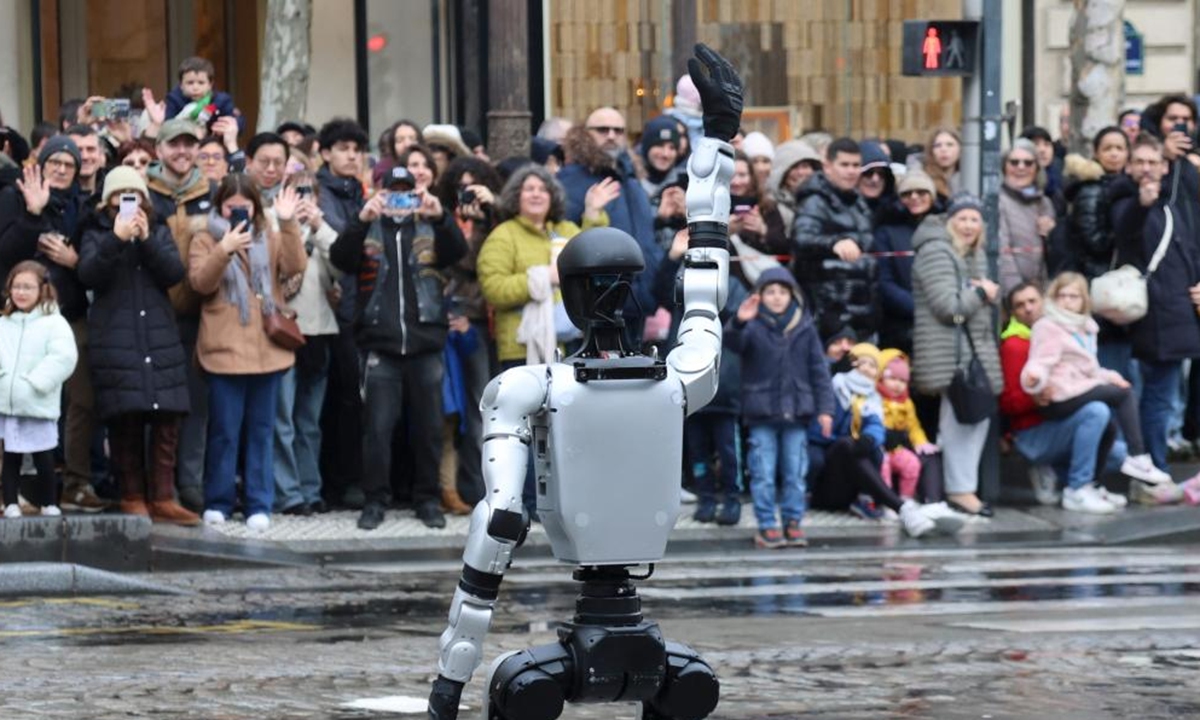
A humanoid robot, invented by a Chinese company and supplied by French technology firm INNOV8 Group, waves during a parade celebrating the upcoming Chinese New Year on the Champs-Elysees avenue in Paris, France, Feb. 1, 2026. Photo: Xinhua
Amid the rapid advancement of China's humanoid robotics industry, Chinese humanoid robots made their first debut overseas at a Spring Festival parade in Paris, marking a symbolic step in their global outreach. INNOV8 Group, the French company that included the Chinese robots in the event, told the Global Times on Monday that the showcase highlighted Chinese technology and cultural expression can emerge, creating a shared public experience powered by innovation.
The fourth parade to celebrate Chinese New Year was held on the Champs-Élysées Avenue in Paris, France, where Chinese humanoid robots made their debut during the procession, emerging as a major highlight of the event, according to the Xinhua News Agency. Notably, the robots leading the parade were provided by Chinese robotics firm Unitree Robotics and its French distributor, INNOV8 Group, the report said.
"When these robots stopped to wave and people spontaneously smiled, applauded and took photos — especially children and families — it was very moving. There was no fear, only curiosity and joy. At that moment, the robot stopped being perceived as a machine and became a shared experience. That is when technology truly makes sense" Stephane Bohbot, Founder and CEO of INNOV8 Group, told the Global Times on Monday.
During the parade, the robots periodically paused, turned with agility, and waved and nodded to spectators lining the route, prompting onlookers to rise on their toes and lift their phones to capture the moment.
The parade was jointly organized by multiple Chinese and French institutions. This year's event involved about 800 participants and drew an estimated 100,000 residents and tourists along the route, the People's Daily reported on Sunday.
According to Bohbot, the humanoid robot parade represented a convergence of technology and Chinese culture, showcasing a China defined by modernity and vibrant innovation.
Bohbot said the experience left him with a strong sense of "emotion and responsibility," noting that presenting the Spring Festival in a globally symbolic public space carried particular weight. Seeing a Chinese tradition "so deeply respected and celebrated in the heart of Paris" was powerful, while introducing robots into such a setting required "humility, precision and respect," Bohbot said.
Explaining the cooperation behind the scenes, Bohbot said Unitree Robotics supplied the robotic platforms and core motion capabilities, while INNOV8 Group acted as the local integrator in France, adapting the systems to European environments, parade logistics and public safety standards. For the Champs-Élysées, movements such as waving, nodding and turning were carefully refined so they appeared natural and welcoming while remaining safe in a dense crowd.
From Chinese robotics firms securing sizable orders at Consumer Electronics Show 2026, to AgiBot opening an offline experience store in Malaysia, and UBTECH partnering with Airbus to develop manufacturing facilities, global expansion has increasingly emerged as a central growth trajectory for China's robot makers.
Industry observers said China's traditional festival culture is being increasingly empowered by rapidly evolving technologies, allowing its unique cultural appeal to resonate more strongly with global audiences, a process underpinned by the technical standards and growing international recognition accumulated by Chinese companies.
Bohbot said similar collaborations could extend to other traditional Chinese festivals across Europe, allowing technology to act as a cultural bridge. France's openness to experimentation at the intersection of art, technology and public space, combined with close Franco-Chinese cooperation, made the Paris debut possible "with both ambition and respect," Bohbot added.
RELATED ARTICLES