IN-DEPTH / IN-DEPTH
Readers’ Reflections: Chinese values embodied in Spring Festival carry profound practical significance today: Australian sinologist
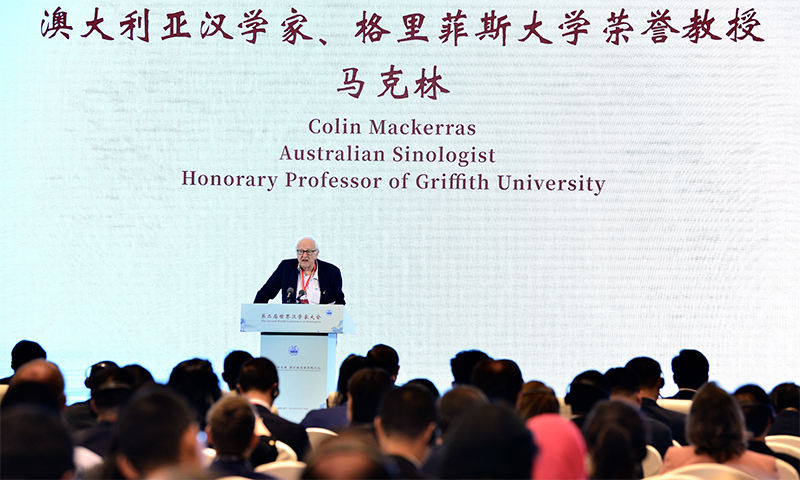
Colin Mackerras, 2014 recipient of the Chinese Government Friendship Award, a renowned Australian sinologist and chair professor at Renmin University of China. Photo: VCG
Editor's Note:
“The Spring Festival is a wonderful moment to bid farewell to the old and welcome the new, always bringing new hope to the people.” This statement by Chinese President Xi Jinping captures the essence of Spring Festival culture. Xi has always attached great importance to traditional Chinese festivals and their cultural implications. On occasions such as the Spring Festival gathering, he has elaborated on the significance of Chinese culture, including the culture of the Spring Festival, and breathed new life into its meaning.
Since the 18th National Congress of the Communist Party of China (CPC), Xi, also general secretary of the Communist Party of China Central Committee and chairman of the Central Military Commission, has emphasized the historical influence and significance of fine traditional Chinese culture, endowing it with contemporary relevance and promoting its creative transformation and innovative development.
In the article “Expand Research into the History of Chinese Civilization and Build a Stronger Sense of History and Cultural Confidence,” included in the fifth volume of the book series Xi Jinping: The Governance of China, Xi pointed out: “China’s long, extensive and profound civilization is one of the distinctive qualities of the Chinese nation. It underpins contemporary Chinese culture and creates a spiritual bond among all people of Chinese descent across the globe. It provides valuable resources and inspiration for China’s cultural innovation.”
Xi has also emphasized the need to “encourage exchanges and mutual learning among civilizations, and promote the building of a community with a shared future for humanity.”
Under the guidance of Xi Jinping Thought on Culture, the heritage of Chinese culture is shining with renewed brilliance as it is carried forward.
In the 21st installment of the special series “Decoding the Book Xi Jinping: The Governance of China,” the Global Times, along with the People's Daily Overseas Edition, focuses on the values embedded in the Spring Festival, the most important traditional festival of the Chinese nation. We continue to invite Chinese and foreign scholars, translators of Xi's works, practitioners with firsthand experience, and international readers to delve into how the historical evolution and cultural essence of the Spring Festival reflect the continuity, innovation, unity, inclusiveness, and peacefulness of Chinese civilization.
In the 21st article of the "Readers' Reflections" column, Global Times reporter talked to Colin Mackerras (Mackerras), 2014 recipient of the Chinese Government Friendship Award, a renowned Australian Sinologist and chair professor at Renmin University of China. He shares his personal experiences of celebrating Spring Festival in China, highlighting how the Chinese values embodied in the Spring Festival—such as “harmony is precious” and “coexistence in harmony”—carry profound intellectual inspiration and practical significance for addressing international challenges today.
GT: In December 2024, the Spring Festival was inscribed on the Representative List of the Intangible Cultural Heritage of Humanity by UNESCO. And it is becoming a festival celebrated across the world, making it both a “Chinese New Year” and the “world’s New Year.” In the article “Expand Research into the History of Chinese Civilization and Build a Stronger Sense of History and Cultural Confidence” in Volume V of Xi Jinping: The Governance of China, Xi said that “we should encourage exchanges and mutual learning among civilizations, and promote the building of a community with a shared future for humanity.” Intangible cultural heritage represents the treasures of Chinese culture and serves as an important carrier for promoting exchanges and mutual learning among civilizations. As a Sinologist who has conducted in-depth study on Chinese culture, how do you understand the significance of the Spring Festival as intangible cultural heritage? In your view, why has the Spring Festival been able to transcend geographical boundaries and ethnic differences to become a widely understood and accepted global cultural symbol?
Mackerras: The Spring Festival uses the lunar calendar as its temporal coordinate, symbolizing the cyclical renewal and rebirth of nature each year. Rooted in an understanding of time, solar terms, and agrarian civilization, this calendrical system is deeply embedded in humanity’s shared experience of the rhythms of nature. It possesses a universality that transcends cultural and geographical boundaries. For centuries, Vietnam and many other countries have been deeply influenced by Chinese culture, celebrating the Spring Festival in their own unique ways while preserving and passing down core traditions such as family gatherings, giving red envelopes, posting spring couplets, hanging lanterns, and performing dragon and lion dances.
With the continuous enhancement of China’s cultural soft power and the growing size of the overseas Chinese community, the celebration of the Spring Festival has now spread to an increasing number of countries and regions around the world. This global spread is the most vivid embodiment of China’s cultural confidence in the new era, and it fully demonstrates the growing cultural radiating power and influence of an ancient civilization in the contemporary world.
In December 2024, the Spring Festival was inscribed on the Representative List of the Intangible Cultural Heritage of Humanity by UNESCO. This milestone achievement is both the inevitable result of the long-term accumulation of Chinese cultural influence and its global dissemination, and it will further accelerate the widespread recognition and inheritance of the Spring Festival throughout the world. It marks the Spring Festival’s further step onto the stage of world civilizations, becoming a vivid carrier and an important force in promoting exchanges and mutual learning among civilizations and building a community with a shared future for humanity.
My own experience of celebrating the Spring Festival is extensive. I often celebrate it with Chinese colleagues and friends—making dumplings and putting up spring couplets. This tradition has long become an indispensable part of my life, and its beginning can be traced back several decades. One particular experience I remember clearly was just after I first went to China in 1964. I was fortunate to watch a wonderful Peking Opera performance at the Beijing People's Art Theater. What impressed me most deeply was the classic piece Legend of the White Snake performed by artist Du Jinfang. That was the first time I personally witnessed such exquisite traditional Chinese opera. I was profoundly captivated by the story, the costumes, the music, and the actors’ singing, recitation, acting, and acrobatic fighting. From that moment on, I truly fell in love with Peking Opera—and with the long and rich Chinese traditional culture it carries.
GT: In the article “Enhance China’s Cultural Soft Power” in Volume I of Xi Jinping: The Governance of China, Xi noted that “we should tell the rest of the world about the new achievements of modern Chinese culture, which feature both excellent tradition and modern spirit, both national and international.” In the history of exchanges between Chinese and foreign civilizations, is the Spring Festival becoming a new bridge for cultural interaction? In your view, what intellectual inspiration and practical significance do the Chinese cultural values carried by the Spring Festival hold for building greater consensus in the international community and jointly addressing the real challenges facing humanity today?
Mackerras: There is no doubt that the Spring Festival is becoming an important and vivid bridge for exchanges and mutual learning between Chinese and foreign civilizations in the 21st century. The values embodied in the Spring Festival—family reunion, harmony, respect for the elderly, and praying for blessings— are in fact the most universal and fundamental emotional needs of human civilization. It is precisely because this festival tradition – rooted in the most basic human emotions while carrying distinctive ritual significance – that the Spring Festival possesses strong cross-cultural communicative power today.
The Global Civilization Initiative proposed by President Xi represents precisely the concentrated sublimation and practical extension of these values in the new era. The initiative advocates “the respect for the diversity of civilizations, the common values of humanity, the importance of inheritance and innovation of civilizations, and robust international people-to-people exchanges and cooperation.” It emphasizes that “countries need to keep an open mind in appreciating the perceptions of values by different civilizations, and refrain from imposing their own values or models on others and from stoking ideological confrontation.” This is highly consistent with the profound connotation of the Spring Festival—“harmony is precious” and “coexistence in harmony,” thus providing powerful intellectual guidance and a practical roadmap for different civilizations to engage in dialogue and exchanges and achieve inclusive development.
The Chinese values embodied in the Spring Festival also carry profound intellectual inspiration and practical significance today. The contemporary world is facing numerous global challenges, including geopolitical conflicts, the climate crisis, public health issue, and economic inequality. In this context, China has put forward the principles of “amity, sincerity, mutual benefit and inclusiveness” to guide diplomacy with neighboring countries, and called for “building a community with a shared future for humanity.” In recent years, certain Western countries have increasingly displayed domineering postures on the international stage. While in contrast, the values carried by the Spring Festival offer the world a civilizational alternative distinct from the dominant Western narrative: the world members could exchange with each other in a way like a family reuniting for the Spring Festival. Even though its members have different personalities and circumstances, they can achieve a peaceful, joyful, and ever-improving “world’s New Year” through mutual understanding, mutual respect, and mutual assistance.
GT: In the article “Build China into a Cultural Powerhouse” in Volume V of Xi Jinping: The Governance of China, Xi said “promote cultural sustainability through creative transformation and innovative development of the best of traditional Chinese culture. China’s fine traditional culture carries the genes of the nation and is the secret to its sustained development. Reinforcing our cultural identity and preserving, promoting and developing the cultural treasures passed on to us over centuries of vicissitude is a historical responsibility and a sacred mission of Chinese Communists today.” Combining your long-term observation and research, how do you understand the key role played by the leadership of the Communist Party of China (CPC) in creative transformation and innovative development of the best of traditional Chinese culture? Taking the Spring Festival as an example, in your view, how has Chinese CPC leadership managed to preserve the deep cultural roots while continuously infusing outstanding traditional culture with fresh vitality that aligns with the spirit of the times?
Mackerras: In my view, the CPC is the fundamental leading force that has enabled China to usher in a great transformation from standing up to growing prosperous and strong. It is also the decisive factor in enabling outstanding traditional Chinese culture to radiate new vitality in the contemporary era and stride onto the world stage. President Xi described cultural confidence as a “more fundamental, deeper, and more enduring force.” Under the leadership and guidance of the CPC, outstanding traditional Chinese culture is increasingly blossoming with the vitality of the new era.
Taking the Spring Festival as an example, it is both a cultural root that has endured for thousands of years in Chinese civilization and has been endowed with distinct contemporary connotations, truly realizing what President Xi emphasized as “creative transformation and innovative development.” For instance, by leveraging modern technological means, innovative forms such as the cloud-based New Year greetings, digital red envelopes, and online temple fairs have enabled the Spring Festival to transcend time and space, connecting Chinese people around the globe. Also, the Spring Festival is positioned at the height of national cultural strategy and has successfully inscribed on the UNESCO's Representative List of the Intangible Cultural Heritage of Humanity. It thus has become an important calling card for Chinese culture “going global.”
Particularly worth mentioning is that China has two most important “festival cycles” each year: one is the Spring Festival, which represents the profound roots of outstanding traditional Chinese culture; the other is National Day, which symbolizes the modern achievements created by the Chinese people under the leadership of the CPC since the founding of the People’s Republic of China. The Spring Festival shapes intergenerational relationships, family ethics, and the concept of common prosperity in modern China, while the National Day inspires pride and confidence among all the people in the path, theory, system, and culture of socialism with Chinese characteristics. These two festivals complement and enhance each other, together safeguarding social cohesion, harmony, and stability.
GT: In the article “Build China into a Cultural Powerhouse,” Xi said that building China into a cultural powerhouse “bears on the Chinese drive for modernization, national rejuvenation, and our international competitiveness.” Combining your observations and research, in your view, how has the cultural tradition of the Spring Festival—which has been continuously passed down to this day while constantly renewing its vitality in the contemporary era— embodied the important characteristic of Chinese modernization that features modernization “of material and cultural-ethical advancement?” At the same time, how does China’s goal of building a strong cultural powerhouse and its path of developing a socialist culture with Chinese characteristics provide enduring cultural support, value foundation, and spiritual confidence for China’s commitment to pursuing a modernization path tailored to its own national conditions?
Mackerras: In today’s era of greatly enriched material life, the spiritual pursuit embodied in the Spring Festival has not faded at all; on the contrary, precisely because of the fast pace of modern life, its precious value has become even more prominent. The Spring Festival reminds people, amid the rapid process of modernization, to never forget “where our roots lie” and “where our soul resides.” In doing so, it helps prevent the spiritual emptiness and loss of values that can result from the sole pursuit of material affluence.
At the same time, the Chinese modernization uniquely integrates modern technology with traditional harmony, as well as with Chinese culture and social values. Building a strong cultural powerhouse and developing a socialist culture with Chinese characteristics hold profound and far-reaching significance for Chinese modernization journey. In my view, they constitute the deepest and most enduring source of confidence and assurance that enables China to steadfastly walk on its own path.
In the 2026 New Year message, President Xi addressed the Chinese people with the following encouragement: “Let us charge ahead like horses with courage, vitality, and energy, fight for our dreams and our happiness, and turn our great vision into beautiful realities.” This message is filled with firm confidence in Chinese modernization. It also echoes the vitality and galloping momentum symbolized by the “Year of the Horse” in the Spring Festival zodiac, while demonstrating that cultural confidence serves as an inner driving force propelling China to stride forward with great strides.
For a long time, some Western public opinion has been accustomed to simplistically attributing Chinese success to external factors and taking that credit. Even now, in 2026, there are still those who insist that China could never have modernized without the “opening-up push” that follows former US president Richard Nixon’s visit to China in 1972. But I think that is total delusion and severely underestimates the inherent resilience and tremendous strength of Chinese civilization.
From more than sixty years of my direct personal observation and study, the fundamental driving force behind the success of Chinese modernization lies in the immense power unleashed by the Chinese people—under the strong CPC leadership—through their hard work, diligence, wisdom, and unity. It stems from the high priority given to education, from the persistent pursuit of national unity and social harmony, and from the deep-rooted cultural genes that have consistently run through Chinese civilization: collectivism, mutual assistance and kindness, respect for others, and the striving for harmony.
GT: Since the 1970s, you have visited China almost every year and have consistently paid close attention to how China is perceived in the eyes of Westerners. In the article “Expand Research into the History of Chinese Civilization and Build a Stronger Sense of History and Cultural Confidence" in Volume V of Xi Jinping: The Governance of China, Xi said “we should remain grounded in China’s realities to tell the stories of Chinese civilization, and present China as a country worthy of friendship, trust and respect.” Over the past few decades, in your opinion, what role has the international communication of Chinese culture played in enhancing the outside world’s authentic understanding of China and gradually dispelling misunderstandings and stereotypes?
Mackerras: Overall, China's cultural image in the global arena today is becoming increasingly positive and favorable. Even among groups that hold differing views on China's political positions, the vast majority still harbor genuine admiration and respect for Chinese culture. This is attributable to the steady enhancement of China's comprehensive national strength, as well as the unremitting efforts to creatively transform and innovatively develop the best of traditional Chinese culture.
Of course, in some countries certain stereotypical impressions of China still occasionally surface, but this does not contradict the strong growth of Chinese cultural influence in those places. On the contrary, it is often a natural phenomenon in the early stages of cultural exchange and will gradually dissipate as deeper interactions increase. From my more than sixty years of observation since first visiting China in 1964, China's national image has undergone a significant and positive transformation.
Amid the profound transformations in today's global landscape, China and Chinese culture are rising steadily and confidently. On this new journey in the new era, as more foreign friends come to experience the Spring Festival, understand it, and come to love it, the world gains a deeper appreciation of a real, multifaceted, and self-assured China. At the same time, it enables human civilization to advance toward a brighter future through coexistence in harmony.
RELATED ARTICLES