Starmer faces immense pressure as top aides quit over Mandelson scandal, may erode current administration’s political trust base: expert
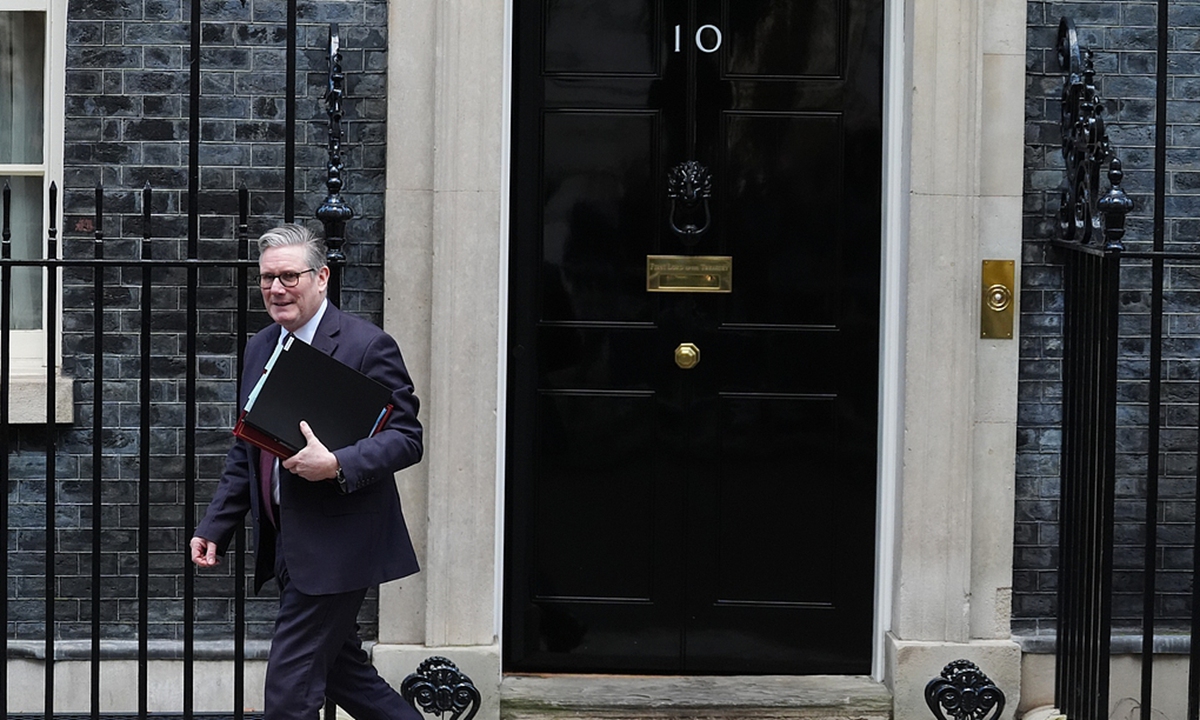
British Prime Minister Keir Starmer leaves 10 Downing Street for a meeting on February 4, 2026. Photo: VCG
British Prime Minister Keir Starmer's director of communications Tim Allan has resigned, Sky News reported Monday, following Starmer's chief of staff Morgan McSweeney quitting his role over a scandal related to the appointment of Peter Mandelson as the envoy to the US, who reportedly has ties with Jeffrey Epstein.
The recent developments have put immense pressure on Starmer, per Sky News. A Chinese expert said that neither the communications director nor the chief of staff is a member of the cabinet - and at the moment, their departure is unlikely to deliver an immediate substantive shock to the Labour government. However, the expert noted that the case has undermined the political trust base and poses a real challenge to the current administration.
Allan said in a brief statement sent to local media that "I have decided to stand down to allow a new No10 team to be built. I wish the PM and his team every success," Xinhua reported.
McSweeney said he took "full responsibility" for advising Starmer to hire Peter Mandelson as US envoy, despite Mandelson's known connections to the convicted pedophile financier Epstein. He said the decision "undermined trust in Labour, the country and politics itself," reported the Guardian.
Starmer is set to face the Parliamentary Labour Party on Monday amid anger over the appointment of Mandelson as ambassador to the US, according to Sky News. Currently, Starmer has asked his deputy chiefs of staff, Jill Cuthbertson and Vidhya Alakeson, to be acting chiefs of staff.
Per a Bloomberg report, UK government officials were bracing for cabinet ministers to privately tell the prime minister to stand aside or threaten their resignations if he doesn't. One aide to a cabinet minister said it was 50-50 whether Starmer would last the week.
The Bloomberg report noted that losing the top aide leaves Starmer exposed at a time when frustrated members of government are braying for change at the top, with Health Secretary Wes Streeting and former Deputy Prime Minister Angela Rayner touted as contenders to succeed him.
Wang Yiwei, a professor at the School of International Studies of Renmin University of China, told the Global Times on Monday that Mandelson's connection with Epstein has undermined the political trust base of the Labour Party and Starmer administration. As such, seeking to repair trust through resignations of those involved and a clear break from controversial figures emerged as a strategic choice.
Wang noted that although the chief of staff plays an important role in political operations, he is not a member of the cabinet. Therefore, his departure is unlikely to deliver a substantive institutional or legal shock to the Labour government at the moment.
For Starmer personally, it may bring some political pressure, but it largely reflects a backlash driven by wider public sentiment.
While some MPs called for Starmer to resign, others defended him. Work and Pensions Secretary Pat McFadden said in an interview with Sky News that Starmer, who was just voted in 18 months ago in a general election, "His task is by no means complete, barely begun."
McFadden said that it is "not good for the country" to change its prime minister every 18 months, which could "lead to chaos and uncertainty, economically, politically and reputationally around the world."
Since 2016, the UK has had six prime ministers in less than 10 years. While the maximum legal term is five years for each premiership, frequent leadership changes have become the norm rather than the exception.
The frequent turnover of British prime ministers has already had a negative effect, resulting in a decline in competitiveness, with underlying economic and social governance issues remaining fundamentally unaddressed, Wang said. He added that from a broader perspective, this is not unique to the UK but a common challenge facing Western countries, reflecting a deeper structural dilemma.
RELATED ARTICLES