Chinese tech, sports brands gain global spotlight at Milan-Cortina Winter Olympics
Chinese brands’ tech and quality mature as they step up global competition: experts
By Zhang Yiyi and Published: Feb 10, 2026 12:05 AM

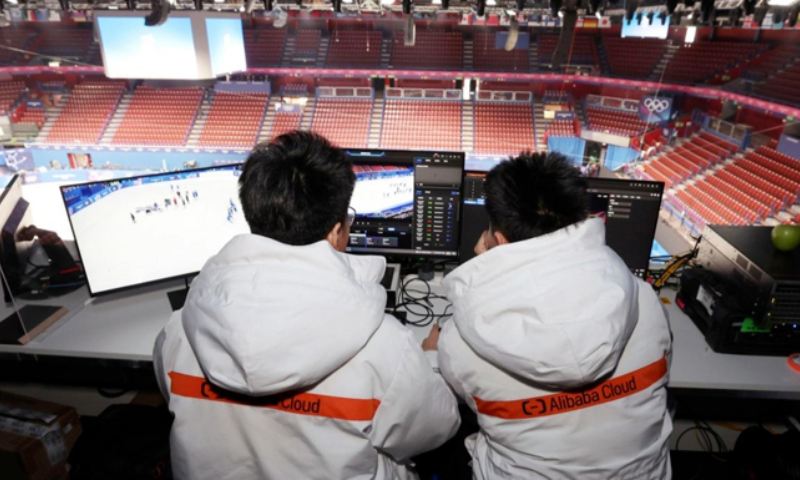
Engineers of Alibaba Cloud work inside the venue of the 2026 Milan-Cortina Winter Olympics. Photo: Courtesy of Alibaba Cloud
The 2026 Winter Olympic Games, currently underway in Milan and Cortina, Italy have drawn global attention, with a growing number of Chinese apparel brands and technology products supporting the event's operations, turning the Games into a key window for showcasing China's manufacturing and technological strengths to the world.
At the Games, Chinese sportswear brands such as Anta and Li-Ning have expanded their presence beyond the Chinese delegation to outfit teams from countries including Italy and Greece, while technology firms such as Alibaba and TCL have joined the Olympics Games as technology partners.
Experts said that Chinese brands' proactive push into overseas markets reflects a shift toward deliberate global positioning and growing confidence in their product strength, technological capabilities and brand value.
China's winter sports equipment landscape has come into sharp focus. At this year's Winter Olympics, Anta Group, through its three brands Anta, FILA and Descente, is providing professional competition and training gear for as many as 13 Chinese national teams, a representative of Anta told the Global Times.
Anta is equipping 10 national teams across core speed disciplines, including short track speed skating, speed skating and skeleton. FILA is providing gear for China's national freestyle skiing aerials team, long regarded as a medal powerhouse, while Descente is supporting both the national snowboard half-pipe team and the alpine skiing team, covering key snow events from technical to speed-based disciplines, Anta told the Global Times.
Chinese outdoor apparel brand TANBOER signed a sponsorship deal with Austria's national snowboard team.
At the Olympics, the podium and opening ceremony are prime stages for exposure and national images. At this year's Winter Games, Li-Ning supplied the Chinese delegation's opening and medal-ceremony uniforms.
Developed in collaboration with the China National Space Administration, the uniforms utilize aerospace thermal-lock insulation and basalt-based far-infrared technology in Winter Olympics medal-ceremony wear, improving both warmth and breathability.
Beyond ceremonies, what athletes wear has become prime real estate for brand exposure. On Saturday (local time), Chinese snowboarder Su Yiming won bronze in the men's big air final, delivering the Chinese delegation's first medal at this year's Winter Olympics. He competed in gear from national team sponsor Anta, while close-ups of his Burton snowboard effectively doubled as high-credibility advertising within the sport. Off the slopes, Adidas gained visibility through his training, daily life and social media accounts, while Li-Ning's medal-ceremony outfit appeared on the podium, where athletic achievement and brand value briefly converged.
Chinese technology firms are taking on deeper roles in the Games' digital backbone. Alibaba Cloud has a partnership with Olympic Broadcasting Services and the International Olympic Committee to deploy cloud and AI technologies for the Milano-Cortina 2026 Winter Olympics, according to a statement Alibaba sent to the Global Times.
TCL has a partnership with Olympic Broadcasting Services to supply hundreds of TVs, digital signage and LED screens for Olympic broadcasts, with its display products also deployed across key venues including competition sites, broadcast centers and the Olympic Village, according to Yicai.
Wang Peng, an associate research fellow at the Beijing Academy of Social Sciences, told the Global Times that Chinese brands' faster push into overseas sporting arenas marks a shift from resource integration to standards-setting. Unlike earlier appearances that leaned more on the spillover of the national image at home events, their deeper engagement in international competitions is now underpinned by core technological capabilities and supply-chain strength, signaling participation in global competition at a higher level.
Zhang Yi, CEO of the iiMedia Research Institute, told the Global Times that from Beijing 2022 to the Milan-Cortina Games, Chinese brands have shifted from home-stage exposure to direct competition across multiple national delegations, where performance, delivery and commercial acceptance matter more than symbolism. The change highlights growing maturity in global operations and signals that Chinese brands are being tested and judged within the core of the global sports industry.
Wang noted that overseas perceptions of Chinese brands are shifting from "contract manufacturing" to "technology-driven." High-profile exposure at top-tier events and through elite athletes provides strong validation of product performance and builds trust for consumer conversion, while the ability to meet professional demands in extreme conditions helps extend influence more sustainably into the mass market.
In the global sports industry, the sight of athletes from multiple countries competing in China-made gear is more than a commercial transaction — it represents a new calling card that Chinese manufacturing is presenting to the world, experts said.
RELATED ARTICLES