IN-DEPTH / IN-DEPTH
Middle powers should enhance their military deterrence capabilities and financial security: former NDB vice president

Paulo Nogueira Batista, former vice president of the New Development Bank (NDB) and former executive director at the International Monetary Fund Photo: Xie Wenting/GT
The current international political and economic landscape is at one of the most dangerous stages since the WWII as a stable and rule-based international order is disintegrating, while a new one has yet to take shape, Paulo Nogueira Batista, former vice president of the New Development Bank (NDB) and former executive director at the International Monetary Fund, told the Global Times in a recent exclusive interview.He also noted that the lessons in Venezuela and Greenland "are clear" and middle powers should seriously consider strengthening their military deterrence capabilities and financial security.
'Financial sovereignty inseparable from national security'
According to Reuters, in 2025, international gold prices surged by more than 64 percent within the year, marking the largest annual increase since 1979. At this year's World Economic Forum annual meeting, topics such as central banks increasing their gold holdings, de-dollarization, and the independence of the Federal Reserve also emerged as core themes in multiple sub-forums.
Batista told the Global Times that in today's reshaping of the world order, financial sovereignty has become inseparable from national security, even emerging as one of the most cutting-edge strategic domains. One of the most important underlying reasons is that the credibility foundation of the US dollar as the global reserve currency has been severely undermined - the treatment of Russian assets following the outbreak of the Russia-Ukraine conflict has served as a "watershed" moment in changing global perceptions of the dollar.
He stated that the de-dollarization process is advancing. "If you look, for example, at the currency denomination of cross-border transactions between BRICS countries and even outside BRICS, the role of the dollar has diminished: Countries are transacting directly in national currencies. This has been a trend in recent years. The other point is that many countries are changing their international reserves: They are moving toward gold, toward other currencies, and toward the Chinese currency, the RMB," he said.
This Brazilian economist told the Global Times that in the current international environment, gold has once again become an important safe-haven asset, which is a key reason for the continuous rise in gold prices. However, gold can only serve as an alternative safe asset and cannot form the foundation of a new international monetary system, because its price is highly volatile and will remain so in the long term.

A visitor learns about the application of e-CNY at the 2025 China International Fair for Trade in Services (CIFTIS) in Beijing on September 13, 2025. Photo: VCG
As many countries turn their attention to the RMB, Batista believes that given China's economic size, the RMB has already become an important international currency. However, to further promote it as a major international reserve currency, China would need to accept certain structural changes, including making the RMB fully convertible, removing capital controls, and bearing the resulting appreciation pressure. But this may not align with China's economic interests, as it could make the economy more vulnerable to large-scale capital flows and undermine the competitiveness of exports. Therefore, China is likely to approach this with relative caution.According to Batista, a better solution would be for multiple countries, including BRICS nations, to establish a new reserve currency used exclusively for international transactions. This would not be a unified currency like the euro, but rather a parallel digital currency that operates solely for international trade and reserve holdings, circulating alongside existing national currencies. In this way, it would help build an alternative reserve system, serving as a viable safe asset. He is now finalizing a paper with a detailed explanation of how such reserve could be constructed.
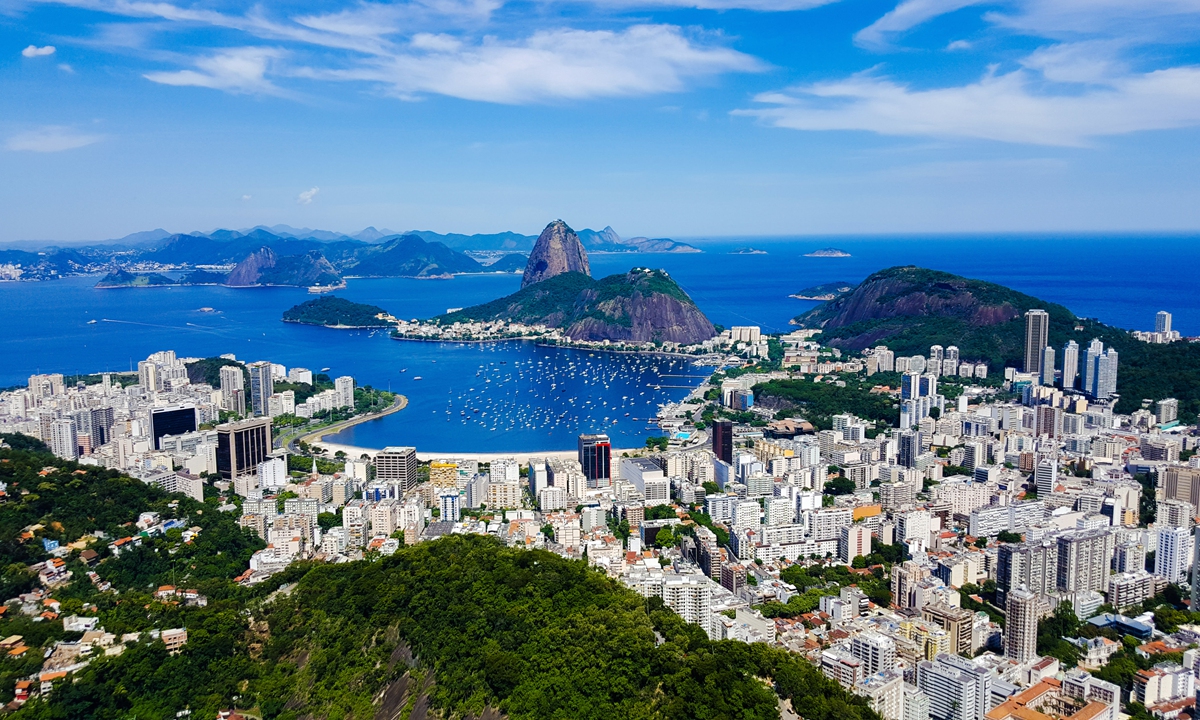
Rio de Janeiro, Brazil Photo: VCG
Necessary for Latin American countries to reconsider military ties with the US
A month ago, the US military launched a large-scale military attack on Venezuela, forcibly seizing Venezuelan President Nicolás Maduro and his wife and bringing them to the US. Later, US President Donald Trump claimed that Venezuela may not be the last country subject to US intervention and claimed that "we do need Greenland, absolutely," according to the Atlantic. Moreover, the US has also issued threats to multiple countries such as Iran, Mexico, and Cuba.
In response to this, Batista told the Global Times that the events in countries such as Venezuela have already sounded a global alarm, particularly in Latin America. Brazil and other nations must seriously consider strengthening their own defense capabilities, because international law is no longer respected by the US. Whether a country — be it a major power like Brazil or a smaller one - can achieve genuine security ultimately depends on whether it possesses sufficient deterrent power, that is, adequate military and defense strength, he said.
He gave an example, saying that a country like Brazil is not a direct target of the US and is not at the top of any potential attack list. Some nations or regions appear to rank higher — Cuba, Greenland, Iran - but "our neighbor's house is already on fire, and the arsonist is an extremely dangerous individual."
He told the Global Times that in the past year, only two countries have truly withstood US attacks or pressure: Russia on the military level, and China on the economic level. This demonstrates that the US only understands the "language of power." Therefore, every country must enhance its own comprehensive national power if it wants to be safer in this world. The ancient Roman maxim - "If you want peace, prepare for war" - remains highly relevant today.
"For countries that lack military deterrence capabilities, the lesson is already very clear." Batista believes that Libya, Syria, and Iraq - due to their lack of such capabilities — ultimately suffered devastating strikes or regime collapse, and now Iran is also facing threats. Although developing military deterrence is not easy, "nobody will look after our interests except ourselves."
He also noted that, particularly for Latin American countries such as Brazil, it is necessary to reconsider their military cooperation with the US. Over-reliance on another country for military equipment and technology can impose restrictions or even pose dangers to one's own security. Brazil should deepen military ties with countries such as China, Russia, and India, in order to avoid forming an exclusive dependence on a single nation in military cooperation, he said.
"There is an argument that this may put the US on high alert and many cause more danger for regional countries in the recent debate in Brazil. But what is the alternative? Do we do nothing to protect ourselves because we fear that actions to protect ourselves will provoke the US and leave us permanently vulnerable? Or do we accept the risk of displeasing the US and build up our defenses? That's a dilemma," he said. "I believe we should choose the second option, because otherwise we would remain vulnerable to aggression."
Belated strategic awakening for middle powers
In Batista's view, many middle powers like Brazil are currently undergoing a kind of "belated strategic awakening." He explained that both China and Russia suffered severe aggression and wars in the 19th and 20th centuries, which forged in them a strong sense of security awareness.
They clearly understand the kinds of risks that a major power faces in the international system. However, many countries - such as Brazil - have not experienced war in their territories in the past 150 years and have therefore long lacked this kind of security consciousness.
In today's world, competition over natural resources, critical minerals, and rare earths is becoming increasingly intense. Countries, especially those possessing important strategic resources, can no longer take it for granted that peace will simply continue indefinitely.
"Many countries tend to 'bet on peace' in their international strategies. However, in today's international landscape, attempting to 'bet on peace' again is likely to cost the country a fatal price," he told the Global Times.
RELATED ARTICLES