Port operations boost Xiangshan live fish exports, bring ‘tastes of the East China Sea’ to foreign dining tables
Editor's Note:
High-end ingredients that were once largely imported are now produced in China and are gradually entering global markets. Meanwhile, as trade and economic cooperation deepens, distinctive foods from around the world have entered China at an accelerating pace and won growing favor among Chinese consumers. "Chinese flavors" are increasingly becoming an active presence on the global consumption stage, while China's dining tables have attracted cuisines from across the world. This two-way flow across mountains and oceans is not merely a meeting of tastes between China and the rest of the world, but also a vivid illustration of how China's vast market is sharing development opportunities globally. This is the third installment of the series.
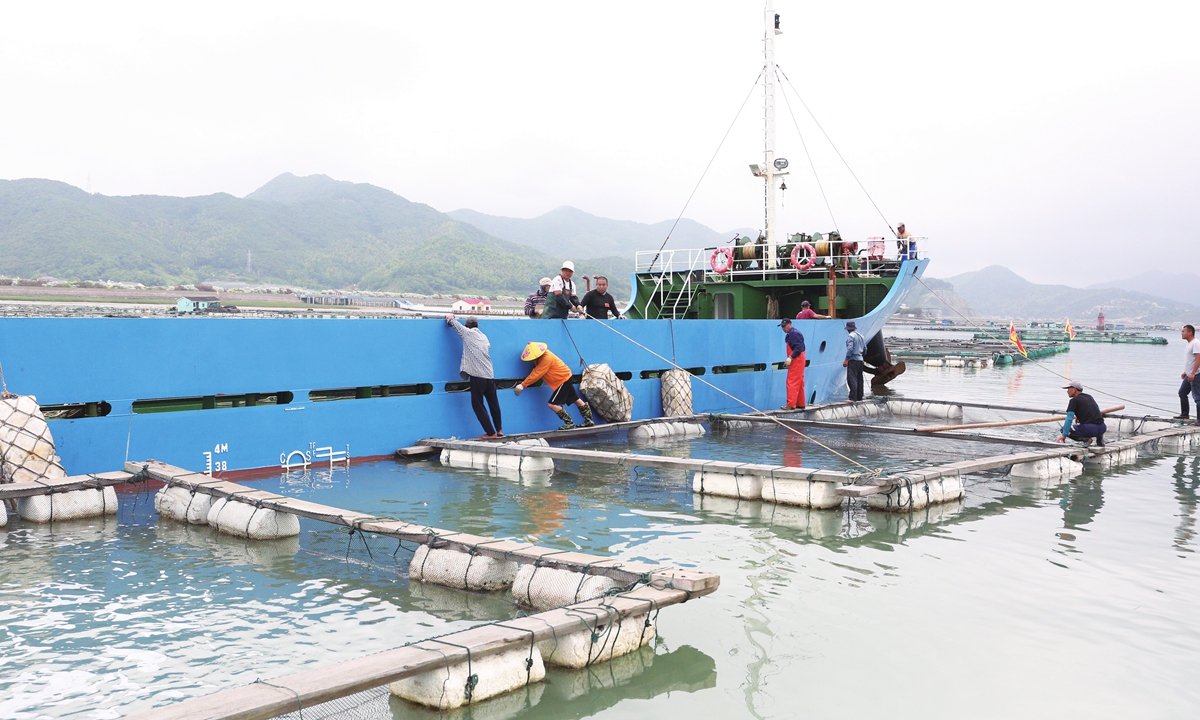
On the glassy waters at Gaoni Village in Xiangshan, a coastal county in Ningbo, East China's Zhejiang Province, crisscrossing square cages are connected to form "floating islands."
Inside them, dozens of live fish thrash and leap - the produce of coastal aquaculture that has begun reaching foreign dinner tables after Xiangshan Port's export lanes opened.
"We have been farming marine fish in nearshore waters for many years," Yan Xingguo, head of Xiangshan Haiyun Aquatic Cooperative, told the Global Times. "At our facility in Gaoni Village, we now operate 602 cages across about 33 mu (2.2 hectares) of water. As our farming scale expands, we set our sights on overseas markets."
The cooperative's push toward overseas markets targets countries with strong demand for imported fresh seafood, Yan said. He singled out South Korea and Japan as priority markets to broaden sales and raise incomes for local villagers.
Live marine fish are the most distinctive export product of Xiangshan Port, Yan said.
"The fish we cultivate in Xiangshan feature a tender texture and high quality, and are very popular overseas. Our weevers are regarded by South Koreans as 'ginseng of the sea'," Yan said.
According to Yan, South Koreans consume a large amount of seafood but have limited domestic supply. They rely mainly on imports, most of which come from China; a significant portion of the live fish from China comes from Ningbo. The exports of live fish to South Korea have become a flagship product driving the local economy, benefiting more than 500 local aquaculture households, bringing each household a net income of at least 60,000 yuan ($8,682) annually.
Xiangshan, located on China's east coast near the East China Sea, serves as a national marine fisheries demonstration zone. Its clear, microbe-rich waters provide ideal conditions for warm-water species such as yellow croaker, sea bass, and other farmed species, resulting in high survival rates and the prized freshness of the catch at harvest.
Each September, Xiangshan celebrates the annual opening of the autumn fishing season, said Zhang Yongqi, deputy general manager of Ningbo Yongyang Foodstuffs Co.
"At that time, our live fish farms are vibrant with activity: trucks loaded with fresh seafood stream in and out. After processing, customs declaration, inspection, and release, these seafood products are turned into fillets, cans, and other seafood items, and shipped to the EU, Japan, South Korea and other markets," Zhang told the Global Times.
Customs data shows that in 2024 and 2025, Xiangshan Port recorded 43 sailings of live fish exports totaling more than 1,300 tons, with an export value of roughly 67 million yuan.
Local producers said the launch of regular export operations at Xiangshan Port has been a crucial boost for the industry, enabling operators to diversify markets beyond domestic demand and add value through processing and cross-border sales, bringing fresher seafood options to overseas consumers as well as offering a tangible boost to incomes and rural development.
Live fish exports from Xiangshan help drive employment across the entire industrial chain, including local farming, processing, logistics, and foreign trade, and turn marine resource advantages into income for fishermen, said a Chinese analyst.
Specialized port for fish exports
On January 17, a live fish carrier, Longtai-6, operated by Ningbo Fengtai Import & Export Co, berthed smoothly at Xiangshan Port. After completing entry procedures, the vessel then loaded approximately 30 tons of live fish at a local farming base before departing for South Korea's Tongyeong.
Zhang Lei, head of the management center of Xiangshan Port, said this was the first import-export vessel to call Xiangshan since the port officially opened on December 24, 2025, marking the start of regular import-export operations.
According to Zhang, the operations of Xiangshan Port have created new opportunities for developing the port economy and building a national-level marine economic demonstration zone in Ningbo.
Unlike Ningbo's core port areas, which focus on container and bulk cargo, Xiangshan Port has pursued a differentiated development path based on local resources and industrial strengths, positioning itself as an "industrial port" and a "specialized port," Zhang said.
"Specifically, building a 'specialized port' means creating a port that serves ordinary people," Zhang noted. Anchored by its designation as a designated port of entry for edible aquatic animals, Xiangshan will concentrate on high-end seafood and specialty goods trade - activities such as live fish exports, small-scale trade, ship exports, and imports of premium seafood and fruit - that directly support local aquaculture and distant-water fishing industries, Zhang told the Global Times.
"Since the port opened in December 2025, we have already handled live fish exports to South Korea and snow crab imports from Russia," Zhang said, underscoring the port's immediate role in serving local communities and regional fishery industries.
'Tastes of the East China Sea'
With a newly opened berth and streamlined customs procedures, Xiangshan Port is accelerating the export of live fish, bringing "tastes of the East China Sea" to foreign dining tables.
"Previously, transporting fish from our farming base to Xiangshan's temporary opening wharf took 10 to 12 hours one way, with limited water quality conditions," said Lin Guocun, head of Ningbo Fengtai Import & Export Co. "Now the voyage to Xiangshan's new open port is just over five hours with better water quality, significantly improving live fish survival rates - tangible, visible convenience," Lin told the Global Times.
"Local border inspection authorities have also rolled out a series of measures to reduce export declaration time," Lin said.
A Xiangshan Customs official told the Global Times that its support for live fish exports focuses on two main fronts: expedited inspection and release at the export stage, and ongoing disease and epidemic monitoring at the farming stage to ensure product safety and quality.
Additionally, to help enterprises better explore overseas markets, Xiangshan Customs has introduced "going global support" measures in recent years, actively supporting overseas registration and market access for aquatic-export producers.
Over two-thirds of aquatic export enterprises in Xiangshan have obtained registration approvals in the EU, South Korea, Brazil, and other countries and regions, helping enterprises expand international markets and helping high-quality agricultural products reach global markets, according to the customs official.
Live fish exports have become a vivid example of Chinese agriculture integrating into the global value chain. With the regular operations of Xiangshan Port and the deepening of its "specialized port" functions, Ningbo's live fish exports are expected to maintain stable volumes while improving quality, Zhu Yi, an associate professor at the China Agricultural University, told the Global Times.
Zhu said Xiangshan has converted natural advantages - clean coastal waters and favorable geography - into a competitive industry chain that links aquaculture, processing, and export.
Leveraging the port's advantages, Xiangshan can expand its future export target markets beyond Japan and South Korea to Southeast Asia, Central and Eastern Europe, and other Belt and Road partner countries. The "going global" story of Xiangshan's fishery industry is becoming a vivid footnote of China's agricultural opening-up and development, Zhu noted.
From a cultural exchange perspective, when "tastes of the East China Sea" appear on Japanese and South Korean dining tables, China's fishery industry is not only exporting products but also showcasing marine ecological governance practices and food safety standards, thereby enhancing foreign citizens' understanding of China's agricultural modernization and promoting people-to-people exchanges through food culture, Zhu said.
High-end ingredients that were once largely imported are now produced in China and are gradually entering global markets. Meanwhile, as trade and economic cooperation deepens, distinctive foods from around the world have entered China at an accelerating pace and won growing favor among Chinese consumers. "Chinese flavors" are increasingly becoming an active presence on the global consumption stage, while China's dining tables have attracted cuisines from across the world. This two-way flow across mountains and oceans is not merely a meeting of tastes between China and the rest of the world, but also a vivid illustration of how China's vast market is sharing development opportunities globally. This is the third installment of the series.
A scene of fish harvest at Gaoni Village's nearshore cage farming base in Xiangshan, Ningbo, East China's Zhejiang Province, on September 19, 2025 Photo: Courtesy of Xiangshan Customs
On the glassy waters at Gaoni Village in Xiangshan, a coastal county in Ningbo, East China's Zhejiang Province, crisscrossing square cages are connected to form "floating islands."
Inside them, dozens of live fish thrash and leap - the produce of coastal aquaculture that has begun reaching foreign dinner tables after Xiangshan Port's export lanes opened.
"We have been farming marine fish in nearshore waters for many years," Yan Xingguo, head of Xiangshan Haiyun Aquatic Cooperative, told the Global Times. "At our facility in Gaoni Village, we now operate 602 cages across about 33 mu (2.2 hectares) of water. As our farming scale expands, we set our sights on overseas markets."
The cooperative's push toward overseas markets targets countries with strong demand for imported fresh seafood, Yan said. He singled out South Korea and Japan as priority markets to broaden sales and raise incomes for local villagers.
Live marine fish are the most distinctive export product of Xiangshan Port, Yan said.
"The fish we cultivate in Xiangshan feature a tender texture and high quality, and are very popular overseas. Our weevers are regarded by South Koreans as 'ginseng of the sea'," Yan said.
According to Yan, South Koreans consume a large amount of seafood but have limited domestic supply. They rely mainly on imports, most of which come from China; a significant portion of the live fish from China comes from Ningbo. The exports of live fish to South Korea have become a flagship product driving the local economy, benefiting more than 500 local aquaculture households, bringing each household a net income of at least 60,000 yuan ($8,682) annually.
Xiangshan, located on China's east coast near the East China Sea, serves as a national marine fisheries demonstration zone. Its clear, microbe-rich waters provide ideal conditions for warm-water species such as yellow croaker, sea bass, and other farmed species, resulting in high survival rates and the prized freshness of the catch at harvest.
Each September, Xiangshan celebrates the annual opening of the autumn fishing season, said Zhang Yongqi, deputy general manager of Ningbo Yongyang Foodstuffs Co.
"At that time, our live fish farms are vibrant with activity: trucks loaded with fresh seafood stream in and out. After processing, customs declaration, inspection, and release, these seafood products are turned into fillets, cans, and other seafood items, and shipped to the EU, Japan, South Korea and other markets," Zhang told the Global Times.
Customs data shows that in 2024 and 2025, Xiangshan Port recorded 43 sailings of live fish exports totaling more than 1,300 tons, with an export value of roughly 67 million yuan.
Local producers said the launch of regular export operations at Xiangshan Port has been a crucial boost for the industry, enabling operators to diversify markets beyond domestic demand and add value through processing and cross-border sales, bringing fresher seafood options to overseas consumers as well as offering a tangible boost to incomes and rural development.
Live fish exports from Xiangshan help drive employment across the entire industrial chain, including local farming, processing, logistics, and foreign trade, and turn marine resource advantages into income for fishermen, said a Chinese analyst.
Specialized port for fish exports
On January 17, a live fish carrier, Longtai-6, operated by Ningbo Fengtai Import & Export Co, berthed smoothly at Xiangshan Port. After completing entry procedures, the vessel then loaded approximately 30 tons of live fish at a local farming base before departing for South Korea's Tongyeong.
Zhang Lei, head of the management center of Xiangshan Port, said this was the first import-export vessel to call Xiangshan since the port officially opened on December 24, 2025, marking the start of regular import-export operations.
According to Zhang, the operations of Xiangshan Port have created new opportunities for developing the port economy and building a national-level marine economic demonstration zone in Ningbo.
Unlike Ningbo's core port areas, which focus on container and bulk cargo, Xiangshan Port has pursued a differentiated development path based on local resources and industrial strengths, positioning itself as an "industrial port" and a "specialized port," Zhang said.
"Specifically, building a 'specialized port' means creating a port that serves ordinary people," Zhang noted. Anchored by its designation as a designated port of entry for edible aquatic animals, Xiangshan will concentrate on high-end seafood and specialty goods trade - activities such as live fish exports, small-scale trade, ship exports, and imports of premium seafood and fruit - that directly support local aquaculture and distant-water fishing industries, Zhang told the Global Times.
"Since the port opened in December 2025, we have already handled live fish exports to South Korea and snow crab imports from Russia," Zhang said, underscoring the port's immediate role in serving local communities and regional fishery industries.
'Tastes of the East China Sea'
With a newly opened berth and streamlined customs procedures, Xiangshan Port is accelerating the export of live fish, bringing "tastes of the East China Sea" to foreign dining tables.
"Previously, transporting fish from our farming base to Xiangshan's temporary opening wharf took 10 to 12 hours one way, with limited water quality conditions," said Lin Guocun, head of Ningbo Fengtai Import & Export Co. "Now the voyage to Xiangshan's new open port is just over five hours with better water quality, significantly improving live fish survival rates - tangible, visible convenience," Lin told the Global Times.
"Local border inspection authorities have also rolled out a series of measures to reduce export declaration time," Lin said.
A Xiangshan Customs official told the Global Times that its support for live fish exports focuses on two main fronts: expedited inspection and release at the export stage, and ongoing disease and epidemic monitoring at the farming stage to ensure product safety and quality.
Additionally, to help enterprises better explore overseas markets, Xiangshan Customs has introduced "going global support" measures in recent years, actively supporting overseas registration and market access for aquatic-export producers.
Over two-thirds of aquatic export enterprises in Xiangshan have obtained registration approvals in the EU, South Korea, Brazil, and other countries and regions, helping enterprises expand international markets and helping high-quality agricultural products reach global markets, according to the customs official.
Live fish exports have become a vivid example of Chinese agriculture integrating into the global value chain. With the regular operations of Xiangshan Port and the deepening of its "specialized port" functions, Ningbo's live fish exports are expected to maintain stable volumes while improving quality, Zhu Yi, an associate professor at the China Agricultural University, told the Global Times.
Zhu said Xiangshan has converted natural advantages - clean coastal waters and favorable geography - into a competitive industry chain that links aquaculture, processing, and export.
Leveraging the port's advantages, Xiangshan can expand its future export target markets beyond Japan and South Korea to Southeast Asia, Central and Eastern Europe, and other Belt and Road partner countries. The "going global" story of Xiangshan's fishery industry is becoming a vivid footnote of China's agricultural opening-up and development, Zhu noted.
From a cultural exchange perspective, when "tastes of the East China Sea" appear on Japanese and South Korean dining tables, China's fishery industry is not only exporting products but also showcasing marine ecological governance practices and food safety standards, thereby enhancing foreign citizens' understanding of China's agricultural modernization and promoting people-to-people exchanges through food culture, Zhu said.
RELATED ARTICLES