China releases white paper on safeguarding national security in HKSAR following Jimmy Lai sentencing
Policy document clearly articulates, explains rule-of-law principles, forcefully rebut accusations from certain Western claims: expert
By Published: Feb 10, 2026 11:34 PM

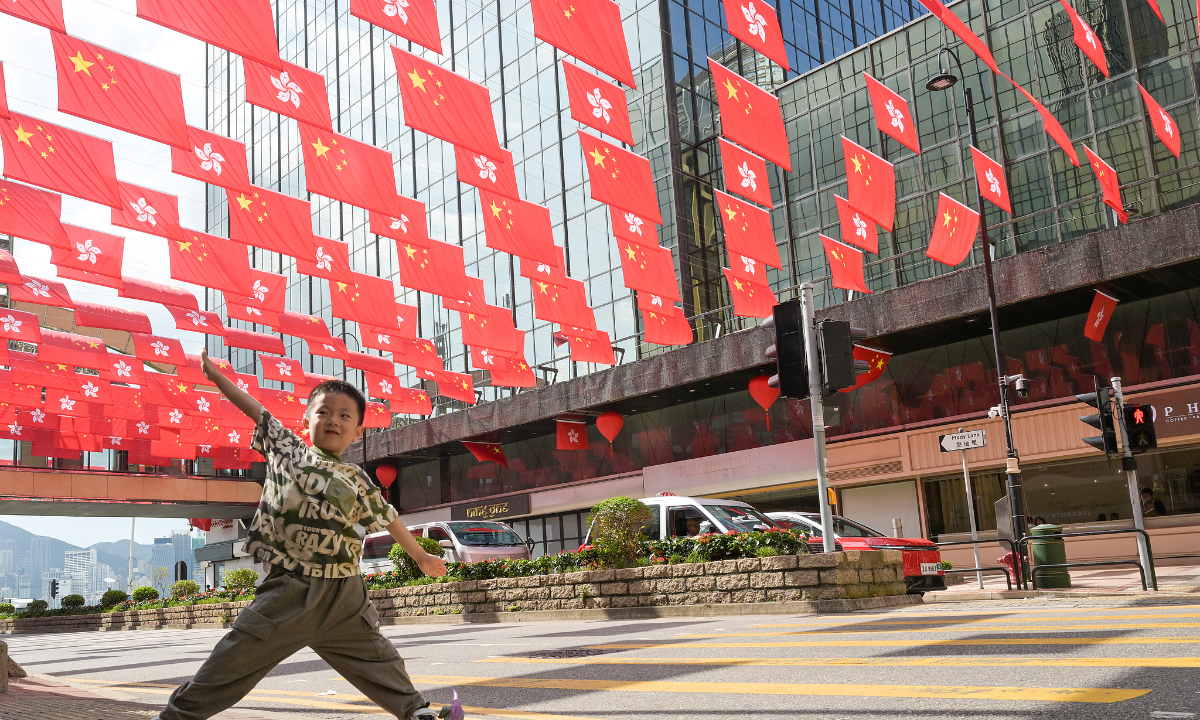
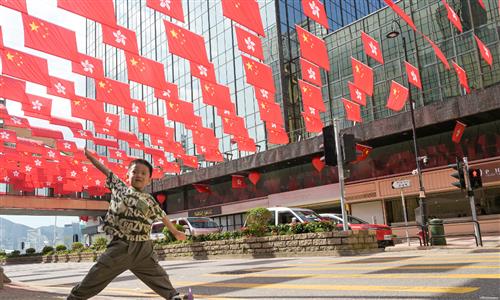
Hong Kong SAR is full of National Day festive atmosphere on October 1, 2025. Photo: VCG
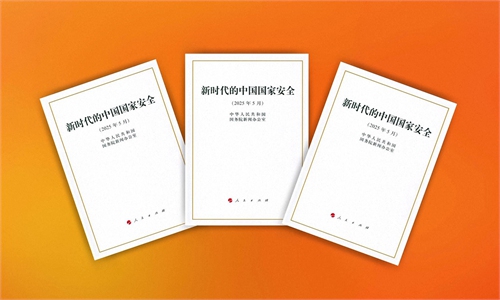
China on Tuesday released a white paper on Hong Kong's efforts to safeguard national security, comprehensively reviewing the practice of the special administrative region's national security practices, highlighting the central government's fundamental responsibility for national security affairs in the city and its staunch backing for the city's safeguarding role.
Analysts said the white paper was issued at the right time after the successful implementation of the National Security Law for Hong Kong and anti-China riots instigator Jimmy Lai Chee-ying's conviction and sentencing for national security offenses. It explains the intrinsic logic linking national security with the steady implementation of the "One Country, Two Systems" principle, clears up confusion, misunderstandings, and misinterpretations surrounding the issue of safeguarding China's national security in the special administrative region, serving as a powerful rebuttal to politically-driven accusations and criticism against China regarding Hong Kong affairs, some analysts said.
Consisting of five parts in addition to a preface and a conclusion, the document, titled "Hong Kong: Safeguarding China's National Security Under the Framework of One Country, Two Systems," details the unrelenting fight for safeguarding national security in Hong Kong and the central government's fundamental responsibility for national security matters concerning Hong Kong, according to the Xinhua News Agency.
It also expounds on the Hong Kong Special Administrative Region's (HKSAR) achievements in fulfilling its constitutional responsibility for safeguarding national security, Hong Kong's transition from disorder to stability and prosperity, and efforts in creating high-standard security for high-quality development of the ''One Country, Two Systems'' policy, per Xinhua.
The white paper said the Chinese government is publishing this document to review Hong Kong's endeavors in safeguarding national security and the experience and insights gained in the process, and also to clear up confusion and misunderstandings surrounding the issue to build consensus, and to ensure the high-quality development of the policy of "One Country, Two Systems'' with high-standard security.
The white paper also reviewed the protracted fight around the local legislation on national security required by Article 23 of the Basic Law, the 2019 turmoil posed by the greatest challenge for safeguarding national security in Hong Kong, and how central government and local government responded to the 2019 turmoil including reinforcing the legal framework and enforcement mechanisms for safeguarding national security in the HKSAR, improving the region's electoral system and governance, and implementing the principle of patriots administering Hong Kong.
This marks the first major white paper on Hong Kong released by the central government in five years. The previous one was issued in 2021 and focused on Hong Kong's democratic development.
Multiple central government agencies expressed the support for the release of the white paper, hailing its far-reaching significance.
The white paper comprehensively reviews the course of Hong Kong's efforts to safeguard national security, elaborates in depth on the central government's principled positions on this issue, and systematically summarizes the experience and insights gained in safeguarding national security under the framework of ''One Country, Two Systems,'' a spokesperson from the Hong Kong and Macao Affairs Office of the State Council said on Tuesday.
With increasingly complex geopolitical situations, frequent regional conflicts and the emergence of unilateralism and protectionism, unstable factors around the world are on the rise, and the national security risks facing Hong Kong are unpredictable, John Lee, Chief Executive of the HKSAR, said on Tuesday in commenting on the white paper.
"The release of the white paper is of great significance and has come at exactly the right time," Lee said during a press conference on Tuesday.
Why now?
Some Western media like Reuters noted the white paper was released a day after the High Court of the HKSAR handed down a 20-year-imprisonment on anti-China riots instigator Jimmy Lai.
The High Court of the HKSAR on Monday morning sentenced Lai to 20 years in prison. Lai was found guilty in December 2025 by the High Court of the HKSAR on two charges of conspiring to collude with external forces and a charge of conspiracy to publish seditious materials.
With regard to the trial of the Lai's case, some Western countries have once again followed their usual practice of expressing opposition and raising the so-called doubts. Against this backdrop, the central authorities' release of the white paper is significant in "setting the record straight," Lawrence Tang Fei, a member of the Hong Kong Legislative Council, told the Global Times on Tuesday.
Through the white paper, the full background and sequence of the 2019 turmoil in the city are clearly laid out, and the relevant political ethics and principles of the rule of law are systematically clarified, fundamentally explaining how the country and the HKSAR have handled the matter in accordance with the law, Tang said.
Its core purpose is to clearly articulate and explain the various political and rule-of-law principles, thereby forcefully responding to and rebutting accusations and criticism against China from Western countries that lack factual and legal basis, the local lawmaker added.
The legal and institutional framework for safeguarding national security in the HKSAR has been further refined, but this is not the end point, Tian Feilong, a vice-dean of the Law School of Minzu University of China in Beijing, told the Global Times on Tuesday.
"Sanctions and countermeasures in the field of foreign-related rule of law also fall within the scope of national security, while risks and challenges arising from non-traditional security require continuous and dynamic assessment and response," Tian said, noting that the white paper points the way forward for the further development of HKSAR's legal system for safeguarding national security and provides a policy guide for the new stage of "One Country, Two Systems," moving from stability to prosperity.
Western claims futile
The verdict of the Lai's case has also been mentioned in the white paper. HKSAR's courts have accurately applied the National Security Law for Hong Kong and relevant local legislation in delivering verdicts that uphold national security, the white paper said.
The courts have confirmed that, when individuals exercise their rights and freedom, they shall not refuse to recognize that Hong Kong is an inalienable part of the PRC. They have emphasized that freedoms and rights of individuals in a society underpinned by the rule of law are neither infinite nor absolute. Otherwise, if abused, their destructive and disruptive force would be self-evident. They also confirm that the National Security Law seeks compatibility, alignment and complementarity with local laws, according to the white paper.
The purpose of the white paper is to clarify the central government's primary responsibility and lawful practice in safeguarding national security in Hong Kong under "One Country, Two Systems," signaling that neither internal nor external hostile forces will be allowed to undermine "One Country, Two Systems," Hong Kong's prosperity and stability, or national security, while serving as a warning and deterrent to Western powers, Lau Siu-kai, a consultant from the Chinese Association of Hong Kong and Macao Studies who is also a senior policy advisor, told the Global Times on Tuesday.
"Given the current severe and complex international situation, and the Western powers' persistent intent to contain China, they will continue to use Hong Kong in various ways to endanger national and Hong Kong security. The white paper essentially says the central government will not relax its efforts to safeguard national security; rather, it will remain fully prepared, continuously preventing and responding to threats, and taking countermeasures against hostile forces," Lau said.
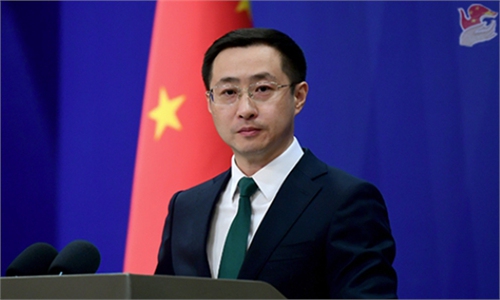
Certain countries and institutions used the judicial case to make malicious smears against Hong Kong and its rule of law, and interfere in China's internal affair. China firmly opposes this and has lodged serious protests with those countries and institutions, the Chinese Foreign Ministry spokesperson Lin Jian said on Tuesday in response to statements issued by the US, the UK, Australia, the EU and others concerning the 20-year-imprisonment sentencing on anti-China riots instigator Jimmy Lai Chee-ying.
Hong Kong affairs are purely China's internal affairs. The rule of law in Hong Kong is unshakable and no foreign country has the right to make irresponsible remarks. The Chinese government remains determined to safeguard the nation's sovereignty, security and development interests and to implement the "One Country, Two Systems" policy. Any attempt to disrupt Hong Kong's advancement from stability to prosperity or to destabilize Hong Kong and contain China is doomed to fail, Lin said.
RELATED ARTICLES