Macron reportedly urges EU to reduce dependence on US, China; protectionism won’t address Europe’s woes: expert
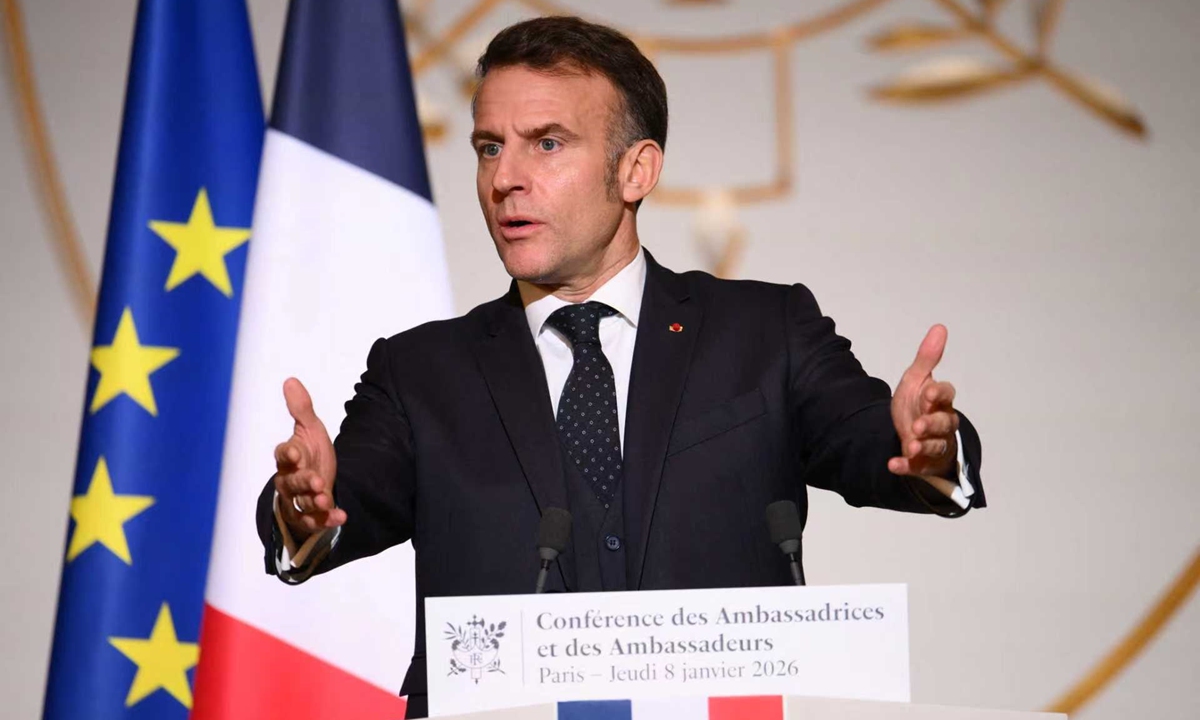
French President Emmanuel Macron during the 2026 Ambassadors' Conference at the Elysee Palace in Paris on January 8, 2026. Photo: VCG
French President Emmanuel Macron has called on the EU to embark on an "economic revolution" and reduce dependence on the US and China, according to media reports. Chinese experts said that the remarks reflect the EU's anxiety amid a slew of challenges, but protectionist actions will not help address these woes.
In an interview with the Financial Times (FT) and other European media outlets ahead of a special EU summit on competitiveness this week, the Frech President said he would press his fellow EU leaders to capitalize on what he called "the Greenland moment," when Europeans realized they were under threat, so as to move ahead quickly with long-delayed economic reforms, FT reported.
"We have the Chinese tsunami on the trade front, and we have minute-by-minute instability on the American side. These two crises amount to a profound shock — a rupture for Europeans," Macron claimed, according to FT.
The French President said that Europe was now dealing with a US administration that was "openly anti-European," "shows contempt" for the EU and "wishes its dismemberment." He also made various claims against China, asserting that the EU is under siege from so-called cheap Chinese goods, per the FT report.
The remarks reflect growing anxiety within the EU amid growing challenges; however, blaming China is a typical scapegoating approach that does not work, Jian Junbo, director of the Center for China-Europe Relations at Fudan University's Institute of International Studies, told the Global Times on Wednesday.
"The core issue lies in Europe's long-standing investment bias toward traditional industries — such as internal combustion engine vehicles, where Europe already holds a global lead — while underinvesting in high-tech sectors," Jian said, noting that this imbalance has left the bloc lagging in emerging industrial competition.
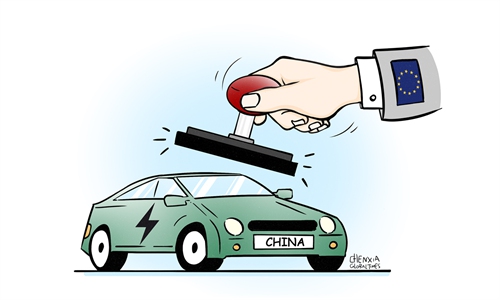
In the interview, Macron urged his EU counterparts to adopt a "European preference" policy to favor the bloc's own companies and technologies in strategic sectors such as electric vehicles, renewable energy and chemicals, according to the FT report.
Macron also voiced support for simplifying EU regulations, breaking down intra-bloc trade barriers and reducing dependence on foreign suppliers for critical inputs and technologies, which he would propose at the Belgium summit, while the discussions at the meeting are expected to feature France's long-standing push for "buy European" policies, with the European Commission set to unveil related legislation later this month, per the FT.
Such proposals are still protectionist in nature and are unlikely to work in helping address the EU's current challenges, said Ding Chun, director of the Center for European Studies at Fudan University.
"Protectionism may offer temporary shelter, but it cannot secure victory in global competition," Ding told the Global Times on Wednesday, noting that competitiveness comes from fair competition and cooperation, not protectionism.
Notably, the French president's proposals face growing resistance in France due to political and fiscal strains, as well as in several EU capitals, where officials argue that some of the proposals run counter to the bloc's single market framework and free trade principles, according to media reports.
A report by POLITICO on Tuesday said that German Chancellor Friedrich Merz's government rejected Macron's call for a joint borrowing scheme ahead of the EU leaders' summit on Thursday. A German government official who is close to the chancellor said that "we think that, in view of the agenda [at the EU leaders' summit], this distracts a little from what it's actually all about, namely that we have a productivity problem," POLITICO reported.
Jian said that the EU should strengthen economic integration with major markets, including China, and leverage its own strengths to jointly expand and upgrade global industrial and supply chains, rather than resorting to political tools to counter market competition.
The Chinese side has repeatedly voiced opposition against protectionist measures.
On January 20, after the EU released relevant documents requiring member states to exclude so-called "high-risk suppliers" from 18 key sectors, including energy, transport and ICT services management, Chinese Ministry of Commerce spokesperson He Yongqian said that China urges the EU to uphold the principle of technological neutrality in cybersecurity, refrain from overstretching the concept of security, avoid going further down the path of protectionism, and not obstruct normal China-EU economic and trade cooperation.
RELATED ARTICLES