US commerce chief under fire over Epstein ties as resignation calls grow; media see stepping down unlikely, Chinese experts note case exposes dysfunction in US accountability system
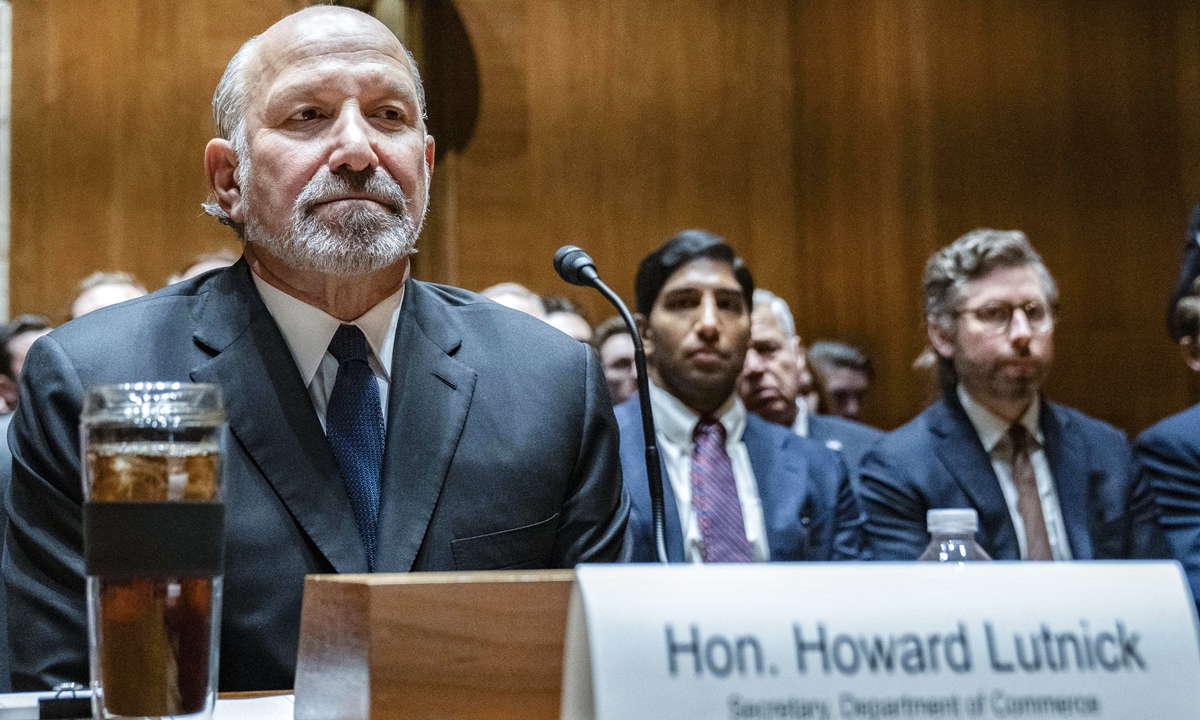
United States Secretary of Commerce Howard Lutnick testifies before the US Senate Committee on Appropriations hearing in the Dirksen Senate Office Building on Capitol Hill in Washington, DC, US, on February 10, 2026. Photo: VCG
US Commerce Secretary Howard Lutnick on Tuesday found himself embroiled in renewed controversy over his past relationship with late US financier and convicted sex offender Jeffrey Epstein, after acknowledging meetings that appeared to contradict his previous public statements.
After the newly released Epstein files triggered political earthquakes in Europe, Lutnick appears to be the first senior official in the current US administration to come under direct scrutiny in the wake of the disclosures, Chinese experts said. Although several US lawmakers have called for his resignation, media outlets, including the Politico, suggest he is unlikely to do so. After the incident surfaced, the White House still stated support to Lutnick.
According to the Associated Press (AP), under questioning from Democrats on Tuesday, Lutnick acknowledged that he had met with Jeffrey Epstein twice after the late financier's 2008 conviction for soliciting prostitution from a child, contradicting Lutnick's previous claim that he had cut ties with Epstein after 2005.
Downplaying his relationship with the disgraced financier, who was once his neighbor in New York City, Lutnick described their contact as a handful of emails and a pair of meetings that were years apart, AP reported.
The controversy intensified following the new release of Epstein files. AP said the newly disclosed records contradicted Lutnick's claims on a podcast last year, in which he claimed he had decided to "never be in the room" with Epstein again after a 2005 tour of Epstein's home that disturbed Lutnick and his wife.
In Washington, several lawmakers have called for Lutnick's resignation. Republican Representative Thomas Massie urged him to step down over the weekend after emails alluding to meetings with Epstein were released. Democratic Representative Ro Khanna joined the call on Monday, according to AP.
Despite mounting political pressure, some US media outlets suggested the likelihood of Lutnick's resignation remains slim. Politico, in a report titled "The White House is shrugging at Lutnick's Epstein ties. His foes are too," cited multiple individuals close to the White House as saying Lutnick is unlikely to be forced to step down.
Comparing the political fallout in Europe with the US response, Politico wrote that "In the US government, the consequences for a relationship with Epstein are few and far between."
White House press secretary Karoline Leavitt said Tuesday that Lutnick "remains a very important member of President Trump's team, and the president fully supports the secretary," AP reported.
Chinese experts said the controversy once again highlights what they described as structural corruption in US politics and the judicial system. Wang Yiwei, a professor at the School of International Studies of Renmin University of China, told the Global Times on Wednesday that in US society, political power and privileged groups often override judicial independence, making it difficult for the system to substantively hold senior officials accountable.
Wang cited remarks made in an interview by a former girlfriend of former UK Prince Andrew Mountbatten-Windsor — who also appeared in the Epstein files — saying that for powerful elites in Europe and the US, "If you're not in those [Epstein] files, it would be an insult, because it just means that you are a bit of a loser." For some in Western high society, appearing in the Epstein files may not even be seen as particularly shameful, Wang said.
Li Haidong, a professor at the China Foreign Affairs University, told the Global Times that in the US, legal constraints often apply to ordinary citizens, while elite groups can stand above the law, disregarding public interests and exhibiting moral decadence in their personal lives.
The Epstein case merely underscores longstanding dysfunction within the US accountability system. From the fabricated claims of weapons of mass destruction that preceded the Iraq war to the 2008 financial crisis, senior US officials have rarely borne substantive responsibility for major political scandals, he said.
By contrast, the Epstein files have generated more visible political repercussions in Europe. Axios ran a report titled "Europe confronts Epstein shame amid muted US reckoning," detailing how several high-profile figures — including UK Prime Minister Keir Starmer's director of communications and chief of staff, the UK ambassador to the US, former Prince Andrew, and a former Norwegian prime minister and Norway's ambassador to Jordan and Iraq — have faced investigations or stepped down over links to Epstein.
"The fallout from the release of the Epstein files has become a stress test for accountability among Western elites and their governments — and has exposed a stark contrast between how the US and its allies approach reputational blows," Axios wrote.
Li said that European political systems continue to place relatively greater emphasis on the rule of law and impose higher moral expectations on politicians, with public opinion more capable of translating reputational damage into political consequences.
In the US, however, "scandals like the Epstein files have surfaced before, and they surely will happen again in the country," Li noted, citing entrenched political and judicial structures in the US.
RELATED ARTICLES