Blue Momentum: From fisheries to clean energy, Ningbo's marine economy charts high-quality devt
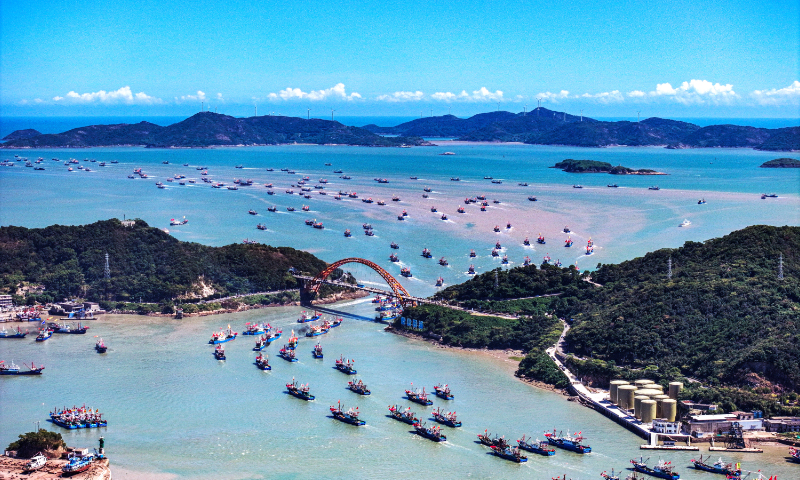
An aerial photo of fishing boats in Xiangshan county, East China's Zhejiang Province, on September 16, 2025 Photo: VCG
Editor's Note:
China has stressed that advancing Chinese modernization requires promoting the marine economy's high-quality development and forging a Chinese path of leveraging marine resources to achieve strength. With a mainland coastline stretching 18,000 kilometers and a sea area under its jurisdiction of around 3 million square kilometers, China is a major maritime nation with vast potential for developing its marine economy. To document the high-quality development of China's marine economy, the Global Times is launching the "Blue Momentum" series of in-depth articles from local marine economic powerhouses. The first installment focuses on Ningbo, East China's Zhejiang Province.

With the press of a button, a school of yellow croakers surges into the net, flapping and flashing in the sunlight as they are lifted from the water. For 53-year-old Zhou Huiming, it is a routine day on the deep-sea smart aquaculture platform - the Donghai No. 1.
About a two-hour boat ride away from Ningbo, East China's Zhejiang Province, the massive deep sea floating platform sits steadily on the water like an island anchored to the seabed. Covering the area of six basketball courts and standing as tall as a seven-story building, the Donghai No. 1 is Zhejiang's first deep sea semi-submersible aquaculture platform. This platform has reshaped Zhou's career - from being a traditional fisherman to a high-tech one.
More importantly, it epitomizes the rapid rise of the marine economy in Ningbo, a coastal city with a long history of being a trading port and is now home to the world's biggest port by cargo throughput. Beyond ports, the city's marine economy has grown into a broader engine of development, encompassing fisheries, green energy and equipment manufacturing.
Ningbo also represents a microcosm of China's efforts to promote high-quality development of the marine economy. During a high-level meeting of the Central Commission for Financial and Economic Affairs in July 2025, Chinese leadership stressed that advancing Chinese modernization requires "promoting the marine economy's high-quality development. As development efforts intensify, the "blue momentum" of China's marine economy is picking up pace, experts said.
Fishing to feeding
In Ningbo, this momentum is illustrated by the bustling scenes on the Donghai No. 1.
With the Spring Festival holidays just around the corner, Zhou and his colleagues are working around the clock to meet a steady stream of orders, hauling large batches of fresh yellow croakers from the Donghai No. 1 to dining tables across the country and in some neighboring countries.
The platform houses three large breeding cages, each 32 meters long and 27 meters wide, with water depths of 13 meters. According to Li Luguo of Ningbo Haifa Fisheries Technology, the operator of Donghai No. 1, underwater cameras monitor fish health, while a real time system tracks water quality.
The Donghai No. 1 produces about 400 tons, or roughly 900,000 fish, of high-quality yellow croakers annually, with a total output value of around 40 million yuan ($5.8 million), according to the company. And it has strengthened the local fishery industry and reshaped the lives of fishermen like Zhou.
In the past, Zhou spent weeks at sea with no guarantee of a catch, a life he described as being entirely at the mercy of the weather. That changed in August 2025, when he joined the Donghai No. 1 as the platform marked its first year of operation.
"My work is now easier and safer, and I am proud to be part of the marine industry's ongoing upgrade," Zhou told the Global Times.
While the offshore breeding platform reflects Ningbo's push to upgrade local industries, land-based salmon farming highlights how international cooperation can drive industrial innovation.
Inside a tall facility on the coast of Xiangshan county, Ningbo, Atlantic salmon are being raised in a controlled environment using modern technology to meet China's growing demand for high-quality seafood.
"We are in China for China. The [Chinese] market is always our key market," Andreas Thorud, managing director of Nordic Aqua (Ningbo), told the Global Times nearby a table displaying the Chinese and Norwegian flags.
As Asia's first large scale land-based salmon project, Nordic Aqua's first two phases are set to 8,000 tons annually in 2027. Phase three is expected to expand total capacity to 20,000 tons. Thorud credited strong local government support, highly developed infrastructure, and local talent for the success.
Enterprise to cluster
The fishery industry is just one part of Ningbo's flourishing marine economy. In fact, some sectors are already world-leading.
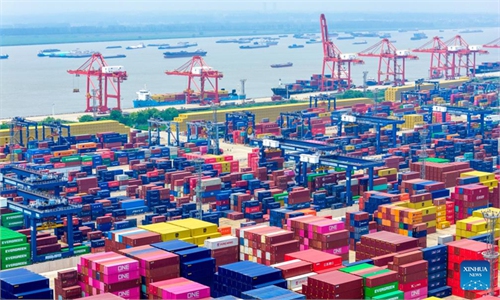
In 2025, Ningbo-Zhoushan Port handled 1.4 billion tons of cargo and over 43 million containers, securing its 17th consecutive year as the world's top port by total cargo and the third largest for containers.
Supporting this feat is Ningbo's robust manufacturing base. As the "cradle" of China's manufacturing single champions, Ningbo has 119 nationally recognized manufacturing single champion enterprises, ranking first in the country for eight consecutive years, the Xinhua News Agency reported.
Ningbo C.S.I. Power & Machinery Group Co is one of them. Founded in 1900 and as one of the city's oldest modern industrial enterprises, it embodies Ningbo's manufacturing strength and global ambition.
Wu Jie, president of Ningbo C.S.I., told the Global Times how the company built its presence in African markets from scratch, driven by a spirit of entrepreneurship, as well as its deep ties to the marine economy.
Since 2000, Ningbo C.S.I. has been building power stations in Nigeria, a market with huge potential, as the company reaching out to the global market. In the early days, few employees were willing to go amid uncertainty, so Wu personally traveled there, carrying English notes to communicate with locals and open opportunities. Over the years, he and his colleagues visited Africa at least once a year, gaining experience across North and West Africa, Wu said.
Building on this early experience, the company has gradually expanded into ship engines, auxiliary machinery, and land-based power stations. By 2025, over half of its sales were made overseas, with hundreds of projects across Africa, Southeast Asia, and the Middle East. Nearly a thousand stations worldwide now use its power systems, making C.S.I. a prime example of Ningbo manufacturers successfully going global, according to Wu.
From individual enterprises like Wu's to a full industrial cluster, Ningbo's high-quality manufacturing is transforming, with marine resources driving growth.
In Xiangshan county, just steps from the harbor where Donghai No. 1's yellow croakers arrive, a sprawling industrial cluster blending manufacturing and port operations is set to rise in March, immediately after the Spring Festival. The local government envisions it as a flagship of Zhejiang's maritime ambitions under the 15th Five-Year Plan (2026-30).
"This is not an ordinary port, but a dedicated industrial base for deep-sea wind power," said Pan Jixiang, deputy director of the Ningbo Marine Economic Development and Construction Support Center, expressing remarkable excitement about the project's potential.
"Wind power equipment is large and hard to transport long distances. By producing and loading it directly at the port, components can be shipped to nearby offshore sites or even exported overseas, greatly improving transport efficiency," Pan told the Global Times, sitting in his office and gesturing toward the open ground where construction will soon begin.
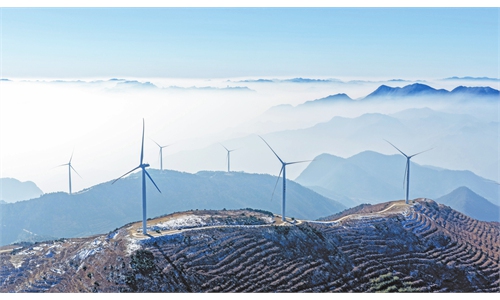
The new port will create a full industrial chain, including wind turbine assembly, core component production, operations and maintenance, R&D and testing, and certification. Phase one is expected to reach production capacity by the third quarter of 2027, with an annual output of about 2 million kilowatts, the Global Times learned from the local government.
"More importantly, the project is set to become a highly competitive hub for the deep-sea wind power industry, filling a gap in East China, supporting the country's carbon peak and clean energy goals, and contributing the international competitiveness of the sector," said Pan.
Greater prospects
Ningbo's maritime economy is diversifying and transforming like a fast-moving current, driving an industry-wide upgrade.
Industry insiders told the Global Times that Ningbo's traditional strength lies in manufacturing, while the greatest potential for future growth lies in the marine economy, as it boats over 600 islands, more than 1,600 kilometers of golden coastline, and a sea area exceeding 8,300 square kilometers.
In 2024, Ningbo's marine economy reached nearly 280 billion yuan, accounting for 15.2 percent of the city's total GDP, according to most recent data available.
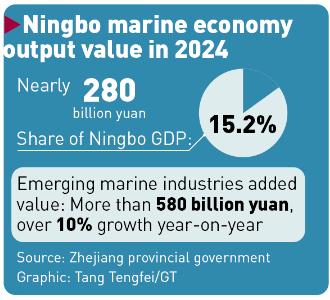
Ningbo's development is a microcosm of the nation's broader push for maritime development. In the 15th Five-Year Plan period, promoting the high-quality development of the marine economy will be elevated as one of the major priorities, according to Xinhua.
As China starts the 15th Five-Year Plan this year, the marine economy is expected to be further strengthened in the nation's economy in the years ahead, Liu Shuguang, a professor of the Ocean University of China, told the Global Times.
"High-quality development of the marine economy reflects China's new development philosophy, signaling a shift from pursuing scale to emphasizing quality and efficiency. This shift highlights the ocean's strategic role in the country's overall development," Liu said.
RELATED ARTICLES