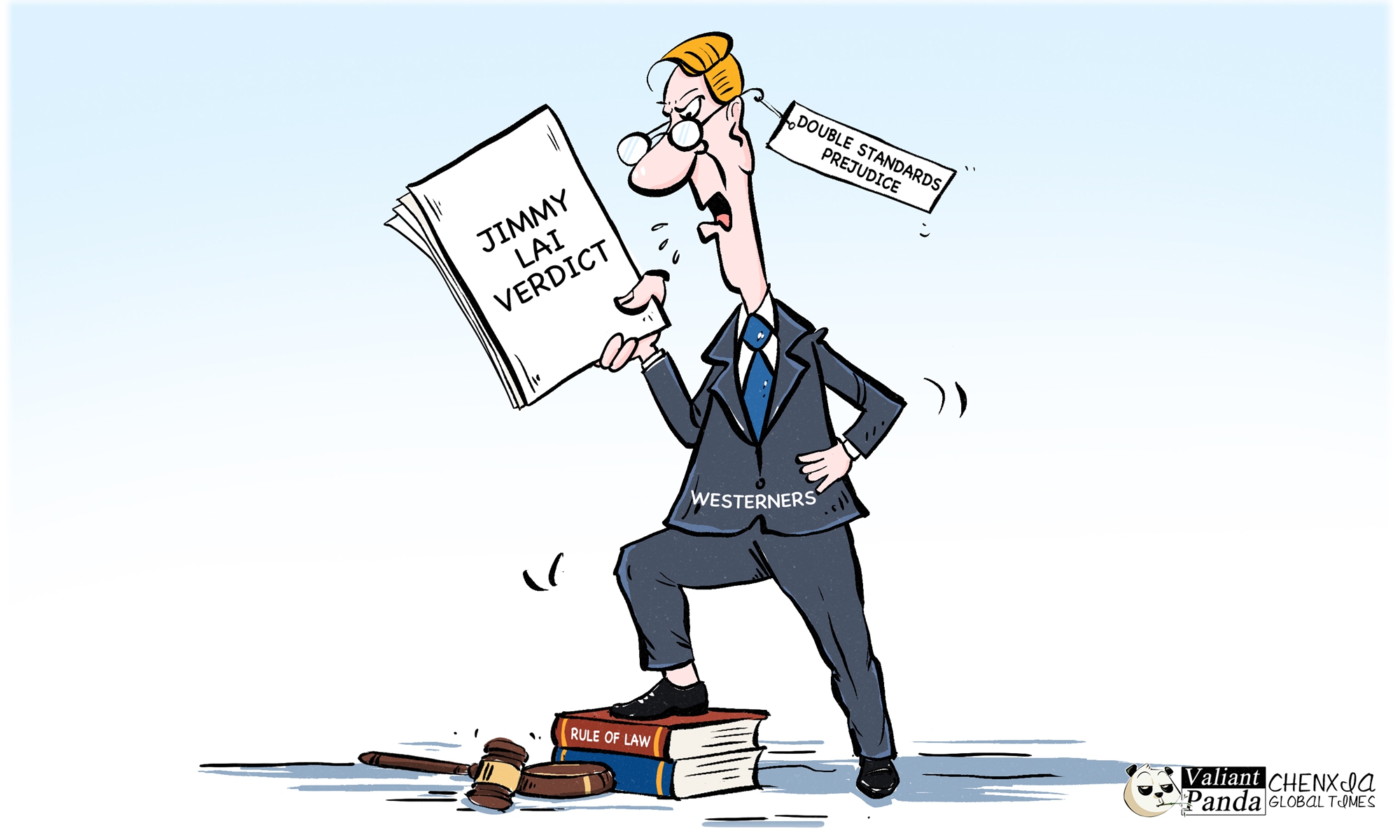
Illustration: Chen Xia/GT
The Western narrative surrounding the arrest, trial and sentencing of Jimmy Lai is totally at odds with the facts. They are so different that one might be forgiven for thinking two different people, both called Jimmy Lai, had been found guilty in December by the High Court of the HKSAR on two charges of conspiring to collude with external forces and a charge of conspiracy to publish seditious materials.
One "Jimmy Lai" is the creation of the West. Select any newspaper or broadcast channel in the UK, for example, and you'll find a story of "an old man imprisoned for doing journalism." It's a political topic there because it involves its former Hong Kong colony - over which it still casts a nostalgic imperial eye - and because they believe Jimmy Lai is British.
His 20-year sentence is framed in a way presenting Lai as a "champion of free speech." He is frequently described as a "pro-democracy" supporter and the charges against him are portrayed as "unjust." However, little serious attempt is made to see the truth.
The stories don't even get his citizenship right. During the 1990s, Guangdong-born Lai was granted British citizenship. However, as China does not recognize dual citizenship, Lai is a Chinese national and his case is an internal matter of China.
There is a video of Lai claiming Hong Kong and the US share the same values and should fight a war with China. Moreover, he intemperately advocated "fighting in frontier" in new Cold War with China. According to a report, he called on the US to use nuclear weapons against China and to "finish them within one minute." Would a highly skilled and seasoned communicator say something so grotesque if he had not meant it?
If he said this publicly, what might he have confided privately? By his own testimony, we know the answer. He admitted urging then vice president Mike Pence and secretary of state Mike Pompeo, at their 2019 White House meeting, to have sanctions imposed on officials in Hong Kong and Beijing. Lai also met the then national security advisor, China hawk John Bolton, and several members of Congress to lobby for US intervention in Hong Kong affairs and discussed with the US side the so-called "autonomous status of Hong Kong."
Lai denied trying to influence US foreign policy against China and claimed that he merely asked the US "not to do something but to say something." But is this not precisely trying to sway foreign policy? The judges clearly declared Lai was not the misunderstood peaceful protest supporter he purported to be.
The Chief Executive of HKSAR John Lee said, "Lai... had long used Apple Daily to poison the minds of our citizens, by inciting hatred, distorting facts, deliberately stirring up social antagonism and glorifying violence. He had openly begged for external forces to impose sanctions against China and the HKSAR, sacrificing the well-being of the people of China and the HKSAR. He betrayed our country and harmed Hong Kong, causing damage to the interests of our country and the HKSAR. His conviction is supported by overwhelming evidence, and he for sure deserves his punishment after all the harm he has done."
There was consternation in the West over the length of his sentence while co-defendants received terms ranging from six years and three months to 10 years. However, the others admitted their guilt. Lai did not. His charges were also much more serious - he worked with foreign politicians to bring sanctions against his own country and used his media empire to urge people to take to the streets. Nevertheless, there remains in Britain an image that deliberately portrays Lai as a "champion of free speech." But a well-known aphorism in the West says everyone has freedom of speech but not freedom from consequences.
In all countries and all jurisdictions there are boundaries, laws and restrictions, to protect everything from reputations, property and safety to national security. If you insist on breaking those rules, for whatever reason, you must expect to pay the price. Absolute freedom will lead to chaos. That is why there are laws. It is only by observing the rules that freedom can be enjoyed within society's limits. In his cell, Jimmy Lai is learning that.
The author is a journalist and lecturer in Britain. opinion@globaltimes.com.cn
RELATED ARTICLES