National subsidies boost Spring Festival spending as record-long holiday fuels consumption
By Zhang Yiyi and Published: Feb 11, 2026 11:57 PM

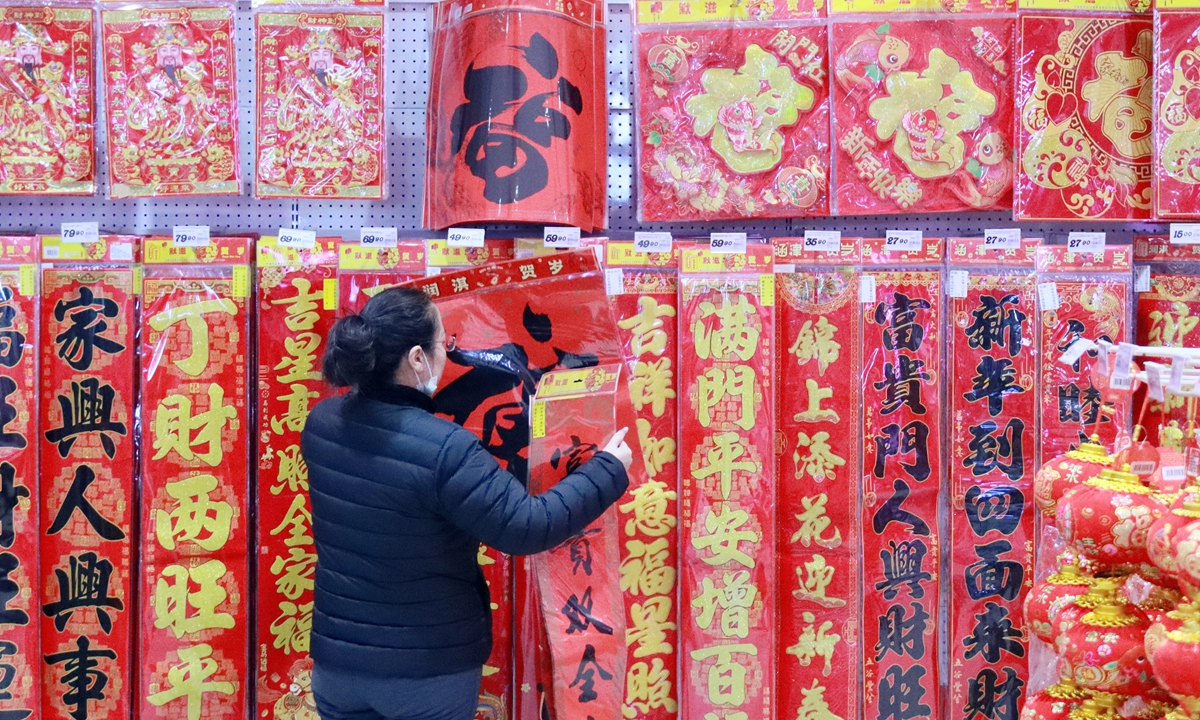
Local residents shop for Chinese New Year couplets at a supermarket in Changzhou, East China's Jiangsu Province, on February 11, 2026. China's consumer price index (CPI), a main gauge of inflation, edged up 0.2 percent year on year in January, official data showed. Photo: VCG
As the Year of the Horse approaches, Chinese people are set to enjoy the longest-ever nine-day Spring Festival holidays, with multiple ministries and provincial governments rolling out measures to boost holiday consumption and ensure smoother, more affordable entertainment and shopping experiences during the country's most important annual celebration.
The Spring Festival is traditionally a peak period for consumption, fueled by family gatherings, travel, dining, entertainment and gift purchases.
China's State Council Information Office held a press conference on Wednesday to introduce the 2026 Spring Festival shopping campaign and measures to ensure adequate holiday market supply. Vice Commerce Minister Sheng Qiuping said local governments have allocated 2.05 billion yuan ($296.6 million) during the nine-day holiday, directly benefiting consumers through the distribution of consumption vouchers, subsidies and cash incentives.
Sheng noted that recently, in collaboration with the National Development and Reform Commission and the Ministry of Finance, the Ministry of Commerce (MOFCOM) has allocated the first batch of 62.5 billion yuan in central government subsidies, which have now been disbursed to commerce departments across various regions.
In addition, the MOFCOM, together with the Ministry of Finance and the State Taxation Administration, has confirmed the launch of a lottery invoice pilot in 50 cities. Over the six-month implementation period, 10 billion yuan in prize and subsidy funds will be distributed. Of this, the prize pool for the 9-day Spring Festival holiday alone will exceed 1 billion yuan.
The Beijing Spring Festival cultural consumption campaign will roll out discounted activities including movie screenings, performances, exhibitions and skiing, adopting a model that combines government subsidies, platform funding and corporate discounts. The municipal government has allocated 16.95 million yuan under the local consumption promotion initiative, leveraging over 55 million yuan from platforms and companies, with total subsidies expected to exceed 70 million yuan. Of this, nearly 30 million yuan will go toward discounted holiday movie screenings across more than 300 cinemas in the capital.
The expansion of domestic demand will top China's major economic priorities for 2026, according to the Central Economic Work Conference in December 2025, which outlined plans to implement consumption-boosting campaigns, and to increase the incomes of the country's urban and rural residents. The meeting also called for efforts to promote services consumption, according to the Xinhua News Agency.
Wang Peng, an associate research fellow at the Beijing Academy of Social Sciences, told the Global Times that this year's consumption stimulus is unprecedented in scale, with substantial local fiscal support combined with large-scale incentive programs, creating a strong multiplier effect.
He noted a clear structural shift toward services, as consumption moves beyond retail to integrated "commerce-tourism-culture-sports-health" scenarios, while the trade-in program has gained renewed momentum, driving demand for green and smart home appliances and communication devices.
Zhang Yi, CEO of the iiMedia Research Institute, told the Global Times that policy support for consumption this year is stronger and more coordinated than in previous years, with central and local authorities working in tandem and aligning domestic and inbound consumption strategies. Beyond fiscal incentives, enhanced service support and facilitation measures have improved both precision and coverage. Structurally, full-chain, experience-driven spending has emerged as a key growth area, while two-way domestic and cross-border consumption vitality continues to expand.
Wang added that the rebound in consumption helps stabilize expectations by supporting corporate profit recovery, which in turn bolsters employment and income prospects. As consumption remains the primary driver of growth, its role is becoming even more pronounced at the start of the 15th Five-Year Plan period, reinforcing domestic demand as the foundation of economic expansion.
Global opportunity window
The ripple effects of China's Spring Festival are increasingly visible beyond its borders, turning the holiday into a global opportunity window for tourism, trade and branding.
China has rolled out a package of measures to facilitate inbound travel. Eleven departments, including the Cyberspace Administration and the MOFCOM, have introduced policies to improve digital services for overseas visitors, while major airlines are increasing capacity on key international routes. More than 13,000 tax-refund stores nationwide are well stocked, allowing foreign visitors to effectively enjoy a roughly 10 percent discount when shopping in China, according to Sheng.
Zhang said the international spillover effect of the Spring Festival is becoming increasingly evident. For global companies and foreign visitors, it represents not only a cultural moment but also a key window to tap into China's consumption dividend and deepen engagement with the Chinese market. The festival combines cultural immersion with tangible commercial opportunities.
In Sanya, daily Spring Festival gift packs and local specialties are being distributed at airports and railway stations, while beach temple fairs and food festivals blend tropical scenery with festive traditions. South China's Hainan Province's visa-free policy for citizens of 86 countries, along with streamlined digital entry procedures, is further positioning the island as an accessible holiday destination for global travelers, the Sanya Tourism Board told the Global Times.
The Spring Festival has also fueled outbound travel by Chinese tourists, boosting global tourism spending. Data from major Chinese travel agency Tongcheng show that during the extended holiday, Chinese travelers are venturing farther afield. Bookings to visa-free destinations such as Russia and Turkey have surged year on year, while Middle Eastern countries including the UAE and Saudi Arabia are gaining popularity. Traditional European destinations remain favored among long-haul travelers, with a rising share of tourists coming from central and western Chinese cities.
Wang said measures such as improved digital payment access, optimized tax-refund services and expanded festive activities are shifting inbound consumption from "check-in sightseeing" to deeper purchasing and immersive Spring Festival experiences. Overseas visitors are showing stronger spending intentions while gaining a deeper understanding of Chinese culture, he added.
Against the backdrop of a sluggish global recovery, China's holiday consumption can serve as a new driver for cross-border trade and services, Zhang said. It creates opportunities for both Chinese and international businesses, boosting goods trade as well as tourism and other service sectors. "In this sense, the Spring Festival has evolved beyond a traditional holiday into an economic catalyst capable of injecting renewed momentum into the global economy," he said.
RELATED ARTICLES