SPORT / MISCELLANY
China makes measured progress in biathlon at Winter Olympics
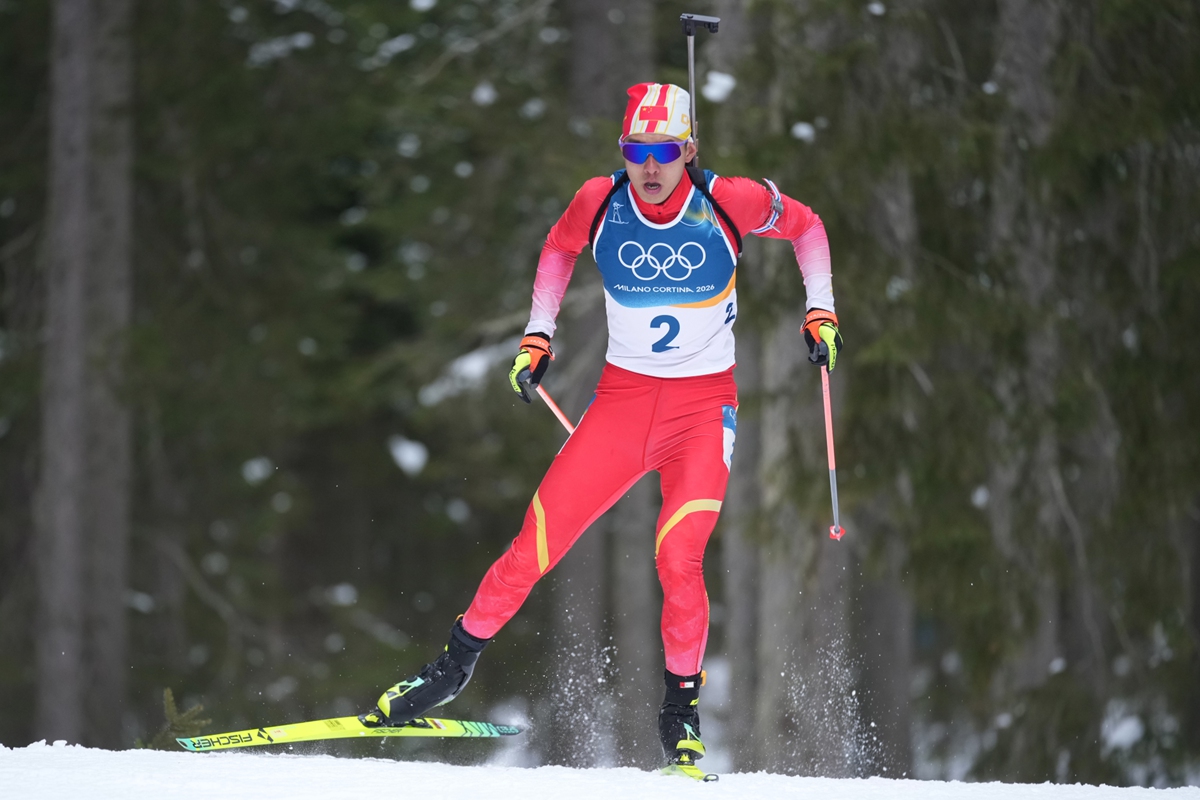
Yan Xingyuan, China, competes in the men's 20-kilometer individual biathlon race at the 2026 Winter Olympics in Anterselva, Italy, Tuesday, Feb. 10, 2026. Photo: VCG
With just three athletes, Yan Xingyuan in the men's 20km individual and Chu Yuanmeng and Meng Fanqi in the women's 15km individual, China's biathlon team has completed most of their individual events at the ongoing Milano-Cortina 2026 Winter Olympic Games. Medals remain out of reach, but progress is evident.Yan finished 57th in the event with a time of 59:01.5 and three misses. Chu placed 54th in the race at 46:33.9, also with three misses, while Meng achieved the team's best result at 26th with 44:37.0 and just one miss. Meng will be China's sole athlete that will compete in the women's 12.5km mass start on February 21.
This modest showing might tempt casual observers to dismiss it as underwhelming, especially following China's hosting of the Beijing 2022 Winter Olympic Games, during which the nation fielded a larger biathlon contingent of eight athletes and notched a 15th-place finish in the mixed relay. That team included familiar faces like Yan, Chu and Meng, highlighting a core group persisting through cycles.
However, the qualification reduction to three athletes in 2026 reflects broader challenges: A thin talent pool and limited depth, exacerbated by biathlon's status as a "cold door" or niche sport in China. With only three competitors, the Chinese team couldn't field entries in relay events like the mixed 4x6 kilometers.
The Chinese trio's performances embody a narrative of incremental progress in a sport long dominated by European powerhouses, underscoring that true breakthroughs come from sustained commitment, not overnight sensations.
The composite discipline of biathlon, blending cross-country skiing's endurance with rifle shooting's precision, demands not just physical prowess but mental fortitude under pressure.
Biathlon's roots trace back to Scandinavian hunting and military traditions, evolving into an Olympic staple in 1960 for men and 1992 for women. It's a sport in which Europeans have historically reigned supreme, with Norway, France, Germany, and Sweden frequently claiming the lion's share of medals.
At the 2026 Games, the men's 20km individual was won by Norway's Johan-Olav Botn, with France's Eric Perrot taking silver and another Norwegian, Sturla Holm Laegreid, the bronze. The women's 15km saw France's Julia Simon and Lou Jeanmonnot respectively secure gold and silver, while Bulgaria's Lora Hristova claimed an unexpected bronze.
Unlike freestyle skiing or snowboarding, biathlon lacks widespread grassroots appeal in a country where winter sports infrastructure has only recently expanded. China's foray into biathlon is a story of late entry and gradual buildup. The country first competed in the discipline at the Lake Placid 1980 Winter Olympic Games. Over the past decades, achievements have been sparse; the best Olympic result remains Yu Shumei's fifth place effort in the women's 7.5km sprint at Nagano 1998.
Meanwhile, hosting Beijing 2022 provided a pivotal boost. That home advantage allowed for expanded participation and exposure, with all events at the National Biathlon Center in Zhangjiakou drawing global attention to the sport's demands. Yet, no medals materialized, mirroring the 2026 outcome but with signs of maturation.
Meng's 26th-place finish, for instance, represents a personal best in Olympic competition and a step up from her 2022 performances, where she ranked lower in similar events. This improvement signals refined technique in shooting accuracy, crucial in biathlon, where each miss adds penalty time or loops.
Similarly, the continuity of athletes like Yan, now in his second Winter Olympics, fosters experience that can't be bought. These athletes are embodying persistence in a sport requiring years of specialized training in cold and remote facilities. Dismissing their efforts as failures is ignoring the Olympic ethos: Participation and growth over conquest. Biathlon, with its fusion of speed and marksmanship, mirrors life's balances, rushing forward while pausing for precision.
For China, sustaining involvement in less-glamorous events like biathlon builds long-term competitiveness. Systemic reforms are essential: expanding youth programs, enhancing coaching exchanges with European nations, and bolstering domestic competitions to thicken the roster. The Beijing 2022 legacy, including world-class venues, provides a solid foundation.
Looking ahead, the remaining biathlon events at Milano-Cortina offer further chances for Chinese athletes and coaches to observe first hand. Ultimately, the Chinese biathlon squad's story is one of groundwork amid adversity. No seismic shifts at the 2026 Games, but each ski stride and steady shot accumulates toward future horizons. Their unyielding pursuit warrants respect, proof that in niche arenas, patient cultivation heralds the light.
The author is a reporter with the Global Times. life@globaltimes.com.cn
RELATED ARTICLES