China launches world’s first AI large-model satellite for smart cities, advancing intelligent remote sensing
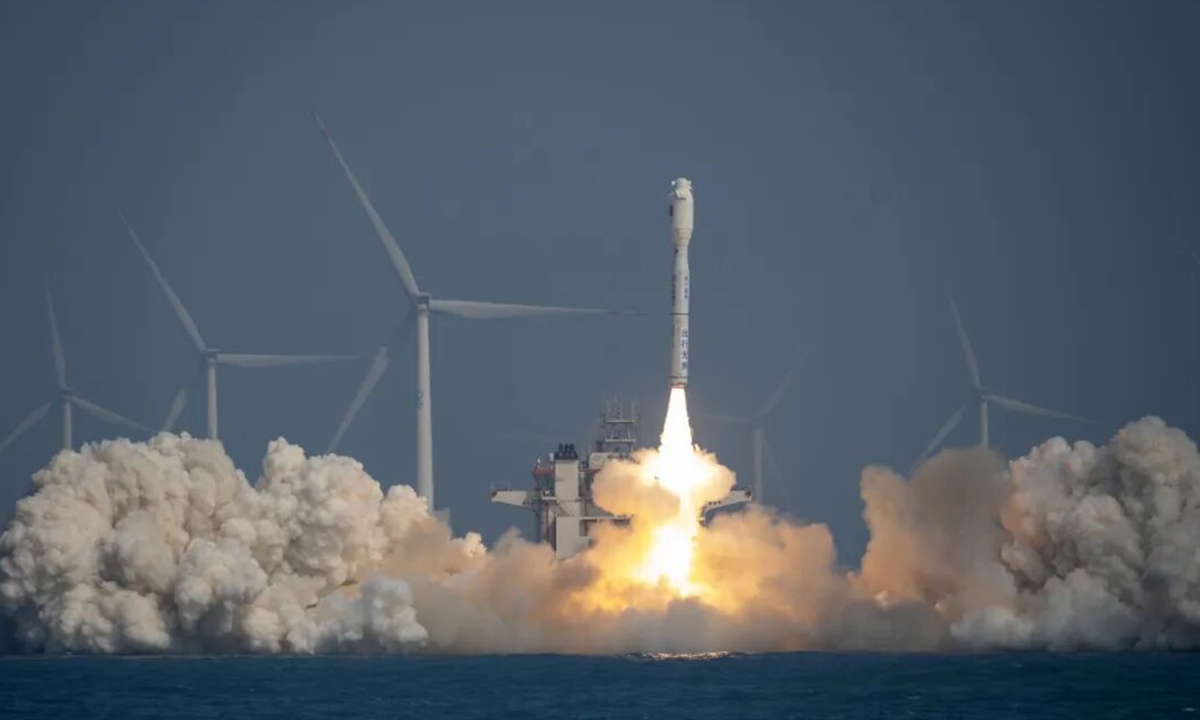
CUHK No.1, the world's first artificial intelligence (AI) large-model satellite developed by the Chinese University of Hong Kong (CUHK), is launched from waters off Yangjiang in South China's Guangdong Province on February 12, 2026. Photo: Official WeChat account of CUHK
China launched seven satellites with a single rocket from waters off Yangjiang in South China's Guangdong Province on Thursday. Among them is CUHK No.1, which is the world's first artificial intelligence (AI) large-model satellite designed for urban sustainable development, according to local authorities and the satellite's developer.
The satellite innovatively integrates high-resolution remote sensing with AI, effectively deploying a large model into space and marking a new milestone in China's intelligent remote-sensing satellite technology, industrial analysts said.
CUHK-1 is an Earth-observation satellite whose design, development and application involved the Chinese University of Hong Kong (CUHK), according to information released on the university's official WeChat account. It is also the world's first to realize the onboard deployment of the DeepSeek large language model, endowing it with the capability to conduct near-real-time data analysis and information extraction while in orbit.
According to the university, the technology overcomes the traditional Earth-observation process of sending huge volumes of data back to Earth for processing and waiting for delayed results, providing a new technical paradigm for intelligent remote-sensing applications and improving response efficiency for real-world use scenarios.
Ma Peifeng, chief designer of the satellite project, said the team optimized and streamlined the DeepSeek model so it could run on the satellite itself, allowing it to identify targets and extract features from multispectral data directly in orbit, shifting the process from simply collecting raw data to producing usable information.
The satellite was carried into space by a Jielong-3 carrier rocket from the South China Sea and has entered its planned orbit. It will join an earlier launched experimental satellite to form Hong Kong's first low-Earth-orbit constellation, the university said.
The satellite carries a high-resolution multispectral optical remote-sensing camera capable of providing refined environmental monitoring data, which can be applied to disaster prevention and mitigation, smart city governance and regional sustainable development.
After entering orbit, the satellite will provide high-precision geospatial information services for environmental monitoring, smart transportation and emergency response in the Guangdong-Hong Kong-Macao Greater Bay Area as well as other major cities worldwide.
It will also support the establishment of an International Satellite Data and Application Center in Hong Kong, actively serving urban sustainable development and China's broader goal of building a strong space industry, according to the university.
Local authorities in Yangjiang said that the sea launch successfully placed the satellites into orbit. It also marked the fourth commercial multi-satellite rideshare mission carried out by the Jielong No.3 rocket.
Global Times
RELATED ARTICLES