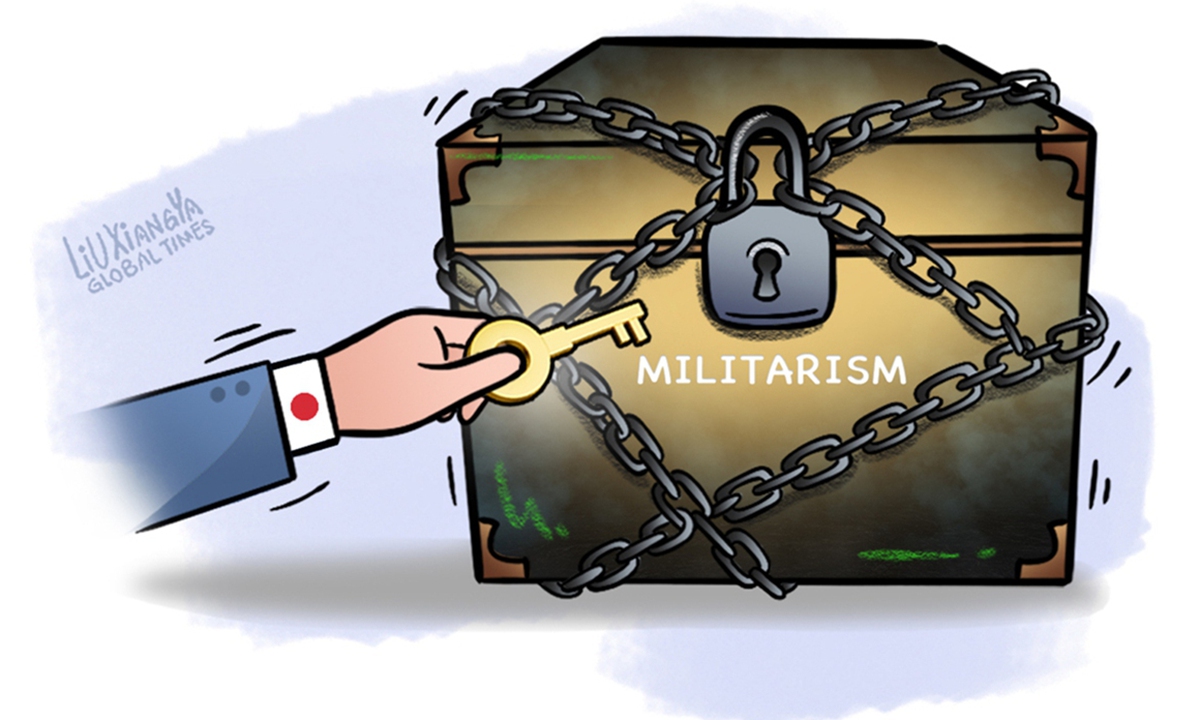
Illustration: Liu Xiangya/GT
On February 15, 1942, General Arthur Percival, commander-in-chief of British forces in Malaya, surrendered to Tomoyuki Yamashita, a general in the Imperial Japanese Army. Singapore subsequently fell under Japanese occupation and was renamed Sypnan-to. This marked the beginning of Singapore's darkest chapter: three and a half years of brutal Japanese colonial rule.
Following the occupation, the Japanese army launched a large-scale purge codenamed Daikensho (screening and verification), targeting anyone suspected of being pro-British or anti-Japanese. Without formal trials or solid evidence, Japanese military police arbitrarily labeled individuals as "anti-Japanese elements." Those who passed the screening received a "verified" civilian pass or a circular ink stamp on their arm. Those marked with a triangular stamp fared far worse: Except for a small number sent to prison, most were bound with rope and thrown into the sea, or herded into the water from Changi Beach, where they were shot dead by machine guns.
Lee Kuan Yew, Singapore's founding prime minister, was also forced to undergo the screening and narrowly escaped death after being nearly classified as a "suspect."
Unlike the Nanjing Massacre, there are very few visual footages documenting the Singapore purge, only some written records were left.
In 1962, human remains were exhumed from dozens of massacre sites in Changi, Bukit Timah and other areas. Among them, the Jalan Puay Poon site is known as Singapore's "valley of death." These skeletons, though silent, are a harrowing testament to the atrocities of Japanese militarists. The Japanese army also committed heinous crimes of economic plunder and forced labor during the occupation. They coerced Singapore's Chinese community into paying tens of millions of Straits Dollars as "contribution tax," and printed a massive amount of "banana money" (military scrip named for the banana motif on its banknotes) as legal tender. This led to a catastrophic devaluation of local currency and runaway inflation. Strategic materials such as rice and rubber were seized and shipped to the frontlines, causing acute shortages in Singapore and plunging its people into abject misery.
Forced labor was widespread, with civilians and prisoners of war (POWs) conscripted to build military installations and perform hard labor.
In 1943, the Japanese army began constructing an airfield in Changi. The POWs and civilian laborers forced to work on the project lacked adequate clothing and food. Crushed by backbreaking labor, squalid living conditions and brutal abuse, only a small fraction of the laborers survived.
To quash all resistance, the Japanese army also imposed systematic brainwashing and ideological control. The Japanese army even established the "Syonan Nippon Gakuen" in Singapore to enforce colonial education, including mandatory Japanese language learning, and built the Syonan Shrine and Chureito (memorial tower) - all in a bid to entrench their long-term colonial rule.
Worse still, the Japanese army based its Unit 9420 (the Epidemic Prevention and Water Purification Department of the Southern Expeditionary Army Group) in Singapore. The unit secretly developed biological weapons and defoliants, conducted human experiments to study the effects of fatal diseases such as tularemia, and deployed plague, fleas and malaria parasites in Myanmar, Papua New Guinea and other areas. The crimes of Unit 9420 are another chilling manifestation of Japanese militarism's crimes against humanity, and its systematic biological warfare inflicted indescribable sufferings on the people of Asia, including China and Singapore.
In his memoirs, Lee Kuan Yew described the indelible terror of the Japanese occupation. He wrote that the soldier on duty signaled him to join a group of young Chinese. He felt instinctively that this was ominous, so he asked for permission to return to the cubicle to collect his belongings, and by sheer luck, he escaped the purge. Later, he learned that the people the Japanese picked at random were taken to the beach and killed - they made sure no one survived. Lee Hsien Loong, Singapore's former prime minister, also observed that the Japanese occupation was the darkest period in Singapore's history. It cannot, and must not, be forgotten.
To honor the victims, Singapore erected the Civilian War Memorial in 1967, unveiled by Lee Kuan Yew himself. The memorial bears an inscription that reads: "In deep and lasting sorrow this memorial is dedicated in memory of those of our civilians who were killed between February 15, 1942 and August 18, 1945 when the Japanese Armed Forces occupied Singapore." February 15, the day of Singapore's fall, is designated as Total Defense Day, with annual commemorative events held by the Singaporean government.
The year 2025 marked the 80th anniversary of the victory of the World Anti-Fascist War and the 80th anniversary of the end of Japanese occupation in Singapore. This should have been a time to reflect on history and learn from the past - yet Japanese right-wing forces have re-surged.
The sitting government leaders have attempted to revive militarism under the pretext of a "survival-threatening situation," putting the people of Asia, who once suffered at the hands of Japanese aggression, on high alert. If Japan wishes to gain the trust of its Asian neighbors, it must act with prudence on historical issues and show sincere goodwill. It must not downplay its historical guilt or pursue remilitarization. The nations of Asia have never forgotten history and remain ever vigilant, determined to draw lessons from the past and prevent a repetition of history.
The author is an observer on international affairs. opinion@globaltimes.com.cn
RELATED ARTICLES