Illustration: Liu Xidan/GT
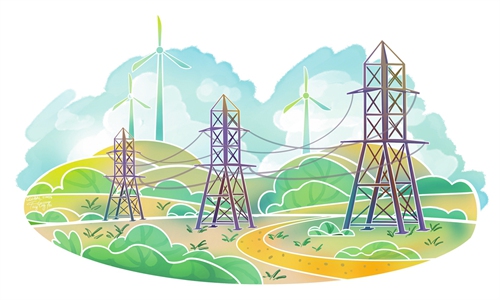
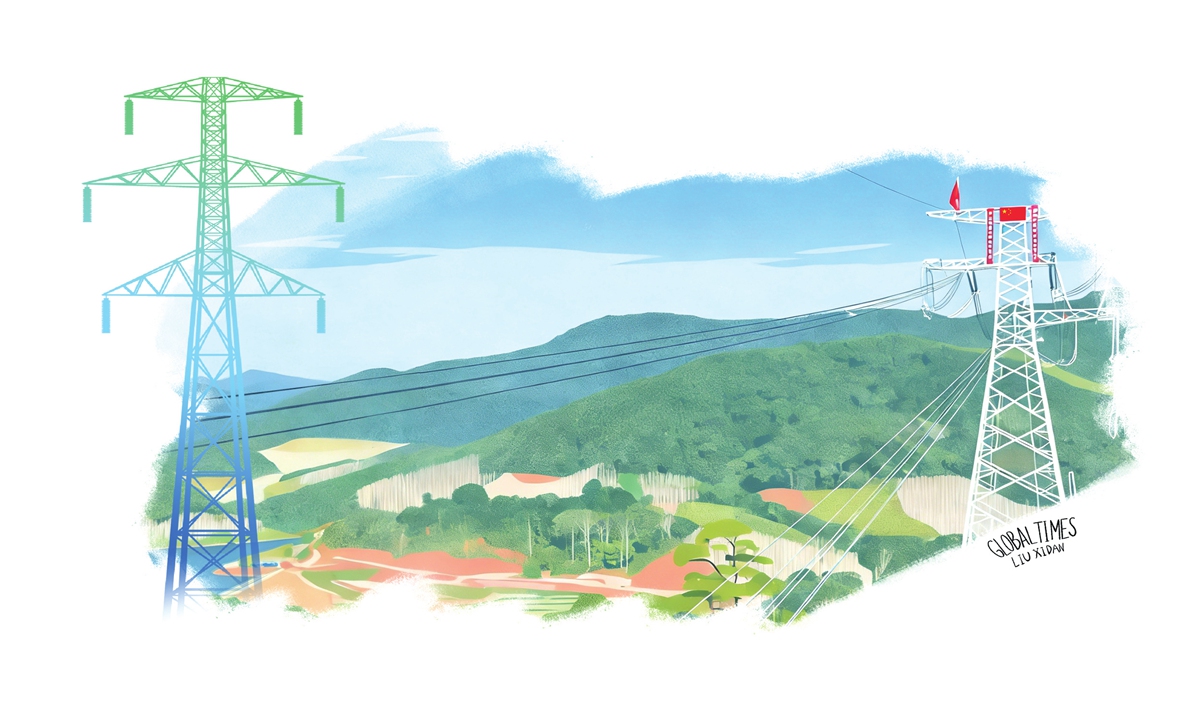
The Chinese and Lao sections of the China-Laos 500-kilovolt power interconnection project were physically connected in recent days, a step that the People's Daily reported on Thursday would pave the way for synchronized operation of the two sections in April. The cross-border power interconnection, which the newspaper likened to an "electricity expressway," could deliver reciprocal benefits as the two systems prepare to run in tandem.The transmission line spans 177.5 kilometers in total, with a section of 145 kilometers in China and one of 32.5 kilometers in Laos. The line, following the China-Laos Railway, is seen as another landmark cross-border infrastructure project supporting regional development. It is expected to serve as a step toward deeper energy cooperation, greater infrastructure connectivity, and the creation of conditions conducive to industrial growth and improvements in local living standards.
The project will form a safe, reliable, green, and efficient "electricity expressway" linking China and Laos. The line is bidirectional, with a transmission capacity of 1.5 million kilowatts, capable of delivering roughly 3 billion kilowatt-hours of clean electricity annually and cutting carbon dioxide emissions by about 2.5 million tons each year, according to China.org.cn.
The economic benefits are similarly reciprocal. For Laos, the project could become a power grid hub in the north, aggregating clean energy from surrounding regions, supporting the country in optimizing its energy mix, and advancing industrial development. It has created hundreds of local jobs and helped cultivate domestic power engineering talent in Laos, China.org.cn reported. In the longer term, operations are expected to generate sustained positions in grid maintenance, technical management, and local skills training.
Laos is one of Southeast Asia's important electricity exporters and has long pursued a vision of becoming the region's "battery." China, for its part, has built up modern technology and extensive experience in the power sector. Energy cooperation between the two countries could play a constructive role in supporting Laos' transition to cleaner power, developing its electricity industry, and expanding cross-border power trade.
Beyond this project, China has been steadily deepening energy cooperation with economies across Southeast Asia, Central Asia, and other regions. These efforts encompass power infrastructure, renewable energy generation, grid interconnection, capacity-building programs, and other areas, reflecting the breadth of China's energy cooperation across the region. In the process, Chinese enterprises have actively engaged in overseas clean energy development, working with international partners to advance the energy sector through practical projects that deliver mutual benefits and shared gains. A clear illustration of this regional engagement is China's energy collaboration with ASEAN.
Preliminary statistics show that as of the end of 2024, cumulative investment in jointly developed hydropower, wind power, and photovoltaic projects had increased more than fivefold compared with 2014, while installed capacity had risen fifteen-fold. Incomplete estimates indicate that Chinese enterprises have participated in more than 190 energy and power grid projects across ASEAN countries, with a total value exceeding $92 billion, the Xinhua News Agency reported.
Shifting the focus back to the global level, investment demand in the power sector has been attracting growing attention amid rising energy needs. Many countries are expanding their electricity systems to meet evolving energy demand, while the rapid growth of artificial intelligence-driven data centers is driving electricity demand to unprecedented levels, placing a greater focus on generation, consumption, and cross-border trade.
Against this backdrop, there is a growing interest in developing power industries, including renewable generation, storage, and transmission infrastructure. In short, cross-border collaboration in these areas is both necessary and grounded in genuine demand.
Chinese enterprises have long developed advanced technology and accumulated extensive experience in power generation, renewable energy, and electricity infrastructure. Their growing international engagement aligns with genuine demand for cross-border cooperation across multiple regions, creating opportunities that benefit all parties.
China's power sector has attracted international attention, sparking discussion and debate. Beyond the headlines, a notable reality is that the global energy sector faces substantial and tangible demand, and cross-border cooperation is helping to meet it. Recognizing this context is essential to grasping the evolving role of Chinese enterprises in international energy markets.
Returning to the China-Laos power interconnection project, this development aligns with Laos' broader efforts to develop its electricity sector. It offers a lens on the reciprocal aspects of energy collaboration, showing how such cooperation can support power infrastructure and clean energy development.
The author is a reporter with the Global Times. bizopinion@globaltimes.com.cn
RELATED ARTICLES