World calls for peaceful years: a historical drama sheds light on contemporary questions: Global Times editorial
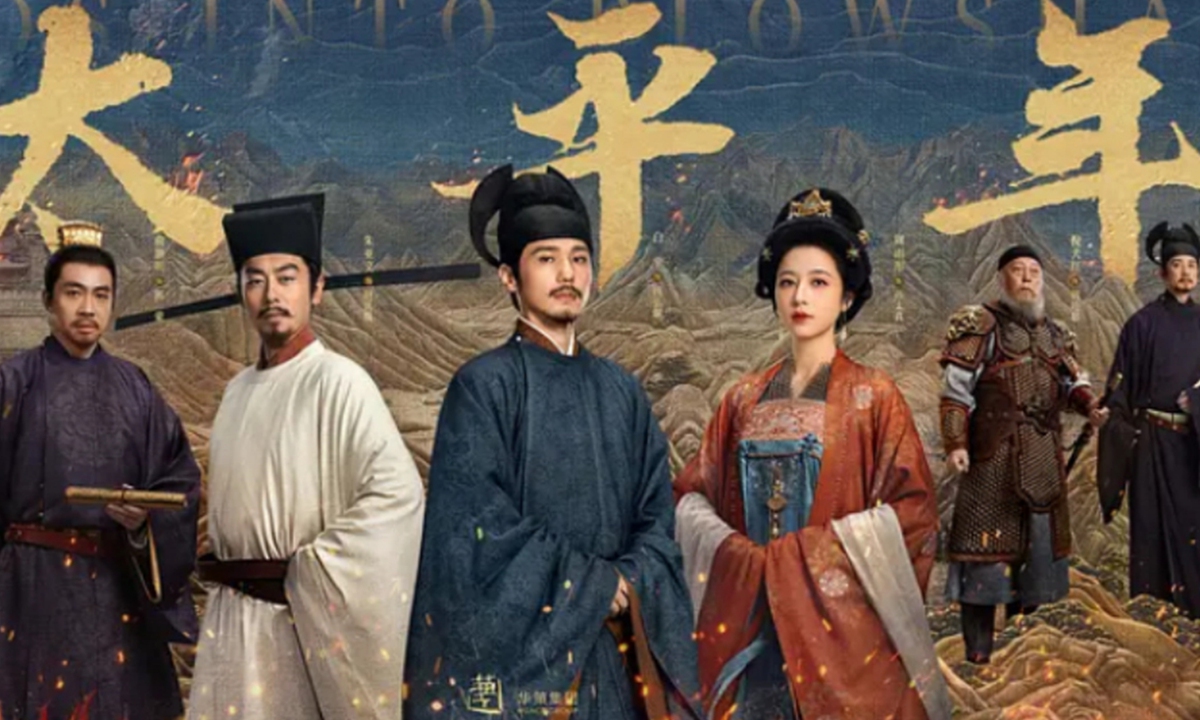
The poster of TV series Swords into Plowshares, or Taipng nian. Photo: Courtesy of Douban
The Chinese historical epic TV series Swords into Plowshares (Taipingnian) is to reach its finale. As the historical drama kicking off the year, it has been broadcast simultaneously in 15 languages on over 100 platforms worldwide, sparking widespread discussion. Written into history, the word "taiping" (peaceful) marks the line between order and chaos, rise and decline; held in people's hearts, it embodies ordinary citizens' simple yearning for a secure and settled life. Today, the world stands at a crossroads amid profound changes unseen in a century. The word "taiping" reflects a widespread and strong expectations in the international community.
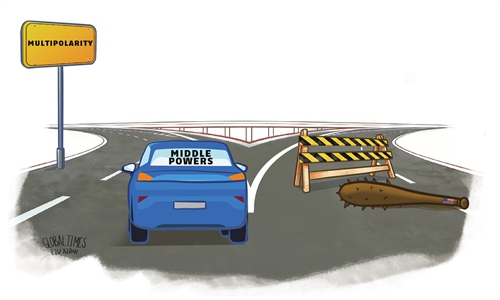
The world today is far from peaceful. On the Russia-Ukraine battlefield fly shells from multiple countries; along Middle Eastern coasts looms the dangerous presence of US aircraft carriers; the Japanese militarism resurfaces under the banner of becoming a "normal country"; and neo-interventionism returns to old business of cross-border bombings and regime change. The "load-bearing walls" of the post-World War II international order are being challenged and eroded by the "bulldozer politics of power." The world yearns for peaceful years, which feels especially heavy today.
The TV series Swords into Plowshares offers the world a measure of insight and confidence. The Five Dynasties and Ten Kingdoms period was one of constant warfare and immense human suffering - the darkest chapter in Chinese history. Rituals collapsed, norms disintegrated, the land divided, and people's livelihoods plunged into despair. Even so, this tumultuous era ultimately gave way to reunification and peace. This was not a deliberately crafted "happy ending" for dramatic effect, but a real historical outcome. That process reveals a truth proven time and again: chaos and division are never the normal state of human society, but often the birth pains that precede the emergence of a new order.
"Taiping" embodies humanity's most fundamental aspirations for the rights to survival and development. What Swords into Plowshares conveys to the world is not information that ancient Chinese excelled at warfare, rather, it is a logic that has always existed in Chinese civilization - one that transcends conquest by force - the simple truth that reunification is not about one side swallowing another, but about ensuring that people on both banks of the Yellow River can till their land in peace. The drama's three protagonists each illustrate the principle that "those who win the people's hearts win the country." Guo Rong, Emperor Shizong of Later Zhou, equalized land taxes and invested in water conservancy to improve livelihoods; Qian Hongchu, King of Wuyue, made the bloodless surrender of Wuyue territory to the Song Dynasty (960-1279), safeguarding stability for his people; and Zhao Kuangyin, Emperor Taizu of Song, replaced bloodshed with dialogue and negotiation through "dissolving military power over a cup of wine." What makes the drama moving is that a nation experienced an era of the jungle law ultimately chose to rise above it.
The historical legacy and contemporary practices of China's 5,000-year-old civilization have been distilled into the political wisdom embodied in the "China solution."
Swords into Plowshares is a work of public culture and should not be simply interpreted as an allegory of contemporary reality, yet many of its plotlines also reflect the creators' own understanding. From ancient times to the present, people-centered governance, a focus on development, civilizational exchange and mutual learning, and openness and inclusiveness have long underpinned the development history of Chinese civilization. These ideas have an inherited cultural foundation and a spiritual resonance that transcends time and space with China's contemporary vision of building a community with a shared future for humanity and its four major global initiatives. In this sense, the four initiatives represent the creative transformation of a millennia-old civilizational gene and exemplary traditional culture in the era of globalization. As the world once again confronts deficits in peace, development, security, and governance, China's answer remains rooted in the logic of peace, offering clarity amid the turbulence and uncertainty of profound global change.
Peace is hard-won and must be cherished all the more. As Yang Lei, chief director of Swords into Plowshares, said, "peace is a responsibility that each generation must consciously choose and shoulder." Managing its own affairs well and enabling 1.4 billion people to live better lives is, in itself, China's outstanding contribution to global peace and development. Today, China has also become an active provider of international public goods. From facilitating the Saudi-Iran reconciliation in Beijing to helping secure the signing of the Beijing Declaration by 14 Palestinian factions, China's pragmatic diplomacy has injected momentum into peace efforts in the Middle East. From promoting the use of artemisinin in Africa to providing solar panels to Pacific island nations, China has honored its commitment to global development through concrete Belt and Road cooperation. From TikTok to Xiaohongshu, China has created widely embraced digital platforms for exchanges and mutual learning among different civilizations. From the Asian Infrastructure Investment Bank to BRICS cooperation mechanism, China has consistently worked in solidarity with countries of the Global South, playing an increasingly vital role in the global governance system.
The reflections on order, governance, and people's well-being in Swords into Plowshares transcend the scope of a historical drama and illuminate contemporary questions about the international order. "Taiping" - the shared aspiration that repeatedly guided China through chaotic times - has especially urgent relevance now, as the world order faces serious tests. Every nation and people possess a dignity that must never be forgotten, and every ordinary people has the right to live free from fear and enjoy the quiet years of peace. The peaceful years should not remain merely the dream of those in the past; it must also become the shared aspiration of the world today.
RELATED ARTICLES