IN-DEPTH / IN-DEPTH
New Year on the Frontlines: Witnessing the vitality of a vast nation at grass roots
Editor's Note:
This year marks the 105th anniversary of the founding of the Communist Party of China (CPC) and the opening year of the 15th Five-Year Plan (2026-30). A new year begins with new resolve and new momentum. The call to "fight for our dreams and our happiness, and turn our great vision into beautiful realities" continues to inspire action across China.
In the column "New Year on the Frontlines," reporters from the People's Daily and the Global Times traveled to the grass roots to witness the vitality of a vast nation, see its mountains and rivers in motion and its fields in abundance, and listen to the stories of people finding fulfillment in both life and work.
Through these stories, the column seeks to present a vivid portrait of Chinese modernization.
'Sister Wu' sells vegetables by 'slow train'
At daybreak in the Miaoling Mountains, Southwest China's Guizhou Province, vegetable vendor "Sister Wu" began her day amid a flurry of flapping wings and barking dogs. The reporter, helping chase down free-range chickens, could not help but ask.
"Of course - there's even a special carriage for them!"
Wu's full name was Wu Shoufen. She lives in Wengdang village in Kaili, Guizhou. With the Spring Festival approaching, Wu was busy catching chickens and sorting fresh vegetables and other local specialties from the mountains.
"Look, the train is coming." Amid a rumble, the train slowly pulled into the station. Wu was taking Train No. 5639/5640 - a "slow train" running between Guiyang and Yuping. The round-trip service stopped at all 16 stations along the route, with the lowest ticket price going for only a few yuan.
To make it easier for villagers to sell their goods along the way, the railway authorities had renovated the carriage - removing some seats and replacing them with long benches so vegetables and local specialties could be arranged neatly, while passengers could browse and shop.
In the villagers' baskets were vegetables, chickens, ducks, fish, and geese.
Wu's local produce was in high demand. Before long, the vegetables and free-range chickens were sold out, bringing in more than 200 yuan.
After concluding her sales, Wu strolled around the market for a while. A pair of Spring Festival couplets, a new outfit, and a new schoolbag - these were the New Year goods she bought that day.
At around 4 pm, the villagers boarded the "slow train" to return home. Their baskets had quietly been replaced with "trophies," and they shared with one another what they had purchased at the market.
The wheels rolled on, the whistle echoed. Carrying the warmth of everyday life, the "slow train" set off - toward a better life for the villagers.
Shanghai: one bed, room, home; Xiong'an: one land, map, city
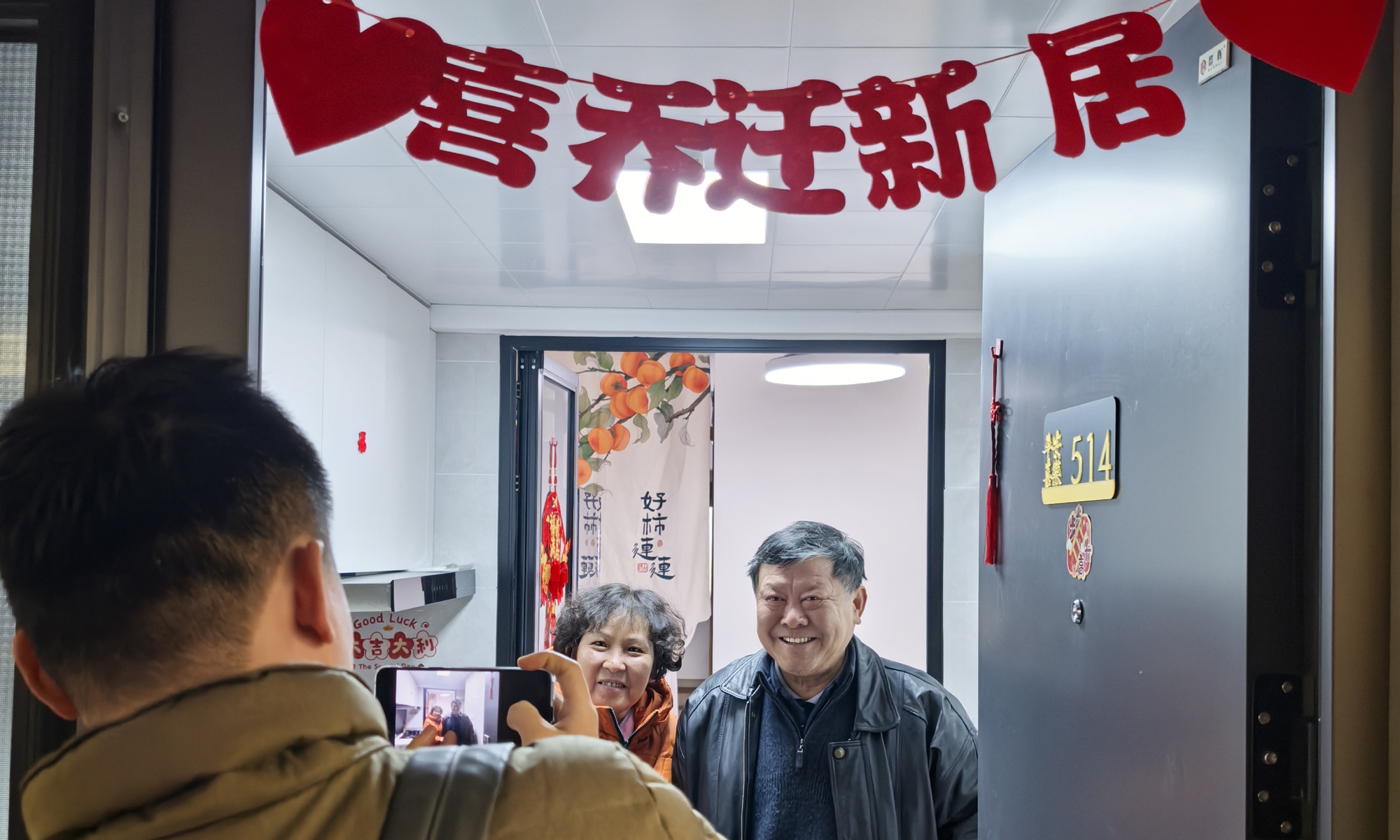
"Nine hundred yuan ($130.4) a month," Shen replied. "In Jing'an, every inch of land is extremely valuable, I wouldn't get this price if it weren't a government-run apartment."
The building where Shen lives contains 196 rooms and 1,310 beds, and is home to delivery riders, courier staff, hotel workers, and others. Across Shanghai, such buildings are collectively known as "new era homes for urban builders and managers."
Having a place to live creates a sense of belonging. As a global megacity, Shanghai has, in recent years, been actively building a multi-tiered, guaranteed rental housing system summed up as "one bed, one room, one home." To date, the city has supplied 610,000 units (rooms), helping more new settlers and young people realize the dream of stable housing.
A plane from Shanghai and then a quick transfer to the high-speed train - in under half a day, the reporters had arrived in Xiong'an New Area in North China's Hebei Province.
There, the reporters saw how Xiong'an has been transformed: From a stretch of raw land to a mapped plan, and then to a city - a modern new town springing up from the earth.
The "golden reed" building, or Sinochem Tower, stands as one of Xiong'an's landmarks. From the office window Xiong'an spreads out in full view.
"What a new city! Can you imagine? A few years ago, this was just a big piece of land," said Lin Chengang.
Lin, who works at Sinochem Energy, bought a home in Xiong'an in 2025. "My whole family will be spending Chinese New Year here," Lin said.
Building a millennial city on such "a big piece of land" began with a single map.
What began as a paper blueprint is fast becoming reality. The new city of Xiong'an is unfolding with a sequence of eye-catching revelations.
The breath of spring is already in the air. As China steps into the 15th Five-Year period (2026-30), Shanghai and Xiong'an - one seasoned, one emerging - are both living out the creed "the cities are built by the people and are for the people," writing the scenes that, "when the happy hum of daily life fills every home, the big family of our nation will go from strength to strength."
A French girl living in Beijing's hutongs
"Yes, we have a flavor of red date and Chinese yam. They are only sold for seven days before the Spring Festival."
On a Sunday morning at a store of the traditional bakery brand Daoxiangcun in Beijing's Dongzhimen, Helene Lemerle from France, leaned close to the counter, her finger resting on a pastry adorned with a small horse design. "I'll take one of these too." She spoke Chinese fluently, even with a Beijing accent.
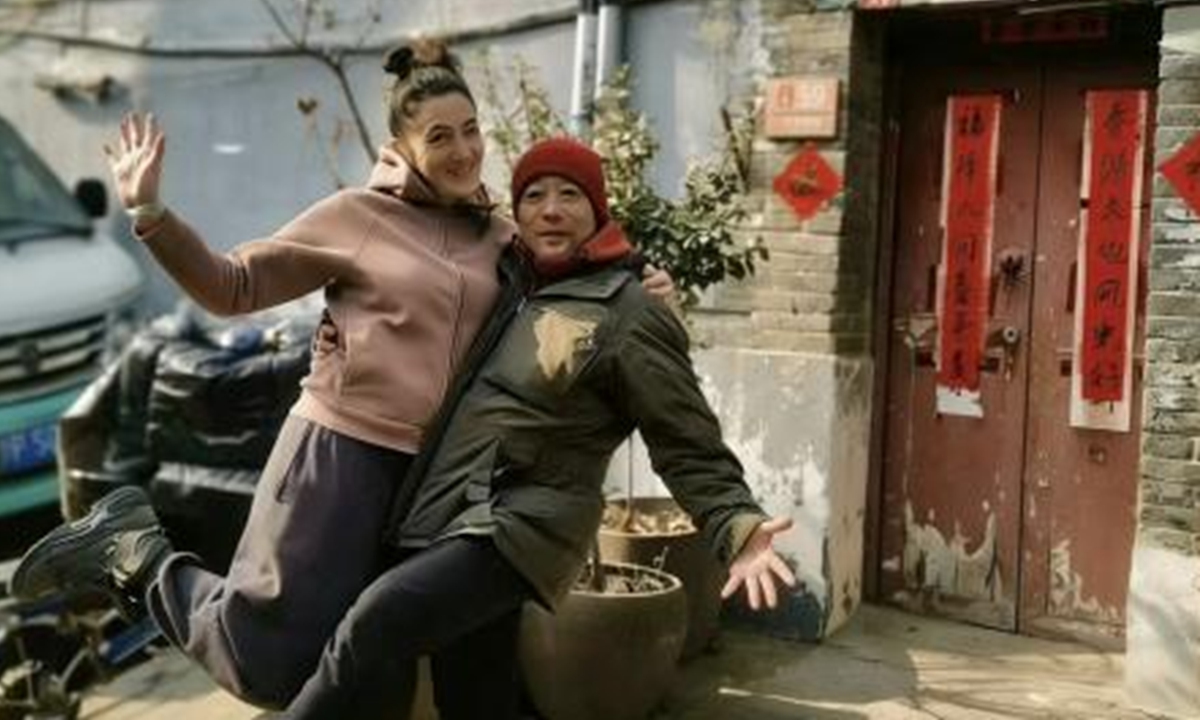
Helene, who also goes by her Chinese name Li Na, shared that she has lived in Beijing's hutongs for over 20 years. "It's incredibly quiet and full of warmth," she said, recounting her daily interactions with neighbors while strolling through the alleys of blue-tiled, gray-brick courtyards.
"Sometimes I'd be startled by the sound of knocking on the door. Then I'd open it to find a neighbor holding dumplings or pancakes, saying, 'Eat while they're hot!'" She mimed opening the door, her laughter warming the crisp winter air.
To her, China's everyday vibrancy, human warmth, sense of security, as well as the confidence and inclusivity rooted in its culture are becoming a source of reassurance for the world.
After 24 years in China, Helene has come to understand the warmth and pace of this land. She has transformed from an observer into a participant, becoming part of China's story.
"I grew up at the stables. I had a horse named Didou, and my equestrian company is named after him," she said. "I hope to help more people understand themselves through interaction with horses."
This is Li Na's new year's wish for the Year of the Horse.
In Beijing's hutongs, the aroma of stewed meat fills the air as households make final preparations for the Spring Festival.
Helene's Chinese father-in-law handwrote a pair of Spring Festival couplets for her: "Blessings fill the springtime, dreams come true in this prosperous era."
Guarding the border at 5,100 meters
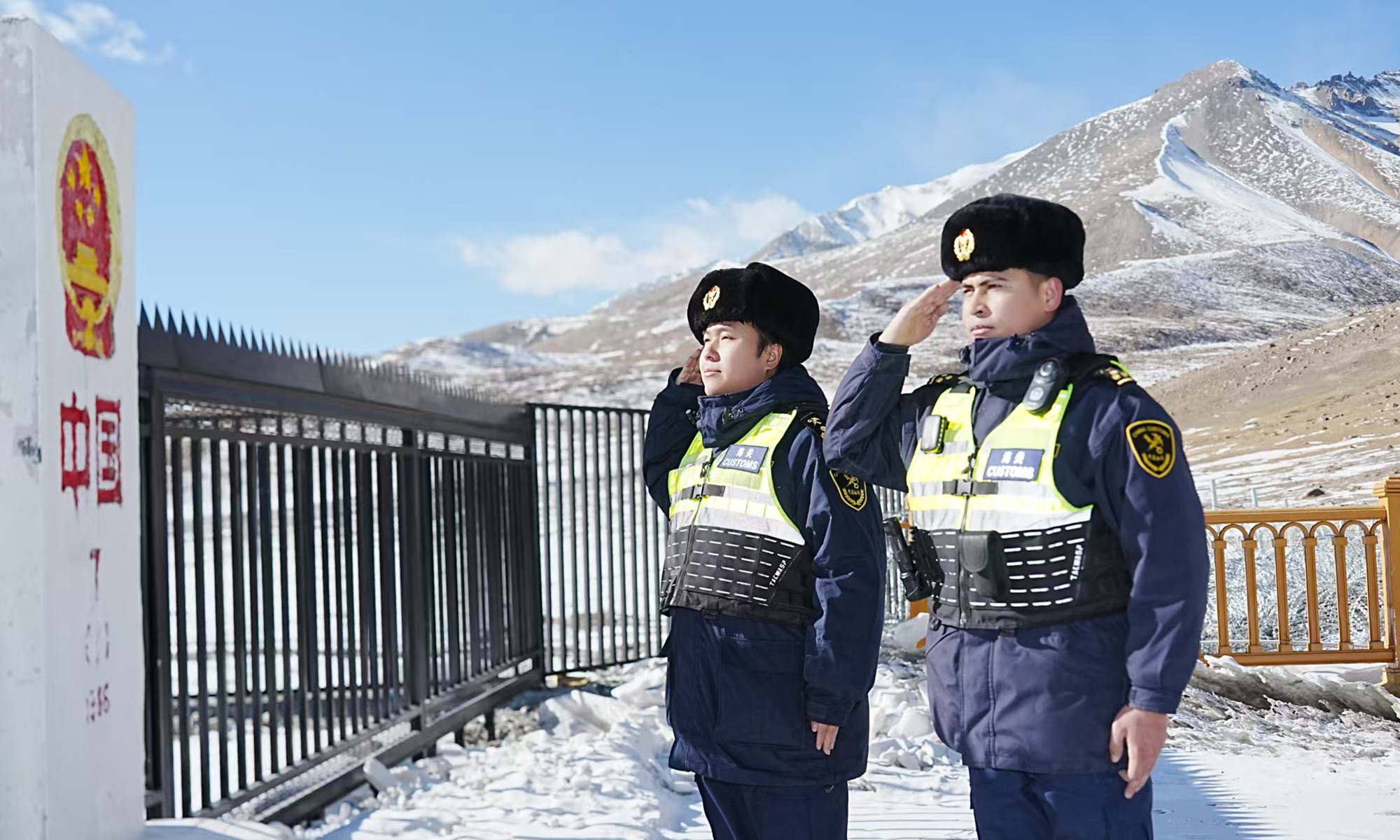
As dawn breaks, China's highest-altitude border gate eases open. The temperature plummets to -25 C, with oxygen levels barely half those at sea level.
"Vehicle number 47 today, documents verified, release!" Zhu Yan, a customs officer at the Khunjerab Pass affiliated with Urumqi Customs, braves the biting wind as he approaches the slow-moving truck.
With the Spring Festival approaching, this sole land route between China and Pakistan has entered its busiest time of the year.
The Khunjerab Pass is located in Taxkorgan Tajik Autonomous County, Northwest China's Xinjiang Uygur Autonomous Region. "Every procedure must be safe and efficient now that more vehicles pass through," Zhu said, his hands bright red from the cold.
"In the past, clearing customs at Khunjerab could take one or two days. During winter, I would have to spend the night in the driver's cabin, shivering under two layers of quilts," said Qin Heyan, a truck driver who frequently travels between China and Pakistan. "But now it's different. From loading goods in Kashi to completing exit procedures at Khunjerab, the whole process takes just over six hours. It's faster and much easier."
The transformation Qin describes stems from Urumqi Customs' "Highway Port plus Local Direct Clearance" supervision model.
Plagued by high altitude, harsh weather, geographic constraints, and cumbersome old procedures, cross-border trucks once faced lengthy delays in Khunjerab Pass. "To address this challenge, we overhauled clearance processes—streamlining 16 tedious steps into 7 and eliminating unnecessary inspections," explains Li Zhuo, head of Khunjerab Customs.
Efficiency gains also come from enhanced collaboration. Khunjerab Customs has established a linkage mechanism with the Kashi Comprehensive Bonded Zone, implementing a "bonded zone stocking, port express clearance" model. Enterprises pre-deliver goods to the bonded zone to complete declarations and inspections in advance. Upon shipment, they only need to complete exit verification at Khunjerab for rapid clearance.
As dusk falls, the day's last exit truck slowly crosses the border. Zhu and his colleagues tally data, review the day's work, and prepare for the next day's operations. "This will be my fourth Spring Festival here," Zhu said. "I can't go home for family reunions, but guarding this 'sky road' to ensure the smooth flow of goods and people makes the commitment worthwhile."
Journey of Yingshan medicinal herbs out of mountains
Poria cocos grows on gentle forest slopes under the trees and relies on locally produced Masson pine as its nutrient source. Around China's traditional solar term Grain Rain, the logs are inoculated with the fungal spawn and buried in the soil, a process called "putting into the pit."
"One mu of land can accommodate more than 1,000 pits, earning several thousand yuan. In recent years, growing Poria cocos and gastrodia has brought pretty good returns," Wang said.
"Although the benefits are good, it's become difficult to keep increasing income further," Yang Zonglin, Party secretary of Shitouzui Township, chimed in.
With the old methods, we're still at the mercy of the weather," Yang said.
"Is there a new method then?" a reporter asked.
"You've hit the nail on the head!" Yang laughed. "We've got some capable people in the town who are exploring new approaches. Come on, let me take you to see them."
Down the mountain, at the Hubei Senrong Traditional Chinese Medicine Development Co, Ltd, villager Shen Guoxian poured corn, wood chips, and other materials into a mixer. With the light press of a button, the uniformly mixed culture medium moved steadily along the conveyor belt toward the bagging machine.
"This is for producing Poria cocos spawn. We can make more than 4,000 bags per hour, and in 2025, we sold a full 5 million bags," said the company's head, Liu Xi.
The greenhouse is right next door at the Hubei Chukang Pharmaceutical Co, Ltd, which serves as the downstream processor for Senrong company's products.
During the interview, the reporters noticed that many village houses along the way were two-story buildings built against the mountains. As local officials put it: "Yingshan's advantage is its ecology, and development must rely on ecology. The county's industrial foundation is relatively weak, but by getting mountain products out and bringing consumption in, the people can still benefit substantially."
This year marks the 105th anniversary of the founding of the Communist Party of China (CPC) and the opening year of the 15th Five-Year Plan (2026-30). A new year begins with new resolve and new momentum. The call to "fight for our dreams and our happiness, and turn our great vision into beautiful realities" continues to inspire action across China.
In the column "New Year on the Frontlines," reporters from the People's Daily and the Global Times traveled to the grass roots to witness the vitality of a vast nation, see its mountains and rivers in motion and its fields in abundance, and listen to the stories of people finding fulfillment in both life and work.
Through these stories, the column seeks to present a vivid portrait of Chinese modernization.
'Sister Wu' sells vegetables by 'slow train'
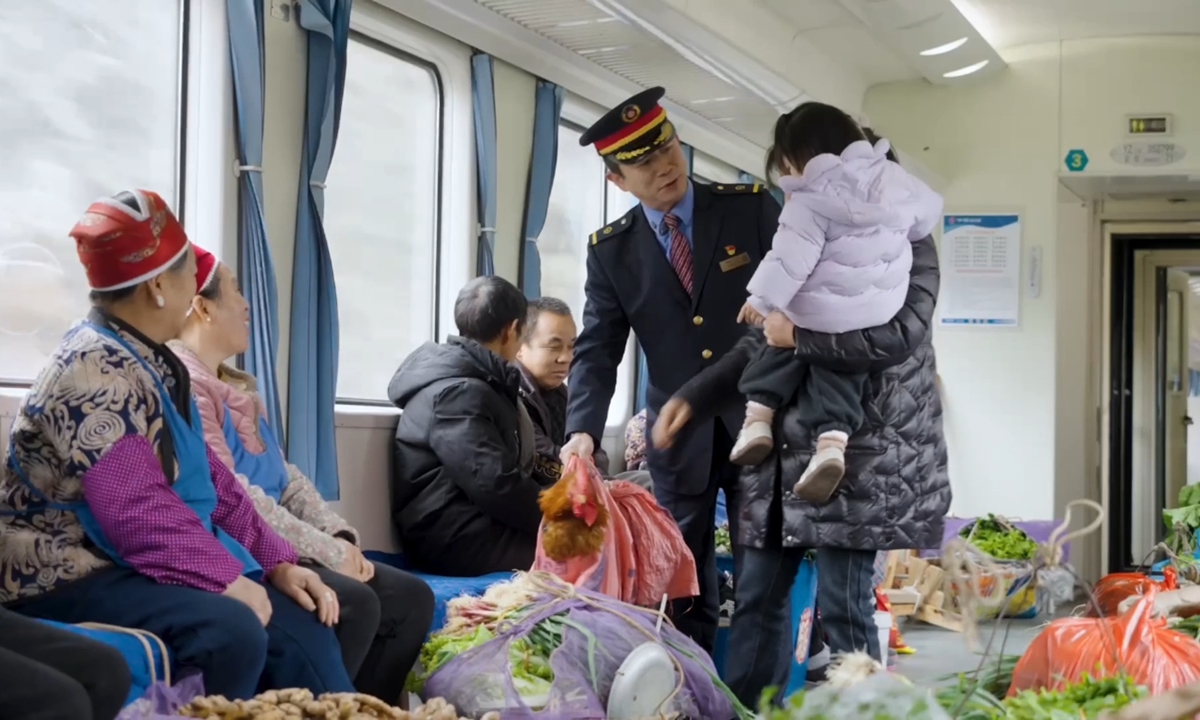
Passengers travel on a "slow train" running between Guiyang and Yuping in Southwest China's Guizhou Province. Photo: Chen Shuang/People's Daily
"Sister Wu, can live chickens be taken on the train?"At daybreak in the Miaoling Mountains, Southwest China's Guizhou Province, vegetable vendor "Sister Wu" began her day amid a flurry of flapping wings and barking dogs. The reporter, helping chase down free-range chickens, could not help but ask.
"Of course - there's even a special carriage for them!"
Wu's full name was Wu Shoufen. She lives in Wengdang village in Kaili, Guizhou. With the Spring Festival approaching, Wu was busy catching chickens and sorting fresh vegetables and other local specialties from the mountains.
"Look, the train is coming." Amid a rumble, the train slowly pulled into the station. Wu was taking Train No. 5639/5640 - a "slow train" running between Guiyang and Yuping. The round-trip service stopped at all 16 stations along the route, with the lowest ticket price going for only a few yuan.
To make it easier for villagers to sell their goods along the way, the railway authorities had renovated the carriage - removing some seats and replacing them with long benches so vegetables and local specialties could be arranged neatly, while passengers could browse and shop.
In the villagers' baskets were vegetables, chickens, ducks, fish, and geese.
Wu's local produce was in high demand. Before long, the vegetables and free-range chickens were sold out, bringing in more than 200 yuan.
After concluding her sales, Wu strolled around the market for a while. A pair of Spring Festival couplets, a new outfit, and a new schoolbag - these were the New Year goods she bought that day.
At around 4 pm, the villagers boarded the "slow train" to return home. Their baskets had quietly been replaced with "trophies," and they shared with one another what they had purchased at the market.
The wheels rolled on, the whistle echoed. Carrying the warmth of everyday life, the "slow train" set off - toward a better life for the villagers.
Shanghai: one bed, room, home; Xiong'an: one land, map, city
A People's Daily reporter takes photos of Yan Weiming and his wife, residents of Caoxi Third Village in Xuhui district, in Shanghai. Photo: Yin Xinyu/People's Daily
"How much is the rent?" A reporter asked."Nine hundred yuan ($130.4) a month," Shen replied. "In Jing'an, every inch of land is extremely valuable, I wouldn't get this price if it weren't a government-run apartment."
The building where Shen lives contains 196 rooms and 1,310 beds, and is home to delivery riders, courier staff, hotel workers, and others. Across Shanghai, such buildings are collectively known as "new era homes for urban builders and managers."
Having a place to live creates a sense of belonging. As a global megacity, Shanghai has, in recent years, been actively building a multi-tiered, guaranteed rental housing system summed up as "one bed, one room, one home." To date, the city has supplied 610,000 units (rooms), helping more new settlers and young people realize the dream of stable housing.
A plane from Shanghai and then a quick transfer to the high-speed train - in under half a day, the reporters had arrived in Xiong'an New Area in North China's Hebei Province.
There, the reporters saw how Xiong'an has been transformed: From a stretch of raw land to a mapped plan, and then to a city - a modern new town springing up from the earth.
The "golden reed" building, or Sinochem Tower, stands as one of Xiong'an's landmarks. From the office window Xiong'an spreads out in full view.
"What a new city! Can you imagine? A few years ago, this was just a big piece of land," said Lin Chengang.
Lin, who works at Sinochem Energy, bought a home in Xiong'an in 2025. "My whole family will be spending Chinese New Year here," Lin said.
Building a millennial city on such "a big piece of land" began with a single map.
What began as a paper blueprint is fast becoming reality. The new city of Xiong'an is unfolding with a sequence of eye-catching revelations.
The breath of spring is already in the air. As China steps into the 15th Five-Year period (2026-30), Shanghai and Xiong'an - one seasoned, one emerging - are both living out the creed "the cities are built by the people and are for the people," writing the scenes that, "when the happy hum of daily life fills every home, the big family of our nation will go from strength to strength."
A French girl living in Beijing's hutongs
Helene Lemerle (left) at a hutong in Beijing. Photo: Courtesy of Helene
Hello, I'd like to buy some loose pastries. Do you have any flavors this year that weren't available last year?""Yes, we have a flavor of red date and Chinese yam. They are only sold for seven days before the Spring Festival."
On a Sunday morning at a store of the traditional bakery brand Daoxiangcun in Beijing's Dongzhimen, Helene Lemerle from France, leaned close to the counter, her finger resting on a pastry adorned with a small horse design. "I'll take one of these too." She spoke Chinese fluently, even with a Beijing accent.
Helene, who also goes by her Chinese name Li Na, shared that she has lived in Beijing's hutongs for over 20 years. "It's incredibly quiet and full of warmth," she said, recounting her daily interactions with neighbors while strolling through the alleys of blue-tiled, gray-brick courtyards.
"Sometimes I'd be startled by the sound of knocking on the door. Then I'd open it to find a neighbor holding dumplings or pancakes, saying, 'Eat while they're hot!'" She mimed opening the door, her laughter warming the crisp winter air.
To her, China's everyday vibrancy, human warmth, sense of security, as well as the confidence and inclusivity rooted in its culture are becoming a source of reassurance for the world.
After 24 years in China, Helene has come to understand the warmth and pace of this land. She has transformed from an observer into a participant, becoming part of China's story.
"I grew up at the stables. I had a horse named Didou, and my equestrian company is named after him," she said. "I hope to help more people understand themselves through interaction with horses."
This is Li Na's new year's wish for the Year of the Horse.
In Beijing's hutongs, the aroma of stewed meat fills the air as households make final preparations for the Spring Festival.
Helene's Chinese father-in-law handwrote a pair of Spring Festival couplets for her: "Blessings fill the springtime, dreams come true in this prosperous era."
Guarding the border at 5,100 meters
Customs officers of Khunjerab Customs are on duty at the Khunjerab Pass in Northwest China's Xinjiang Uygur Autonomous Region. Photo: He Yong/People's Daily
At an altitude of 5,100 meters, Khunjerab Pass braces for the bitter cold of winter.As dawn breaks, China's highest-altitude border gate eases open. The temperature plummets to -25 C, with oxygen levels barely half those at sea level.
"Vehicle number 47 today, documents verified, release!" Zhu Yan, a customs officer at the Khunjerab Pass affiliated with Urumqi Customs, braves the biting wind as he approaches the slow-moving truck.
With the Spring Festival approaching, this sole land route between China and Pakistan has entered its busiest time of the year.
The Khunjerab Pass is located in Taxkorgan Tajik Autonomous County, Northwest China's Xinjiang Uygur Autonomous Region. "Every procedure must be safe and efficient now that more vehicles pass through," Zhu said, his hands bright red from the cold.
"In the past, clearing customs at Khunjerab could take one or two days. During winter, I would have to spend the night in the driver's cabin, shivering under two layers of quilts," said Qin Heyan, a truck driver who frequently travels between China and Pakistan. "But now it's different. From loading goods in Kashi to completing exit procedures at Khunjerab, the whole process takes just over six hours. It's faster and much easier."
The transformation Qin describes stems from Urumqi Customs' "Highway Port plus Local Direct Clearance" supervision model.
Plagued by high altitude, harsh weather, geographic constraints, and cumbersome old procedures, cross-border trucks once faced lengthy delays in Khunjerab Pass. "To address this challenge, we overhauled clearance processes—streamlining 16 tedious steps into 7 and eliminating unnecessary inspections," explains Li Zhuo, head of Khunjerab Customs.
Efficiency gains also come from enhanced collaboration. Khunjerab Customs has established a linkage mechanism with the Kashi Comprehensive Bonded Zone, implementing a "bonded zone stocking, port express clearance" model. Enterprises pre-deliver goods to the bonded zone to complete declarations and inspections in advance. Upon shipment, they only need to complete exit verification at Khunjerab for rapid clearance.
As dusk falls, the day's last exit truck slowly crosses the border. Zhu and his colleagues tally data, review the day's work, and prepare for the next day's operations. "This will be my fourth Spring Festival here," Zhu said. "I can't go home for family reunions, but guarding this 'sky road' to ensure the smooth flow of goods and people makes the commitment worthwhile."
Journey of Yingshan medicinal herbs out of mountains
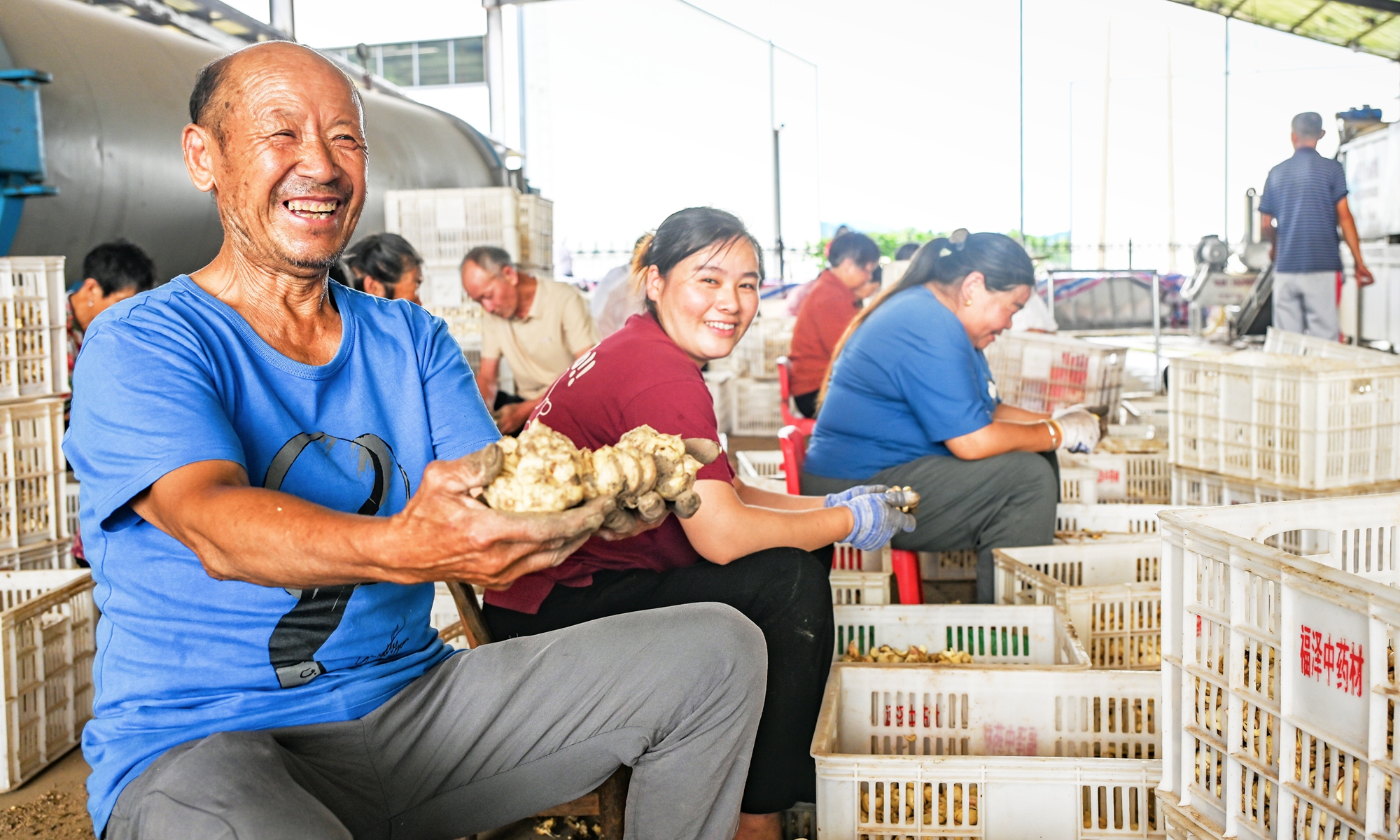
Villagers from Tiantang village in Yingshan county sort traditional Chinese medicinal materials. Photo: Courtesy of the Publicity Department of Yingshan county
As Chinese New Year approaches, in Yingshan county, Central China's Hubei Province, known as the "land of medicinal herbs," Wang Zaiping, a villager from Tiantang village in Shitouzui Township, has been busy. On a sunny mountainside slope, she and her husband diligently turn over pine logs.Poria cocos grows on gentle forest slopes under the trees and relies on locally produced Masson pine as its nutrient source. Around China's traditional solar term Grain Rain, the logs are inoculated with the fungal spawn and buried in the soil, a process called "putting into the pit."
"One mu of land can accommodate more than 1,000 pits, earning several thousand yuan. In recent years, growing Poria cocos and gastrodia has brought pretty good returns," Wang said.
"Although the benefits are good, it's become difficult to keep increasing income further," Yang Zonglin, Party secretary of Shitouzui Township, chimed in.
With the old methods, we're still at the mercy of the weather," Yang said.
"Is there a new method then?" a reporter asked.
"You've hit the nail on the head!" Yang laughed. "We've got some capable people in the town who are exploring new approaches. Come on, let me take you to see them."
Down the mountain, at the Hubei Senrong Traditional Chinese Medicine Development Co, Ltd, villager Shen Guoxian poured corn, wood chips, and other materials into a mixer. With the light press of a button, the uniformly mixed culture medium moved steadily along the conveyor belt toward the bagging machine.
"This is for producing Poria cocos spawn. We can make more than 4,000 bags per hour, and in 2025, we sold a full 5 million bags," said the company's head, Liu Xi.
The greenhouse is right next door at the Hubei Chukang Pharmaceutical Co, Ltd, which serves as the downstream processor for Senrong company's products.
During the interview, the reporters noticed that many village houses along the way were two-story buildings built against the mountains. As local officials put it: "Yingshan's advantage is its ecology, and development must rely on ecology. The county's industrial foundation is relatively weak, but by getting mountain products out and bringing consumption in, the people can still benefit substantially."
RELATED ARTICLES