IN-DEPTH / IN-DEPTH
New Year on the Frontlines: 'Sister Wu' sells vegetables by 'slow train'
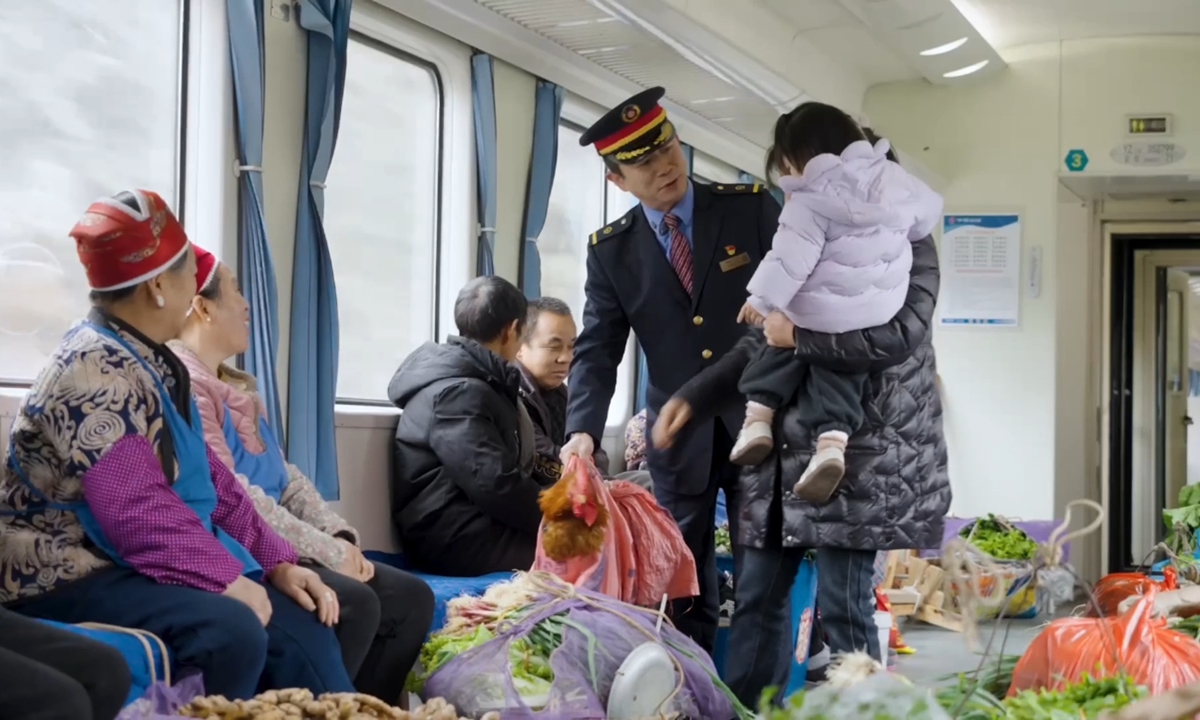
Passengers travel on a "slow train" running between Guiyang and Yuping in Southwest China's Guizhou Province. Photo: Chen Shuang/People's Daily
This year marks the 105th anniversary of the founding of the Communist Party of China (CPC) and the opening year of the 15th Five-Year Plan (2026-30). A new year begins with new resolve and new momentum. The call to "fight for our dreams and our happiness, and turn our great vision into beautiful realities" continues to inspire action across China.
In the column "New Year on the Frontlines," reporters from the People's Daily traveled to the grass roots to witness the vitality of a vast nation, see its mountains and rivers in motion and its fields in abundance, and listen to the stories of people finding fulfillment in both life and work.
Through these stories, the column seeks to present a vivid portrait of Chinese modernization.
"Sister Wu, can live chickens be taken on the train?"
At daybreak in the Miaoling Mountains, Southwest China's Guizhou Province, vegetable vendor Sister Wu began her day amid a flurry of flapping wings and barking dogs. The reporter, helping chase down free-range chickens, could not help but ask.
"Of course - there's even a special carriage for them!" Wu had barely finished speaking when she lunged forward, feinted with her left hand and swiftly reached out with her right - "Got it!"
Wu's full name was Wu Shoufen. She lives in Wengdang village in Kaili, Guizhou. With the Spring Festival approaching, Wu was busy catching chickens and sorting fresh vegetables and other local specialties from the mountains. After packing them neatly, Wu shouldered her load and waited to board a train to Kaili to sell her goods at the market.
"Look, the train is coming." Amid a rumble, the train slowly pulled into the station. Wu was taking Train No. 5639/5640 - a "slow train" running between Guiyang and Yuping. The round-trip service stopped at all 16 stations along the route, with the lowest ticket price going for only a few yuan.
Wu took a deep breath, braced her waist and legs, and steadily lifted a shoulder pole weighing more than 100 jin (50 kilograms). The pole creaked as it settled onto her shoulder.
"Long ago, before the slow train, we had to carry more than 100 jin of vegetables, walk one or two hours on mountain roads, and then take a minibus to the town," Wu said. "By the time we'd arrive at the market, the vegetables would have already wilted and couldn't fetch a good price."
Train conductor Hu Guichuan and other railway staff helped villagers carry their shoulder poles onto the platform and into the train. Wu set down her load in a special "rural market" carriage.
To make it easier for villagers to sell their goods along the way, the railway authorities had renovated the carriage - removing some seats and replacing them with long benches so vegetables and local specialties could be arranged neatly, while passengers could browse and shop.
"On this slow train, besides asking passengers to 'sit in the right seat,' we added another reminder - the villagers' chickens, ducks, and geese must also 'sit in the right seat,'" Hu said.
In the villagers' baskets were vegetables, chickens, ducks, fish, and geese - some still speckled with soil and glistening with morning dew. The shoulder poles were lined up in neat rows.
"Fresh, affordable vegetables are on sale in Carriage No. 3. All are welcome to buy!" the train broadcast announced. Hu warmly guided passengers to Wu's shoulder pole. "What do you think of this chicken? It weighs more than 10 jin - free-range and raised by the villager herself."
Hu oversaw this mobile "farmers' market" as its "golden salesman" and the villagers' "chief interpreter." On board, he patiently promoted the products, helping villagers secure better prices. What seemed like a simple task was something Hu had persisted in for a full 10 years.
"Some people didn't understand and asked if I was trying to pocket the price difference," Hu said. "I told them I did want to 'earn the difference' - so the villagers could earn a little more!"
When the train arrived, Wu welcomed her first customer of the day. "I've bought from her many times!" an old customer said with a smile. "Sister Wu uses farmyard manure to grow her vegetables. They're especially fresh - my family loves the spinach she grows."
Thanks to such sincerity, Wu's local produce was in high demand. Before long, the vegetables and free-range chickens were sold out, bringing in more than 200 yuan. Already fond of smiling, Wu beamed even more brightly.
After concluding her sales, Wu strolled around the market for a while. A pair of Spring Festival couplets, a new outfit, and a new schoolbag - these were the New Year goods she bought that day.
At around 4 pm, the villagers boarded the slow train to return home. Their baskets had quietly been replaced with "trophies," and they shared with one another what they had purchased at the market.
"I used to work in Guangdong and could only come home once or twice a year," Wu told the reporter, showing her son's new award certificate for the semester, her face lit with an irrepressible smile. "Now that the 'slow train' is so convenient, I simply came back to sell vegetables. I can be with my child every day."
The wheels rolled on, the whistle echoed. Carrying the warmth of everyday life, the "slow train" set off - toward a better life for the villagers.
RELATED ARTICLES