US reportedly shelves tech curbs ahead of high-level contacts; Move signals co-op but containment mindset remains unchanged in key sectors: expert
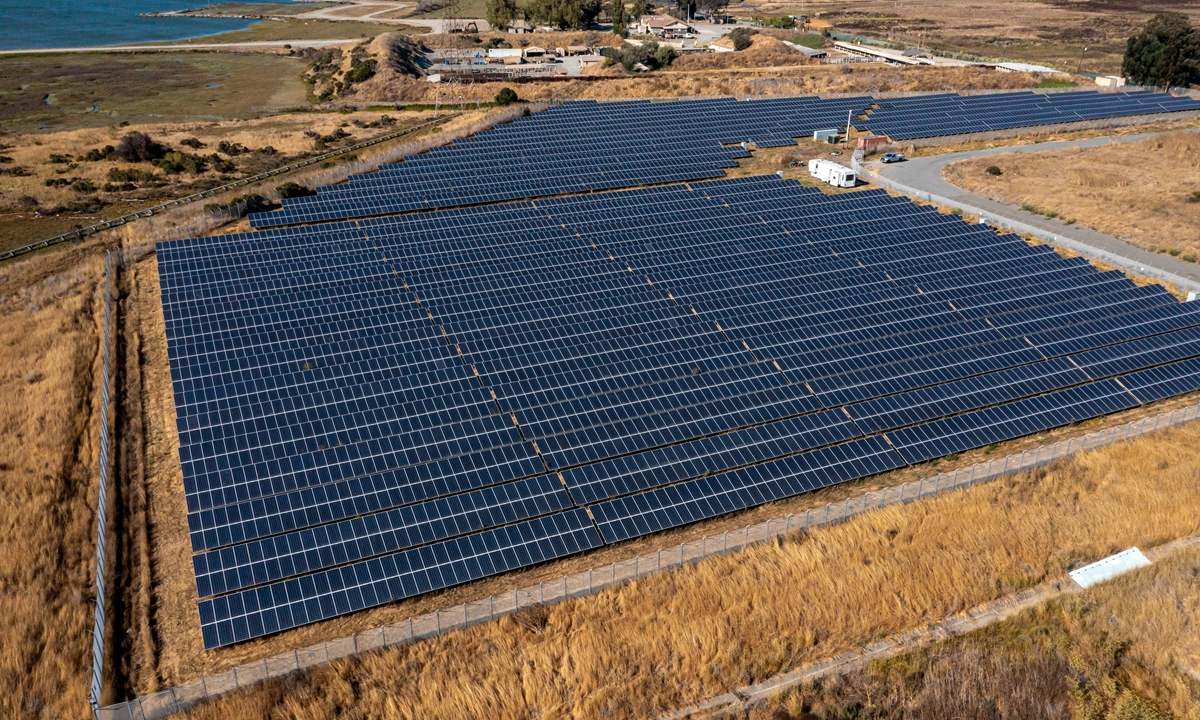
Solar panels in Richmond, California, the US, on August 28, 2025 Photo: VCG
The US administration has decided to shelve several technology restrictions targeting Chinese firms ahead of high-level contacts. Meanwhile, Washington tightened clean-energy subsidy rules the same day against companies deemed overly reliant on Chinese-made equipment, according to Reuters report on Thursday.
Chinese analysts said that the suspension, if confirmed, would represent a pragmatic adjustment benefiting both economies and helping stabilize global markets. But the subsidy curbs suggest that pressure in key sectors remains fundamentally unchanged.
Reuters, citing sources, reported on Thursday (local time) that the US has shelved a number of key tech security measures aimed at Beijing ahead of an April meeting between the two countries' presidents, including a ban on China Telecom's US operations and restrictions on sales of Chinese equipment for US data centers.
The US has also put on hold proposed bans on domestic sales of routers made by TP-Link and the US internet business of China Unicom and China Mobile, along with another measure that would bar sales of Chinese electric trucks and buses in the US, according to the report.
The previously undisclosed decisions are seen as the latest moves by the Trump administration to rein in government actions that could escalate tensions following a trade truce reached by the two countries' leaders in October.
Commenting on reports that US President Donald Trump may visit China in early April, Foreign Ministry spokesperson Lin Jian said on Thursday that "during the telephone conversation between the two presidents a few days ago, President Trump once again expressed his desire to visit China in April. President Xi Jinping renewed the invitation to President Trump to visit China. The two sides are in communication on this."
The China-US economic and trade relations are mutually beneficial in nature. The two sides need to work together to deliver on the important common understandings between the two presidents, and provide greater certainty and stability for China-US economic and trade cooperation and the global economy, Lin said.
The Chinese and US economic and trade teams maintain close communication at various levels through the economic and trade consultation mechanism, He Yadong, spokesperson for China's Ministry of Commerce (MOFCOM) said on Thursday.
He Weiwen, a senior fellow at the Center for China and Globalization, said the suspension of some US restrictions can be seen as a pragmatic step toward stabilizing and normalizing bilateral economic ties and easing tensions, provided the US follows through with concrete actions toward rules-based, mutually beneficial engagement.
Given the deep interdependence between the world's two largest economies in trade and supply chains, stability in China-US relations has direct implications for the global order, he told the Global Times on Friday, noting that recent signs of easing help reduce market uncertainty and support steadier international trade.
China opposes turning trade and technology issues into political weapons while welcoming cooperation that could make 2026 a year in which the two countries advance toward mutual respect, peaceful coexistence and win-win cooperation, Reuters cited the Chinese embassy as saying.
Some US analysts expressed similar views. Reuters cited Wendy Cutler, a former acting deputy US trade representative now with the Asia Society Policy Institute, as saying it is logical for the administration to shelve punitive tech measures as it seeks to "stabilize" relations with China, while pointing to China's leverage in areas such as rare-earth supply.
However, He Weiwen noted the US moves do not represent a fundamental strategic shift. The measures are only suspended rather than removed, meaning they could still be influenced by diplomatic fluctuations and policy uncertainty in Washington.
He cautioned that if the US continues to frame China as a security threat at the strategic level, long-term stability in bilateral relations will be difficult to achieve.
According to Reuters, the US Commerce Department said it is exercising its authority to address what it calls national security risks related to foreign technology and will continue such actions.
Even as tensions appeared to ease, the US Treasury Department unveiled interim rules to implement provisions of a tax law restricting companies from claiming federal clean-energy subsidies if they rely heavily on Chinese-made equipment, while also limiting the use of components or labor sourced from Chinese firms, Reuters reported on Friday.
The guidance aims to reduce reliance on supply chains linked to what the Washington calls "prohibited foreign entities," including China, according to Reuters, but US manufacturers still rely heavily on inputs supplied by Chinese companies despite rapid domestic expansion in solar panel and battery production.
He Weiwen said that the subsidy rules stem from existing legal frameworks and reflect long-standing institutional constraints on China, indicating that while tactical relaxation appears in some areas, Washington continues tightening control over future industries such as energy-transition technologies.
The restrictions, embedded in the Inflation Reduction Act, grant subsidies mainly to projects using domestically produced materials, effectively discriminating against foreign products. China challenged the measure at the World Trade Organization, which ruled on January 30 that the subsidies were inconsistent with WTO rules and called on the US to correct them.
China's Ministry of Commerce, following the ruling, urged Washington to take concrete steps to rectify its practices, safeguard international economic and trade order and promote stable global trade development.
RELATED ARTICLES