New Year on the Frontlines: 'Slow train' links mountain villagers to a convenient and sweeter life


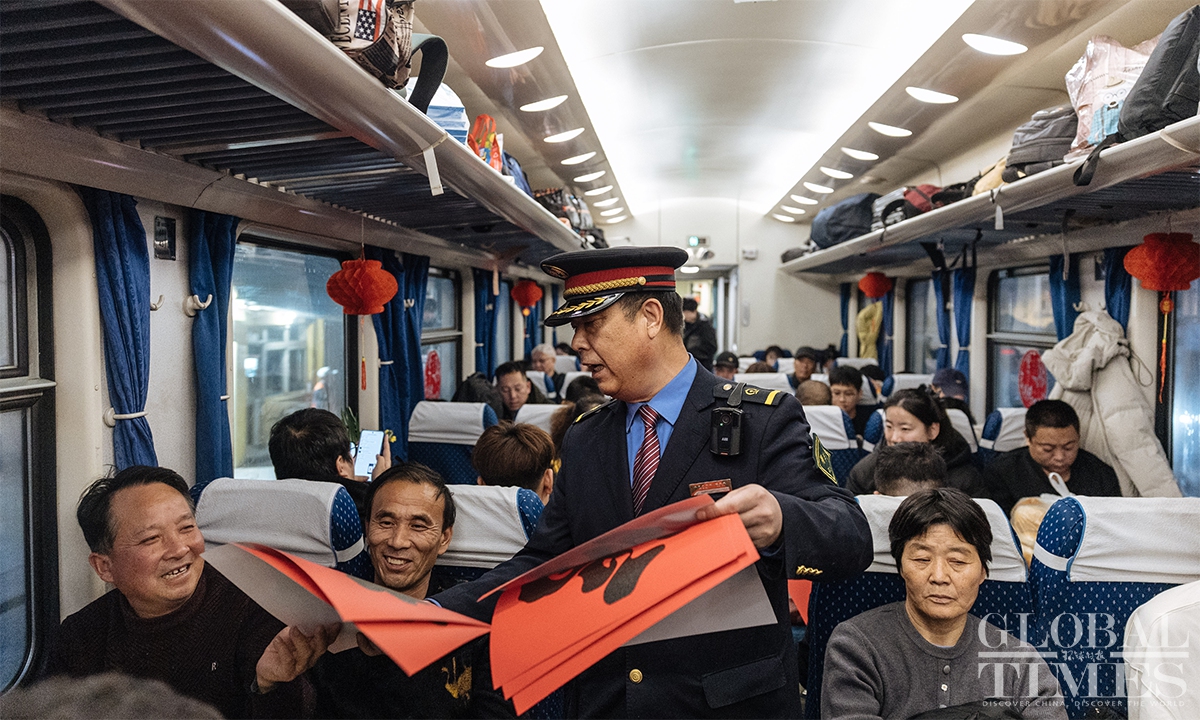
Conductor Cui Daqing hands out red papers with "Fu" character to passengers to celebrate the upcoming Spring Festival aboard Train No. 6437 running from Beijing to Dajian, North China's Shanxi Province, on February 11, 2026. Photo: Li Hao/GT
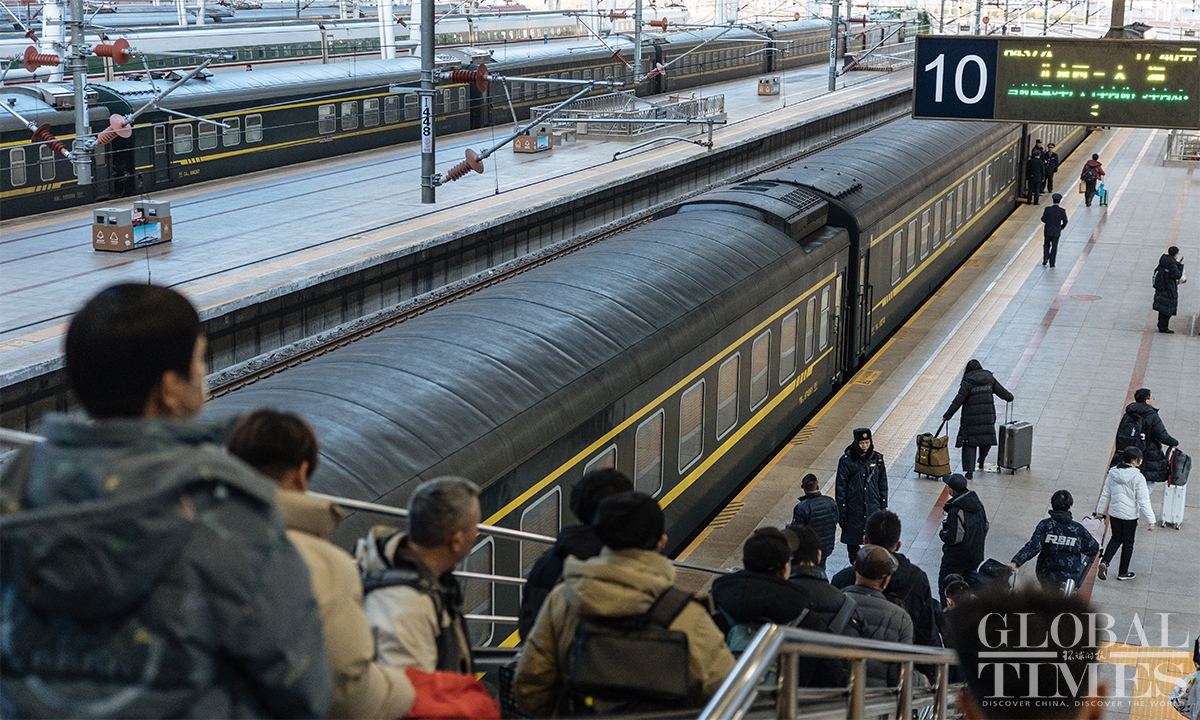
Train No. 6437 waits for departure at Beijing South Railway Station in Beijing, on February 11, 2026. Photo: Li Hao/GT
"Wishing everyone an early happy Spring Festival - here are some 'Fu' characters for you. May good fortune come your way," a conductor called out."Conductor, I'd like one!" "Me too!"
On the afternoon of February 11, train No. 6437 was already filled with a festive atmosphere. Train conductor Cui Daqing held a stack of red papers with "Fu" character, offering passengers warm New Year wishes in a loud and cheerful voice. Festive paper-cut decorations adorned the windows, reflecting the mountain scenery rushing past outside. The luggage racks were crammed with holiday goods - tote bags packed with Beijing specialties and toys for children back home.
This unhurried "green train" was carrying people who had been working or studying in Beijing on their journey home. Inside the carriage, passengers - whether acquainted or not - chatted animatedly, their laughter echoing through the train, much like relatives and friends gathered around a New Year's Eve dinner table.
Recently, a Global Times reporter boarded this "slow train" and found that it serves not only as a "golden corridor" carrying chestnuts and walnuts out of the mountains, but also as a vital link connecting the cultural and tourism development of Shidu and Yesanpo in Beijing and nearby regions. It has also borne witness to the profound transformation of impoverished villages along the route, which have shaken off poverty and regained vitality by leveraging the railway.
This public welfare slow train, carrying memories spanning half a century, is imbued with inclusiveness as its defining feature. By unblocking the "capillaries" of resource flows, it has delivered a warm and solid answer sheet on people's livelihoods amid the Spring Festival travel rush.
A train for the people
Train No. 6437 departs from Beijing West Railway Station at 5:40 pm and arrives at Dajian Station in North China's Shanxi Province at 0:58 am the following day. At 5:39 am, it departs again from Dajian Station for its return trip to Beijing. As the only regular passenger train on the Beijing-Yuanping Railway that stops at every station, it has served residents of towns and villages along the route for more than 50 years.
"The route spans 252 kilometers, with 32 stops along the way, and passes through 121 tunnels and 161 bridges. It has been running since 1972," Cui told the Global Times, reeling off the figures with ease.
Affordability and convenience are the train's most distinctive features. A full-length ticket costs 30.5 yuan ($4.2), equivalent to about 0.18 yuan per kilometer, while the lowest fare is just 4 yuan. During the trip, the reporter observed that only eight stations along the line handle ticketing services; at the others, passengers can simply board first and purchase tickets on the train - as convenient as taking a bus.
A corner of the carriage is stocked with books and newspapers for passengers to read, as well as an emergency kit containing power banks, magnifying glasses, reading glasses and disposable raincoats.
A 57-year-old man surnamed Yang sat by the window in a sleeper carriage, leisurely taking in the scenery outside. He has worked at a cement factory in Beijing for more than a decade and was set to get off at Wang'an Town Station that evening. "The ticket costs just over 20 yuan. The train stops at every small station and goes straight into the town. After getting off, I can just walk home," he said with a smile. "The train may be slow, but it is warm."
Slow yet essential
"This slow train is great precisely because it's 'slow' - you can really take in the scenery!" said 71-year-old Mr Zhang, who was seated by the window with his 70-year-old wife, surnamed Hua, their eyes fixed on the passing landscape.
The couple set off from Shanghai and have traveled across most of the country - south to the azure seas and coconut groves of Sanya in South China's Hainan Province, north to the frozen snowfields of Mohe and the border river scenery of Heihe in Northeast China's Heilongjiang Province, and west to the snow-capped mountains and grasslands of Northwest China's Xinjiang Uygur Autonomous Region.
This time, they made a special trip on Train No. 6438 (the return service is Train No. 6437) to the Zijingguan section of the Great Wall, after visiting the Pingxingguan Victory Memorial Hall in Lingqiu county, Datong, Shanxi, to review the turbulent years of the Chinese People's War of Resistance Against Japanese Aggression more than 80 years ago.
"Of the country's 13 major Great Wall train routes, we have already visited 10, and we basically traveled by train each time," Zhang said with a smile, shaking the ticket in his hand. "The scenery outside the train window is more vivid than any tourist attraction."
The train is also something of a "sightseeing coach," passing more than a dozen tourist attractions along the way, including the Yunju Temple, Shidu and Yesanpo scenic areas.
The train stops at 32 stations along its entire route, quietly boosting tourism development along the line. Every summer, it carries visitors to mountain-and-water scenic areas such as Bailixia, allowing them to embrace cool breezes and lush greenery. In winter, it transports tourists to the Qishan Ski Resort in Laiyuan, Hebei Province, helping them fully enjoy the fun of ice and snow.
Moreover, many villagers take this train to transport their agricultural products to tourist hotspots, earning a considerable income for their families. When heavy snow or other severe weather closes highways in the Taihang Mountains, this slow train becomes the most reliable means of travel for local residents.
Passenger Mr Feng deliberately chose a window seat. "I used to take high-speed trains all the time. They're fast, but they lack this kind of 'immersive' pleasure of watching the scenery," he said.
As he spoke, mountains bathed in the red glow flashed past the window. He quickly took out his phone to snap photos, pointing to the rolling Taihang Mountains in the distance. "Look at the outline of the mountains, the shapes of the clouds, and the winding streams at their feet. Every second brings a change - this is the poetry you just can't find in fast-paced travel."
Toward a better life
The train No.6437/6438 service is not an isolated case.
According to the China News Service, while the Fuxing bullet trains are redefining "China speed" at 350 kilometers per hour and the "eight vertical and eight horizontal" high-speed railway network is weaving a modern transportation artery across the country, 81 pairs of "public welfare slow trains," with an average speed of less than 50 kilometers per hour, can still be seen traversing mountains, forests and remote border villages day after day across the vast folds of the nation's territory.
Most of these trains have maintained low ticket prices unchanged for decades, undertaking essential livelihood functions such as transporting students to school, villagers to markets, migrant workers to jobs and agricultural products to urban areas. Beyond guaranteeing mobility, they have also boosted the outbound sales of agricultural and sideline products from mountainous areas and promoted rural tourism development.
For example, in the hinterland of the Liangshan Yi Autonomous Prefecture in Southwest China's Sichuan Province, the public welfare "slow train" service No.5633/5634 on the Chengdu-Kunming Railway passes through 38 townships and radiates to 97 surrounding townships in Sichuan and nearby Yunnan Province. Ticket prices have remained unchanged for decades, with the lowest fare at just 2 yuan ($0.3), and the train stops at every station. Cherries, walnuts and Chinese prickly ash - villagers bring the crops they grow, the poultry and livestock they raise, and the local specialties they harvest to county towns for sale via the "slow train," which has been dubbed a "mobile vegetable market," the People's Daily reported in June 2025.
According to the Xinhua News Agency, by the end of 2024, China's railway operating mileage had reached 165,000 kilometers, including more than 50,000 kilometers of high-speed rail. At the same time, China has continued to maintain the scale of conventional passenger train services, operating public welfare slow trains and rural revitalization trains to ensure the inclusiveness, balance and accessibility of railway transportation.
In an era of high-speed rail racing ahead, these "slow trains" continue their quiet journey, supporting the aspirations of ordinary families for a better life in the most unadorned way.
As the train rolled steadily onward, Cui moved through the carriage, greeting passengers. "Although our train doesn't have the same facilities as high-speed rail, our service is absolutely in place. We have blended in with everyone here. We have become friends," he said. Some passengers share freshly picked peaches from the mountains with the crew, while others turn to Cui and the attendants for advice whenever they run into difficulties.
Today, many rural families own cars and can drive to county towns or cities to catch faster transportation. Yet this "stop-at-every-station" train continues to fulfill its mission. Like a warm bond, it links one small platform after another, carrying the gentle, unhurried happiness of ordinary people.
RELATED ARTICLES