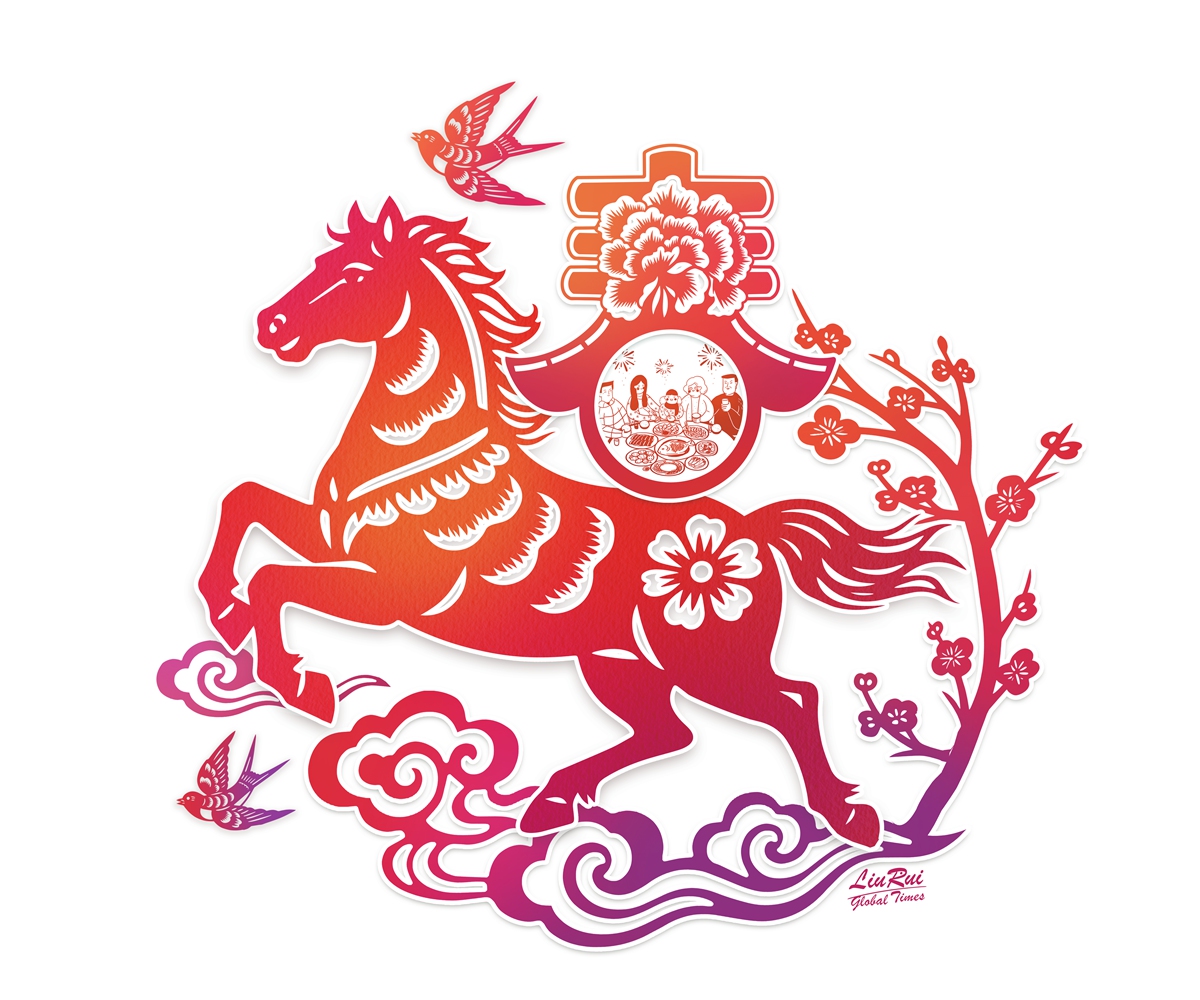
Illustration: Liu Rui/GT
Editor's Note:
The Spring Festival stands as a profound manifestation of the intrinsic cohesion and enduring vitality of Chinese civilization, offering the world a deep cultural code to understand Chinese society. The Global Times invites five experts from different parts of the world to share their perspectives on the festival through five distinct dimensions - each beginning with the letter "R."
Roots: Civilizational roots nourish China's sense of collective responsibility
Vuk Jeremić, the 67th president of UN General Assembly and former foreign minister of Serbia
Few traditions in the modern world so vividly concentrate the enduring vitality and intrinsic cohesion of a great culture as China's Spring Festival. It is not merely a holiday marked by fireworks, family reunions and the color red. It is a living cultural grammar - a set of shared codes through which Chinese society renews its bonds: between generations, between locality and nation, between memory and aspiration. In a time when many societies struggle with fragmentation, the Spring Festival demonstrates how continuity can be a source of creativity and confidence.
From my perspective as a former foreign minister of Serbia and former president of the UN General Assembly, this matters well beyond China. In diplomacy, we often speak of interests and institutions, but we sometimes forget that societies are sustained by stories, symbols and rituals that cultivate trust. To understand China's trajectory, one must understand the civilizational roots that nourish its sense of collective responsibility and long-term thinking.
Serbia and China enjoy excellent relations built on mutual respect and a clear appreciation of each other's histories. Over dozens of visits, I have come to value how Chinese friends connect the personal and the national, the past and the future - especially during this season of reunion.
Routes: Diverse cultural routes weave a shared tapestry of renewal and hope
Ken Hammond, a professor of East Asian and global history at New Mexico State University
I lived in Beijing for several years in the 1980s, working with American educational programs that sent students and travel groups to China. During those years, I experienced the excitement and sense of renewal associated with the Chinese New Year celebrations known as the Spring Festival.
These days, I live in the American state of New Mexico, where I have taught Chinese history for more than 31 years. I am very much looking forward to this year's Spring Festival, which is now celebrated by people in countries all over the world. The Chinese New Year has become a moment of cultural awareness and solidarity that draws people from Asia, Africa, the Americas and Europe together into a sense of shared renewal, as the old year passes and a new horizon opens up before us. Even in places like the American Southwest, the Chinese New Year is marked by festive dinners and public events with Chinese students and scholars at the university, as well as lively programs put on by the city museum.
The Spring Festival has become a global phenomenon, a day that helps remind us all that we are part of a planetary human community, diverse but sharing in the common joys and sorrows of life, and that there are more things that unite us than divide us. These celebrations now follow diverse cultural routes, from traditional family gatherings in China to vibrant public festivities across continents, weaving a shared tapestry of renewal and hope that transcends borders.
Reunion: Family reunion expresses essential values of Chinese civilization
José Medeiros da Silva, a Brazilian professor at Zhejiang International Studies University
At the end of January 2026, I accompanied a young Brazilian who had come to study the Chinese language at Zhejiang International Studies University, where I work, on a journey to explore several iconic sites of both traditional Chinese culture and modern China. Among other places, we visited the birthplace of Mencius and Confucius in Shandong, as well as the memorials of Dr. Sun Yat-sen in Nanjing and Chairman Mao Zedong in Beijing. Throughout our journey, the trains we took were crowded with people traveling early to their hometowns to spend the Chinese New Year reunited with their families, highlighting the deeply human dimension of this festive period.
As is widely known, every year during the Spring Festival, public transport across China reaches peak capacity, with highways becoming densely filled with vehicles. Hundreds of millions of people travel simultaneously with a single shared purpose: family reunion. This annual movement, impressive in both scale and intensity, reveals the central role of the family in Chinese social organization.
I often reflect on the deeper meaning of this gesture and its role in China's social and civilizational cohesion. If, in ancient times, families gathered to celebrate life, sow seeds, renew hope and begin a new cycle of work, this annual reunion continues to fulfil a similar function in the present day. It strengthens the sense of familial belonging and expresses essential values of Chinese civilization, such as unity, sharing and mutual care. Amid the rapid transformations of the contemporary world, the Chinese New Year thus stands as a living link between past, present and future, demonstrating that unity remains a powerful key to renewing hope, overcoming obstacles and achieving abundant harvests.
Resonance: The Spring Festival generates appealing resonance
Adhere Cavince, a Nairobi-based scholar of international relations
There is a profound affinity between African cultures and Chinese traditions, a resonance that turns this distant celebration into something deeply relatable and appealing.
The first chord of connection is struck by the paramount importance of family and community. Just like in Kenya, where holidays mean returning to one's ancestral home, the Chunyun migration in China is a monumental testament to familial bonds. The concept of reunion mirrors our own unwavering commitment to family gatherings. The lively, food-filled, laughter-heavy Chinese New Year's Eve dinner is indistinguishable in spirit from a festive feast in Nairobi or Kisumu, a noisy, joyful affirmation of kinship.
The second point of appeal regards the shared values expressed through hospitality and generosity. The Chinese insistence on sharing food and offering gifts feels intimately familiar. It is the same dance of respect and generosity that we practice.
Furthermore, Chinese culture's vibrant expressiveness and artistic spirit speak directly to the African soul. The bold colors of lanterns and paper cuts, the powerful, rhythmic beats of the dragon and lion dances, the intricate storytelling in couplets - it is dynamic, rhythmic and visually rich, much like our own traditional dances, vibrant fabrics and oral storytelling traditions. We share a love for art that is lived, communal and bursting with life.
The Spring Festival is rooted in bidding farewell to the old and welcoming the new, in rituals meant to attract good fortune and ward off negativity. This forward-looking, hopeful pragmatism, blending deep respect for ancestors with a fierce drive for a better future, mirrors the African spirit. We both understand the need to acknowledge past struggles while celebrating present joys and collectively aspiring for prosperity.
Revelry: Festive revelry goes beyond borders and time
Duong Van Huy, director of the Centre for Vietnam-China Relations Studies, Institute of Asia-Pacific Studies, Vietnam Academy of Social Sciences
The vibrant revelry of the Spring Festival, with its thunderous drums, dazzling dances and shared feasts, finds a profound echo in the celebratory heart of our cultures, turning distant traditions into a familiar, joyous symphony of life.
This tradition begins at the dinner table in each family. The culinary traditions of the Spring Festival contribute greatly to Chinese food culture. The Spring Festival incorporates a significant amount of intangible cultural heritage at various levels. It is a festival brimming with folk tales and traditions.
During the Spring Festival, people continue the tradition of hanging red lanterns, setting off fireworks and pasting red scrolls with rhyming verses on their doors in the hope of warding off evil spirits and attracting good fortune. Besides the customs observed on specific days, there are other intriguing cultural symbols and events associated with the festival. Many of these celebrations and events, passed down from generation to generation, are performed in China, Asia and elsewhere, such as lion dances and lantern festivals, together creating the most joyful days for those celebrating the event. At the same time, the Spring Festival is a time to observe the development of the economy, with the shopping atmosphere and the spirit of the people reflecting the socio-economic development of the year.
RELATED ARTICLES