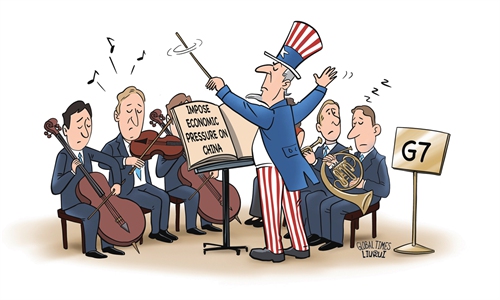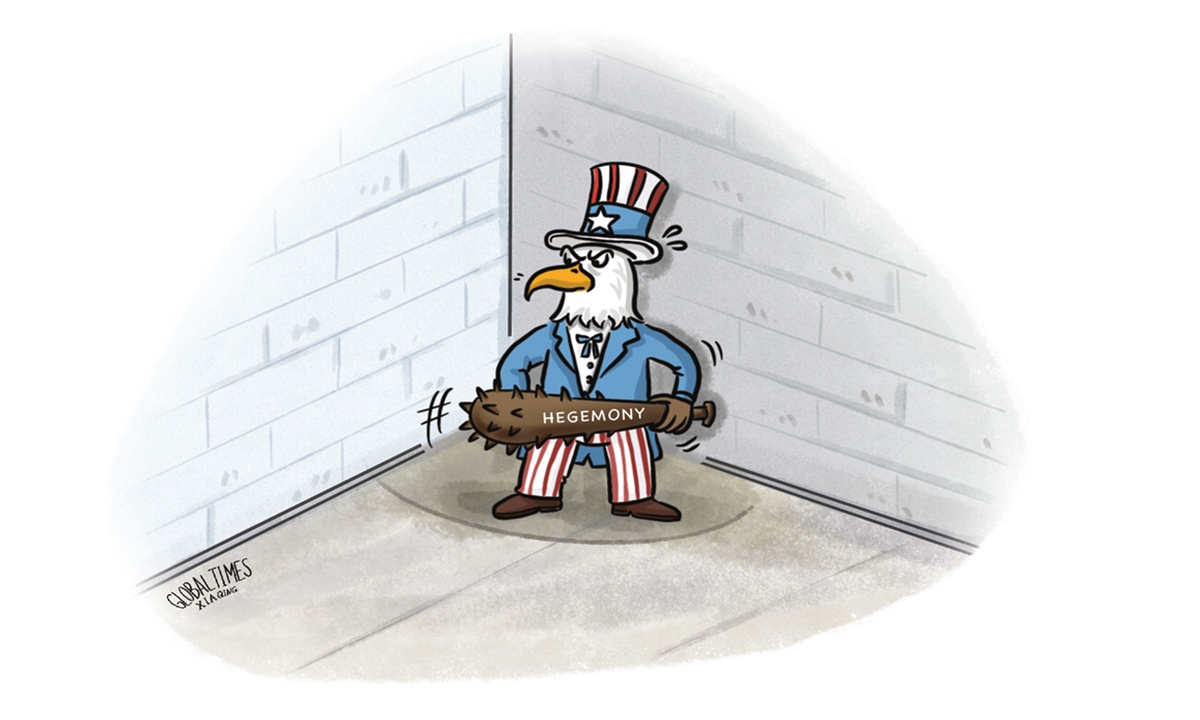
Illustration: Xia Qing/GT
In the early 2000s, in the shadow of September 11 terrorist attacks, the US launched a major campaign against "rogue" terrorist groups. Who would have imagined that 25 years later, in February 2026, the biggest strain on the global order would come from the same country that once claimed to uphold the system.
US' withdrawal in January 2026 from 66 international organizations marks the sharpest break yet with the multilateral architecture it helped construct after 1945. The official rationale speaks of eliminating "wasteful" or "harmful" structures that threaten American sovereignty.
Yet the pattern is revealing: Washington retains its veto in the UN Security Council, its dominant voice in the IMF and World Bank, and its leadership in NATO. What it has discarded are the normative, cooperative and "soft" domains where its preferences are contested and its exceptionalism challenged.
This is autoimmunity in action: the superpower, seeking to protect its sovereignty, is dismantling the connective tissue of the very order it long claimed to defend.
Paradoxically, this voluntary withdrawal by the US may turn out to be more stabilizing for the international system than the continuation of its unpredictable and erratic policy behavior.
The War on Terror did not make the US safer; they multiplied adversaries, strained alliances and eroded the legitimacy of the rules-based order Washington once championed. Worse still, in recent years the country has engaged in abrupt tariff wars, selective interventions (Venezuela 2026), territorial posturing (Greenland), capricious weaponization of the US dollar system, and unilateral withdrawals from various transnational bodies.
By stepping back, the US inadvertently creates breathing room for a more distributed global system to emerge.
Now, so-called middle powers and the Global South are building mechanisms: Regional climate facilities, South-South development banks, expanded BRICS coordination, multi-alignment diplomacy and a myriad of multilateral trade platforms aimed at consolidating global interconnectivity, without the US. This is not fragmentation for its own sake. It is diffusion.
In a genuinely diffused, multi-nodal order, stability arises from redundancy rather than dominance. No single actor's misstep can bring down the system. Regional powers act as local balancers and shock absorbers. For example, ASEAN manages maritime tensions, the African Union handles continental crises and the EU pursues strategic autonomy.
Yet the deepest source of potential stability lies elsewhere. John Maynard Keynes, in The Economic Consequences of the Peace (1919), warned that the Versailles Treaty's punitive humiliation of Germany - reparations that stripped dignity and hope - sowed resentment and future conflict. Sustainable peace, he argued, requires magnanimity over vengeance, inclusion over exclusion, and recognition that prosperity and security are indivisible.
Ascendant powers today appear to have absorbed this lesson. Despite the US' post-Cold War interventions that cost millions of lives, weaponized sanctions, double standards on sovereignty, China and much of the Global South have not sought to humiliate a declining West to a boiling point. Instead, they pursue restraint and strategic patience.
The China-proposed Belt and Road Initiative, Shanghai Cooperation Organisation, and BRICS+ initiatives aim to widen participation and dissolve the logic of domination, not replace one hegemon with another.
Scholars describe the emerging landscape as polycentric or "unbalanced multipolarity." It lacks the clarity of bipolarity but may be more antifragile. Shocks are absorbed across nodes rather than cascading from a brittle center. The unipolar era incentivized challengers to confront the hegemon directly; a distributed system lowers those stakes and encourages pragmatic coexistence.
For the US, this may well offer a necessary cooling-off period. The US will remain a large and capable actor in many domains for years to come. But influence will have to be negotiated issue by issue, coalition by coalition. Leadership will be situational and earned. It will not be structural and cannot be assumed. Exceptionalism must give way to pragmatic coexistence.
Because ascendant powers have learned the lessons of Keynes, however, the demotion need not be humiliating to the point of boiling resentment. The door remains ajar. American innovation, markets, military reach and cultural power retain value.
Allies and competitors will keep channels open for engagement - on climate technology, supply chains, selective security - provided it is equitable. What will compel re-entry is the reality of indivisible security in a multi-nodal world: No state achieves lasting safety at permanent expense to others. Interdependence and shared vulnerabilities will force participation.
Critics warn of anarchy in a "world minus one." Yet early evidence points elsewhere. Since the 2026 withdrawals, diplomatic traffic has surged in Beijing; markets have rerouted around alternative hubs; regional arrangements have deepened without US orchestration. The Westphalian fabric is being rewoven. It could well be becoming more plural and therefore, more durable.
For the US, the path forward is adaptation and humility. The sooner it accepts its place as one great power among several, the sooner it can play that role effectively - and sustainably - in the multipolar or multi-nodal world that is already underway.
The author is an adjunct professor at the Queensland University of Technology and former advisor to former Australian prime minister Kevin Rudd. opinion@globaltimes.com.cn
RELATED ARTICLES