The Spring Festival brings a touch of warmth to the world: Global Times editorial
Illustration: Liu Rui/GT
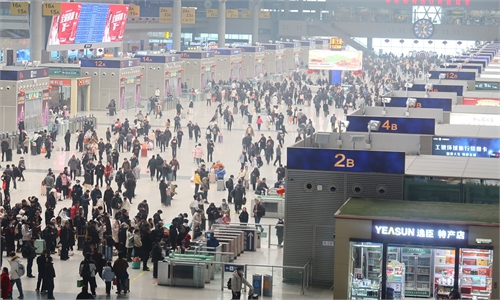
The Spring Festival is the most important traditional festival for the Chinese people. As it approaches, the joy of reunion and anticipation for the future are transforming into the most vivid expressions across China: the millions of travelers heading home in the great Spring Festival migration, the bright red couplets adorning every household door, and the warm greetings of "Happy New Year" exchanged among neighbors. Even if the year has carried its share of worries and hustle, come the Spring Festival, they are gently set aside. In the warmth of family reunions, people recharge and set off for the new year with renewed energy and a better outlook.
On overseas social media platforms, the arrival of the Spring Festival has further fueled the trend of "becoming Chinese," with "spending Chinese New Year in China" emerging as a new fad among many foreign netizens. A recent article in Switzerland's Neue Zürcher Zeitung noted that when people mention China today, many immediately think of a certain atmosphere and lifestyle: "Chinese pop culture is currently experiencing its global breakthrough."
From the blockbuster sales phenomenon of Black Myth: Wukong to the wildly popular trendy toy Labubu, Chinese culture is reaching the world in diverse forms. The New York Times observed that "the internet is embracing Chinese traditions, and influencers welcome them all." The Spring Festival is no longer just a holiday for the overseas Chinese ; it is gradually becoming a global cultural symbol.
The reason the Spring Festival can open doors across different cultures is that it touches the softest, most universal human longing for a better life deep in our hearts. For those foreigners attempting to "spend Chinese New Year in China," they may not understand the auspicious meanings behind the Chinese characters on the couplets, yet they can grasp the happiness of reunion. They may not know the cultural origins of customs like house cleaning, staying up all night on New Year's Eve, or paying respects during visits, yet they can feel the joy of bidding farewell to the old and welcoming the new amid the festive bustle of lanterns and decorations. In a world where news headlines are so often dominated by division, estrangement, opposition, and conflict, the Spring Festival proves in the gentlest way that humanity's shared pursuit is always peace, goodness, and togetherness. This is not merely the export of culture - it is a heartfelt echo of universal human values.
Chinese civilization has long cherished the principle of "harmony is most precious" and "harmonious coexistence" - the philosophy permeates every detail of the Spring Festival.
Families gather around the hearth for the New Year's Eve vigil, young and old alike sharing joy and warmth - this is the harmony of kinship. China's 56 ethnic groups celebrate the New Year together, each showcasing their unique customs while uniting in shared delight - this is the harmony of the nation. People around the world now partake in the festive spirit: Chinese dumplings and tangyuan enter homes abroad, while foreign blessings and goodwill flow back into China - each culture beautiful in its own way, coming together in mutual appreciation and harmony. The ideals of harmony, inclusiveness, and coexistence embodied in the Spring Festival not only nourish generations of Chinese people but also, in today's world full of uncertainties, offer humanity a source of warmth and resilient strength.
China's vibrant Spring Festival economy is also providing opportunities for the world. In the lead-up to the festival, international flight bookings to China surged more than 400 percent year-on-year, with Argentine visitors increasing ninefold and many European countries seeing growth exceeding 200 percent. Prime entry cities like Shanghai, Guangzhou, Beijing, and Chengdu faced hotel shortages, while in Shanghai, the daily salary for guides specializing in less common foreign languages has increased to 2,500 yuan ($362.28). The combination of favorable policies and cultural magnetism has given rise to "Spring Festival inbound tourism" as a new growth engine in the global travel market. At the same time, to catch the peak sales season of the Chinese Spring Festival, Kenyan fishermen are busier than usual catching golden crabs; in Chile, the cherry industry provides approximately 200,000 jobs locally each year, with 90 percent of its products exported to China. "Foreign New Year goods" are booming in China, which vividly illustrates the development logic of sharing and win-win outcomes.
Moreover, the Spring Festival has integrated itself into the modern lives of young people worldwide in a strikingly cutting-edge and tech-savvy way.
Everyone still remembers how DeepSeek burst onto the scene and shook the world during last year's Spring Festival. Just before this year's festival, Seedance 2.0 left the world in awe - it's hard to just call that mere coincidence. After years of steady accumulation, China's homegrown innovation has entered an explosive gusher phase, and "Cool China" has become the fresh new impression the outside world has of the country. As a result, China's Spring Festival is growing ever "cooler" itself - it is evolving into a prime window for showcasing the nation's technological achievements. In fact, during last year's Spring Festival, robots were already appearing in large numbers at temple fairs and markets across the country. What "new tricks" will this year bring? The anticipation is high.
The Bingwu Year of the Horse is about to arrive. The horse symbolizes courage, wisdom, diligence, perseverance, and ambition. This surging "horsepower" is also the new momentum that China is conveying to the world. May this "thousand-mile steed" from the East carry the ancient wisdom of "harmonious coexistence" across mountains and seas, while also pulling the carriage of development forward - together with the world toward a future with less confrontation and more win-win outcomes.
RELATED ARTICLES