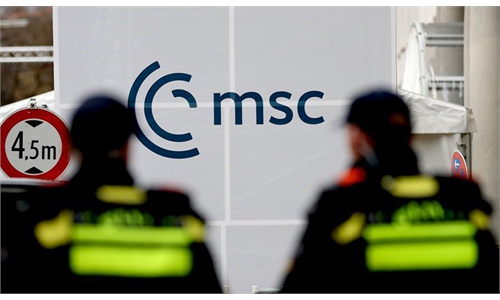
Chinese Foreign Minister meets European leader, top diplomats on sidelines of 2026 MSC; expert says intensive meetings highlight close and inseparable nature of China-Europe ties
By Published: Feb 14, 2026 01:19 PM

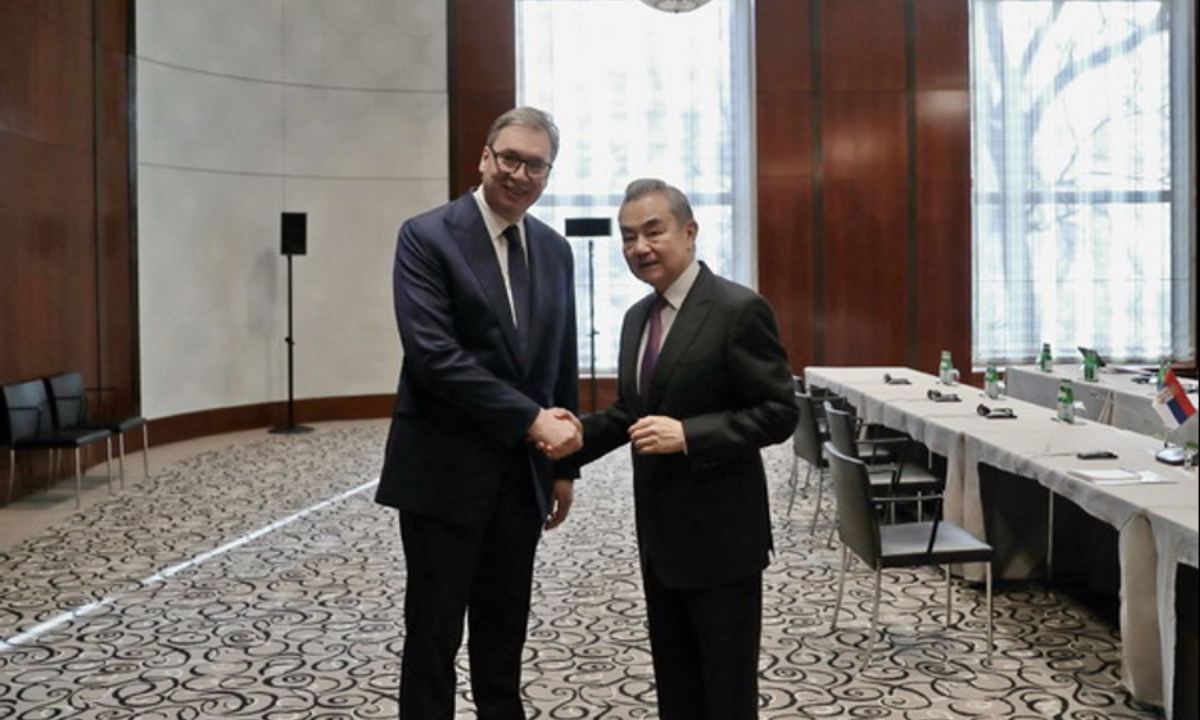
Chinese Foreign Minister Wang Yi meets Serbian President Aleksandar Vucic on the sidelines of the 2026 Munich Security Conference in Germany on February 13, 2026. Photo: Chinese Foreign Ministry
Chinese Foreign Minister Wang Yi, on the occasion of attending the 2026 Munich Security Conference (MSC) in Germany, met with European leader and a number of foreign ministers on the sidelines of the MSC, including Serbian President Aleksandar Vucic, Austrian foreign minister Beate Meinl-Reisinger, British Foreign Secretary Yvette Cooper, German Foreign Minister Johann Wadephul and French Foreign Minister Jean-Noel Barrot, according to official release from the Chinese Foreign Ministry.The 2026 MSC has been held amid intense turbulence in the global landscape and the international order is at a critical juncture marked by the transition between old and new structures. At the same time, bilateral relations between the US and Europe — commonly referred to as transatlantic ties — are undergoing profound changes, some observers said.
Against this backdrop, the importance and multifaceted significance of China-Europe relations have become increasingly prominent, a Chinese expert told the Global Times on Saturday.
“Such intensive meetings with senior political figures from across Europe during the MSC highlighted the close and inseparable nature of China-Europe ties, reflecting the deep interconnection between the two sides at a time of global uncertainty,” Gao Jian, director of the Center for British Studies at Shanghai International Studies University, told the Global Times.
During the meeting with Serbian President Vucic, Wang, also a member of the Political Bureau of the Communist Party of China Central Committee, said China stands ready to work with Serbia to maintain close high-level exchanges, consolidate political mutual trust and firmly support each other in safeguarding respective core interests, calling for enhanced practical cooperation, including the smooth operation of the Hungary-Serbia railway, and maximizing the benefits of a bilateral free trade agreement, according to the Xinhua News Agency.
Wang also urged both sides to carry forward the ironclad friendship between the two countries and open up new prospects for bilateral relations, per Xinhua.
China remains Serbia's true friend and partner in today's increasingly turbulent world, Vucic said, voicing his hope for elevating cooperation with China in political, economic and trade, technological, and cultural fields to a higher level, Xinhua reported.
Vucic reaffirmed Serbia's firm commitment to the one-China principle and its steadfast support for China's just position on achieving national reunification, pledging continued support on all issues concerning China's core interests, per Xinhua.
The 2026 MSC opened on Friday with a focus on one overarching theme: destruction, Euractiv.com reported. In a flashy opening video featuring an animated elephant, attendees at the annual gathering of geopolitical heavyweights were asked to address the elephant in the room and consider this “era of wrecking-ball politics,” the media report said.
In the meeting with French Foreign Minister Jean-Noel Barrot, Wang said urged China and France to make joint efforts to safeguard the status and role of the UN and prevent the world from reverting to the law of the jungle.
Wang Yiwei, a Chinese expert attending the MSC, told the Global Times on Saturday that China has made full use of the platform to conduct numerous bilateral meetings. He described the arrangement as highly meaningful.
Foreign minister Wang Yi addressed the Ukraine crisis during the meetings with Austrian, British, German and French foreign ministers.
The Russia-Ukraine conflict remains the central focus of Europe’s own security concerns and has also become a key source of recent divergences between the US and Europe, Ding Chun, director of the Center for European Studies at Fudan University, told the Global Times on Saturday.
“China’s position of promoting peace talks remains unchanged, and it stands ready to contribute to this effort. Such engagement would also be conducive to the construction of a sustainable post-war European security architecture and a more stable global order,” Ding said.
During his meeting with German Foreign Minister Wadephul, Wang Yi said China is willing to work with Germany to prepare for the next stage of high-level interactions, enrich the comprehensive strategic partnership between the two countries with new substance, advance cooperation across various fields to new heights, and make fresh contributions to the sound development of China-Europe relations.
“Over the past few months, several European leaders have paid intensive visits to China, which indicates that amid the current turbulent international landscape, Europe is also actively exploring a pragmatic, results-oriented and forward-looking new path for China-Europe relations,” Gao said.
RELATED ARTICLES