Expert says ‘strategic nostalgia’ for transatlantic ties reflected in Merz’s MSC remarks; German leader fails to elaborate on economic, technological opportunities China presents
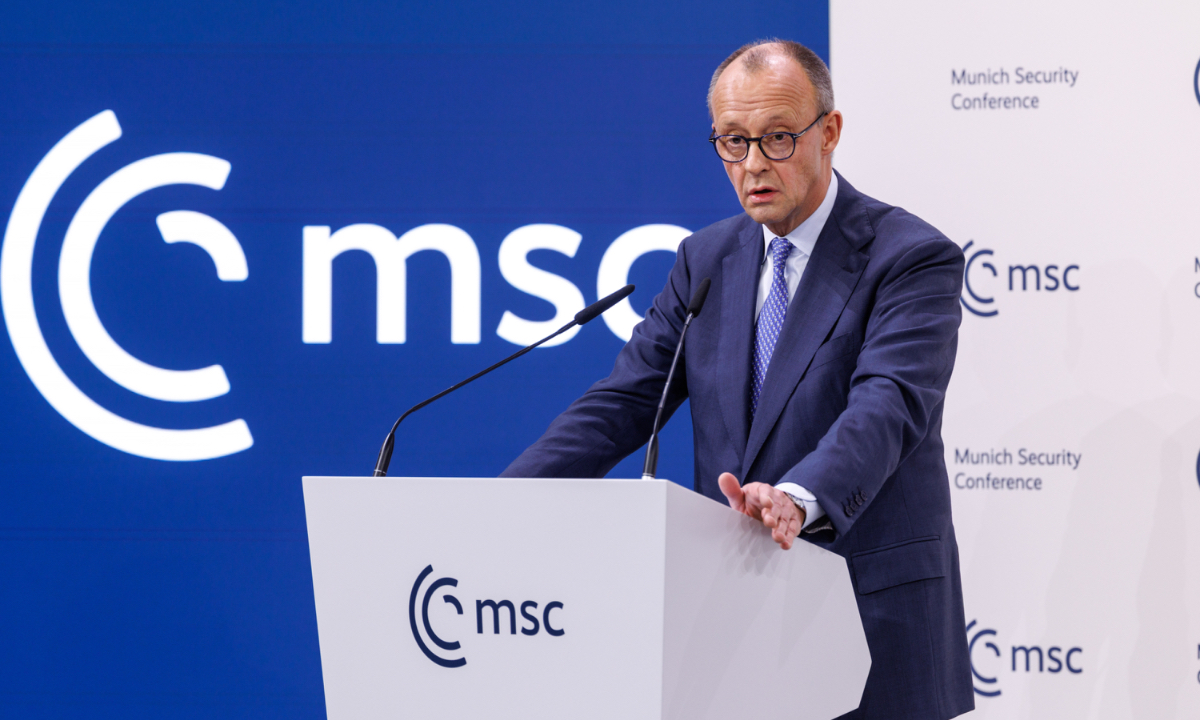
German Chancellor Friedrich Merz speaks at the opening of the Munich Security Conference at the conference hotel Bayerischer Hof in Munich, Germany on February 13, 2026. Photo: VCG
The 62nd Munich Security Conference (MSC) kicked off on Friday, where leaders from several European countries continued their call for a new transatlantic relationship, including German Chancellor Friedrich Merz, who issued warnings to the US leadership, but also calling for the restoration of transatlantic relations.Merz opened the conference on Friday with a blunt assessment of the widening transatlantic rift. According to Deutsche Welle, Merz said the old international rules-based order was being destroyed, adding that in an era of great power competition, "even the United States will not be powerful enough to go it alone."
He, thus, urged a new transatlantic partnership. Being a part of NATO is not only Europe's competitive advantage, but also the US' competitive advantage, Merz said. “So let's repair and revive transatlantic trust together."
The shadows of last year’s conference loomed large over this year’s discussions, as US Vice President J.D. Vance’s speech at the 2025 MSC sent shockwaves through the continent with its dismissive tone toward traditional European security concerns. According to The New York Times, Europeans are now talking about the current US administration “in terms that are more resigned and more urgent than a year ago.”
While Merz’s remarks on shifts in the global order aligns closely with the perspective elaborated by Canadian Prime Minister Mark Carney at last month’s Davos, Merz’s speech signaled a desire for Europe and the US to build a more stable relationship, Jiang Feng, a researcher at Shanghai International Studies University and president of the Shanghai Regional Studies Association, told the Global Times on Saturday.
It could be said that although transatlantic ties are no longer as tight as they once were, some forces in Europe still harbor a strong sense of "strategic nostalgia" for this bond, the Chinese scholar, who is attending this year’s MSC, added.
Merz’s speech amounted to a strategic repositioning of Germany: still anchored in NATO, but preparing for a future in which American guarantees are less reliable and Europe must carry more responsibility, Politico said.
Gao Jian, a senior researcher and Secretary General of the Shanghai Academy of Global Governance and Area Studies at Shanghai International Studies University, told the Global Times that the primary motivation behind Merz’s remark is to emphasize that the transatlantic relationship under the old world order remains the fundamental cornerstone for the US to maintain its hegemony. Yet, Europe’s continued illusions about the US are unrealistic and fundamentally inconsistent with reality, he said.
Merz’s suggestion to fix US-Europe ties seems to come in response to “threats” posed by other countries, including China, some European media outlets pointed out. A Politico report said on Friday that Merz paired his warnings about the US with a “hardening stance toward Beijing” ahead of a planned visit to China later this month, “accusing it of exploiting economic dependencies.”
The German leader failed to elaborate on the economic and technological opportunities China presents or how Europe might collaborate with China to shape a new world order in his address, which Jiang described as somewhat disappointing.
Leaders of some other European countries also highlighted a transformation in US-Europe relations during the MSC; however, experts noted there is a certain degree of differences among them in how to address the new reality.
Speaking at the event on Friday, French President Emmanuel Macron urged the continent to embrace "audacity" and become a geopolitical power in its own right. "This is the right time for a strong Europe," Macron told the MSC, emphasizing that "the Europeans must start this work with their own thinking and their own interests,” France 24 reported.
According to speech extracts released by his office, British Prime Minister Keir Starmer will argue in his MSC address on Saturday that Europe, "a sleeping giant" in his words, must shift from "overdependence to interdependence" while defining a vision for "greater European autonomy" that responds to the call for burden-sharing by forging a "new path towards sovereign deterrence and hard power."
Experts said there is a shared awareness of the reality in Europe that the old global order centered on the US has collapsed, yet, this does not equate to unified action across Europe. Germany still envisions a redeemable transatlantic relation, but some other European leaders highlighted the significance of greater European self-reliance.
Apart from remarks from Starmer, Saturday will see speeches from Chinese Foreign Minister Wang Yi and EU President von der Leyen.
US Secretary of State Marco Rubio is also scheduled to deliver a major address on Saturday. While Rubio is expected to avoid taking Vance's abrasive approach, the BBC reported, it is likely that his remarks will continue the line of rhetoric from the Trump administration regarding Europe, as the US resolve to reshape the transatlantic bilateral relationship is unlikely to change, Gao said.
The deep internal divisions over the way forward will be the biggest obstacle to Europe’s ability to translate the consensus on “strategic autonomy” into concrete action, experts noted.
RELATED ARTICLES