Chinese FM warns against Japan's challenge to post-war international order; remarks serve as a reminder to the international community against Japan’s militarist tendency: Chinese expert
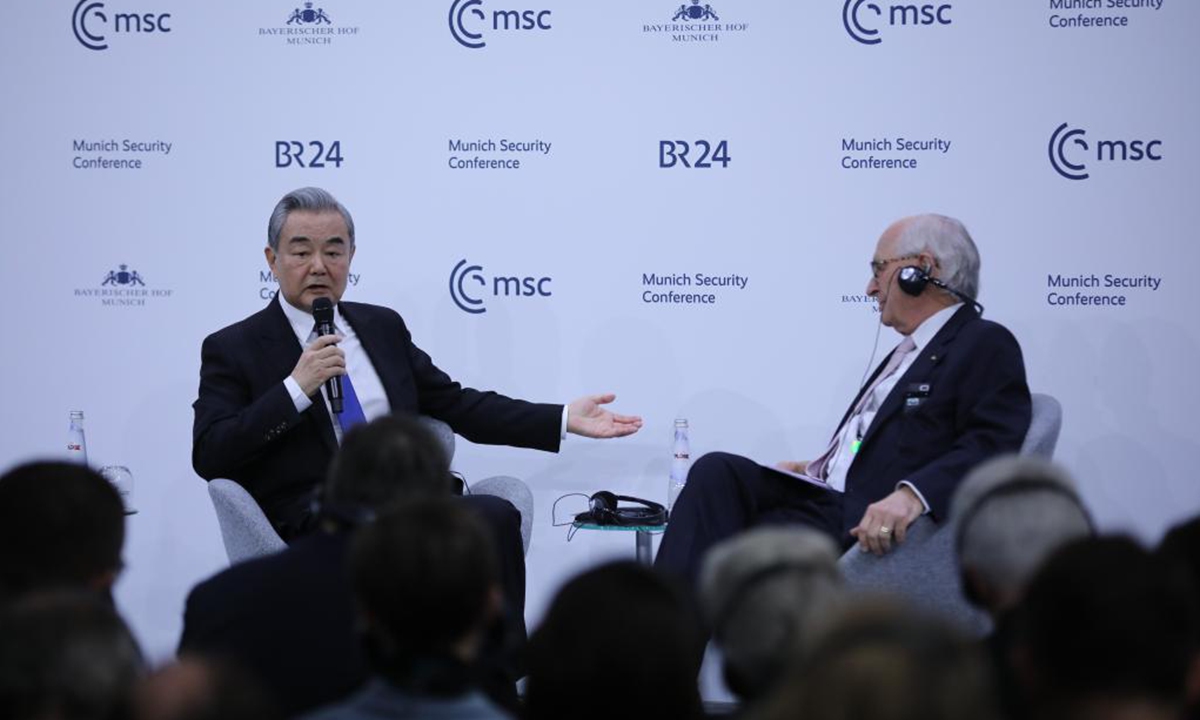
Chinese Foreign Minister Wang Yi, also a member of the Political Bureau of the Communist Party of China Central Committee, responds to questions after delivering a speech at the "China in the World" session of the Munich Security Conference in Munich, Germany, on Feb. 14, 2026. Photo: Xinhua
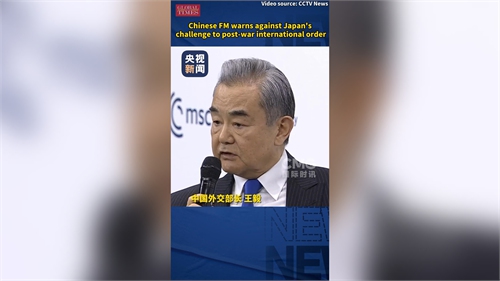
Chinese Foreign Minister Wang Yi on Saturday urged vigilance against recent dangerous trends in Japan, stating that the Japanese leadership's erroneous remarks regarding the Taiwan question directly challenge China's sovereignty and the post-war international order.
Wang, also a member of the Political Bureau of the Communist Party of China Central Committee, made the remarks at the "China in the World" session of the 62nd Munich Security Conference, where he delivered a speech and answered questions.
Responding to a question about China's responsibility for the re-escalation of tensions in the Asia-Pacific, Wang said he does not agree that the regional situation is increasingly tense. Looking around the world, only Asia maintains overall peace, Wang noted, adding that even recent local conflicts, such as those on the Cambodia-Thailand border, were quickly quelled through the efforts of all parties, with China playing a role.
China has become a pillar of peace in Asia and will continue to play a constructive role in regional stability as a significant force for global peace, he said.
However, Wang noted that the Asia-Pacific is not without its challenges, urging vigilance against recent dangerous trends in Japan.
He pointed out that the current Japanese prime minister has publicly claimed that any contingency in the Taiwan Straits would constitute a so-called "survival-threatening situation" for Japan to exercise collective self-defense. This is the first time in the 80 years since the war that a Japanese prime minister has publicly made such an outrageous statement, Wang said. He stressed that such remarks directly challenge China's national sovereignty, the post-war international order in which Taiwan was returned to China, and the political commitments Japan made to China. Wang emphasized that China will certainly not accept this, and neither will the 1.4 billion Chinese people.
Wang's remarks delivered a stern warning against the increasingly emboldened right wing in Japan and signs of a revival of militarist thinking, especially on matters related to China's internal affairs, including China's Taiwan region, Lü Chao, a professor at the Liaoning Academy of Social Sciences, told the Global Times.
Lü noted that following Japan's recent House of Representatives election, right-wing forces have become increasingly emboldened, stirs up public sentiment, amplifies ultra-nationalist emotions, and exerts pressure on the government's foreign policy. He said this has led to a contradictory posture within Japan's politics: on the one hand, Tokyo adopts tougher moves towards China, while on the other hand it makes what he described as insincere statements about seeking to restore relations with China. Wang's remarks issue stern warnings against this trend.
Lü further noted that Japan's recent detention of a Chinese fishing vessel reflects a mindset of testing limits and probing reactions, and Wang's remarks are a warning against such actions.
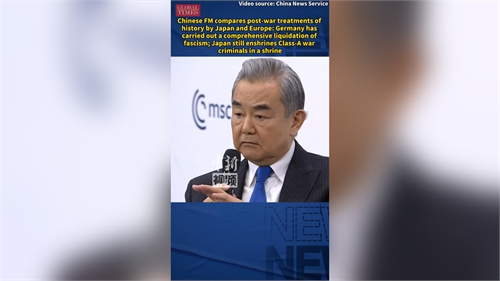
At the Munich Security Conference in Germany, Wang also compared how Japan and Europe have addressed their post-war history. He noted that Germany has carried out a comprehensive liquidation of fascism and enacted laws banning the promotion of Nazism. In contrast, Japan still enshrines Class-A war criminals in a shrine, where Japanese politicians frequently pay homage and revere them as "heroic souls." Such a phenomenon is unthinkable in Europe, Wang said, calling it a root cause of the problem.
The erroneous remarks by the Japanese leadership on the Taiwan question reveal that Japan's ambition to invade and colonize Taiwan has not died out, and the ghost of militarism is still lingering, Wang emphasized. He recalled that Japan launched its aggression against China and attacked Pearl Harbor in the U.S. under the pretext of a so-called "survival-threatening situation."
The lessons of history are not far away and must be closely examined. If Japan refuses to repent, it will inevitably repeat the same mistakes, and kind-hearted people should be vigilant. He reminded the Japanese people not to be blinded and coerced by far-right forces and extreme ideologies again, Wang said.
Wang urged all peace-loving countries to send a warning to Japan: if it attempts to return to its old path, it will bring about its own destruction, and if it gambles once more, it will only be defeated faster and suffer a harsher loss.
Wang's remarks comparing Europe's deep reckoning with its Nazi past with Japan's repeated denial of historical responsibility served to underscore China's position to the international community, and also served as a reminder to the international community against Japan's militarist tendency, Lü said.
Draw attention
Wang's remarks quickly drew attention from Japanese media outlets, with some highlighting different aspects of his criticism of Japan. NHK made a report titled " Chinese FM criticizes Japan at Munich Security Conference", saying "China has used international meetings and talks with other nations to further its criticism of Japan."
Jiji Press reported that Wang said remarks by Japanese leaders that a Taiwan contingency could constitute a so-called existential crisis for Japan directly violate Chinese territorial sovereignty and are absolutely unacceptable.
Oita Godo News took note of Wang's comparison between Japan and Germany, as well as his warning that "if Japan fails to correct its mistakes, history may repeat itself."
Some Japanese netizens also took notice of Wang's remarks, saying they felt the "severity" of Wang's warning, with a netizen identified as @lukmaanelha commented that Foreign Minister Wang Yi's warning was indeed "severe," adding that "Let us resolve the issue peacefully."
These reactions showed that many in Japan have sensed the gravity of the warning conveyed in Wang's remarks. The warning was notably more forthright, not only reaffirmed existing consensus, but also sought to caution the Japanese side against strategic miscalculations on sensitive issues such as history and China's Taiwan region. At the same time, it functioned as a form of "pre-warning" about future trajectories, urging Japan to confront both its historical responsibilities and present-day realities, while reiterating China's position to the international community, Lü said.
RELATED ARTICLES