Rubio offers seemingly ‘reassuring’ messages to Europe in Munich speech, but not substantive commitments Europe truly wants: Chinese experts
By Published: Feb 15, 2026 03:33 PM

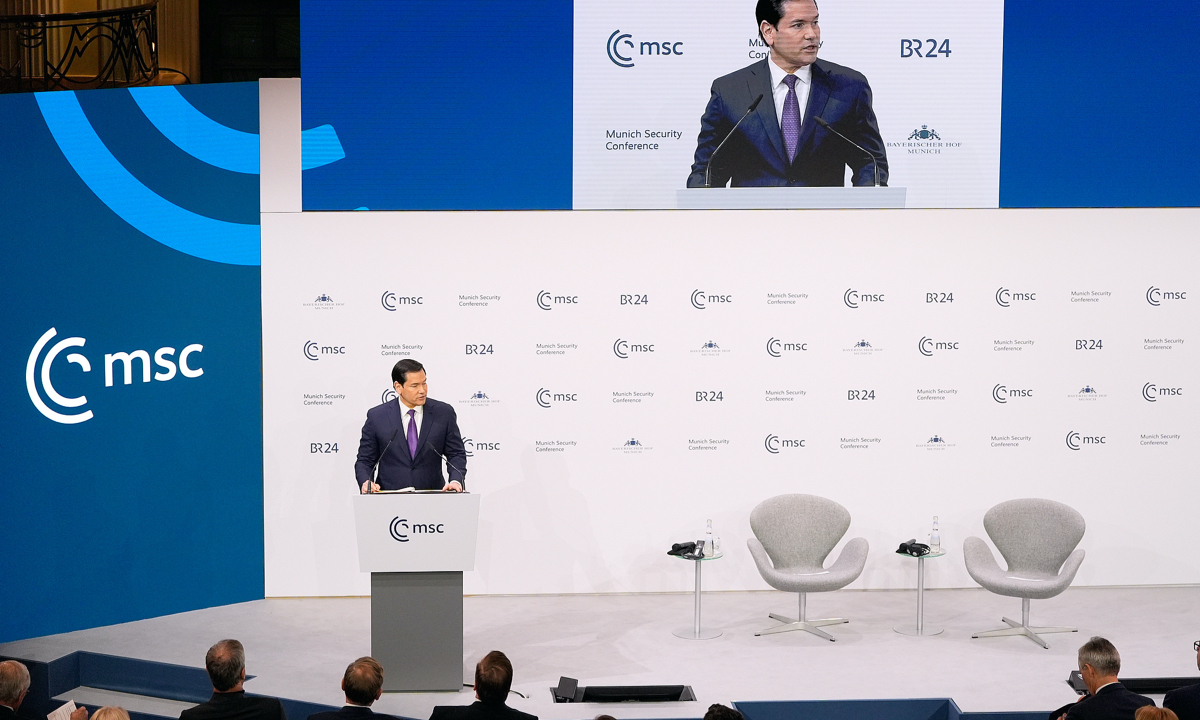
US Secretary of State Marco Rubio makes a speech to Europe at the Munich Security Conference on February 14, 2026. Photo: AP
One year ago, US Vice President JD Vance delivered a speech of unprecedented hostility toward Europe at the Munich Security Conference, marking a decisive moment in the rift between the US and Europe. Exactly a year after, when US Secretary of State Marco Rubio addressed the same conference to the same audience, the question -- where the transatlantic relationship will head -- still lingers.
While Rubio appeared to offer some reassurance to uneasy European leaders at the conference, saying the US remains committed to their long-standing partnership, he did not back down from underlying US demands that European countries change course on a number of fronts, including assuming more responsibility for their security, according to media reports.
Chinese observers said despite the seemingly softer tone of the US secretary of state at the Munich Security Conference, the US did not offer the substantive commitments Europe truly wants and needs, such as a commitment on Greenland, compromise on tariffs and support for Ukraine, and the transatlantic relationship is still subject to US hegemony and Europe should think deeply about the essence of strategic autonomy.
Seemingly reassuring tone
At the annual Munich Security Conference held on Saturday, Rubio reminded his European listeners about the US' centuries-long roots in Europe and said that the US would remain forever tied to the continent.
He told the Munich Security Conference: "We do not seek to separate, but to revitalize an old friendship and renew the greatest civilization in human history," BBC reported.
Rubio said it was "neither our goal nor our wish" to end the transatlantic partnership, adding: "For us Americans, our home may be in the Western Hemisphere, but we will always be a child of Europe."
"And I am here today to leave it clear that America is charting the path for a new century of prosperity, and that once again we want to do it together with you, our cherished allies and our oldest friends," he said, according to the report.
Rubio also attempted to defend the approach of the US in dealing with Europe.
"This is why we Americans may sometimes come off as a little direct and urgent in our counsel... The reason why, my friends, is because we care deeply. We care deeply about your future and ours," said Rubio, adding that "our destiny is and will always be intertwined with yours, because we know that the fate of Europe will never be irrelevant to our own."
"For the United States and Europe, we belong together," he said.
Rubio's speech appeared to offer European leaders some "reassurance."
"I was very much reassured by the speech of the Secretary of State... He said 'We want strong Europe in the Alliance', and this is what we are working for intensively in the European Union," EU Commission Chief Ursula von der Leyen said, according to Reuters, which also cited remarks by Finnish Foreign Minister Elina Valtonen who said that "I am very satisfied with the tone and I also think that the content was largely what we here in Europe expected."
Underlying messages
Nonetheless, while offering "reassurance," Rubio also delivered "subtle criticism," echoing the Trump administration's positions on issues such as mass migration and climate change, and at times needled European policymakers.
According to Reuters, Rubio implied that European leaders had turned their backs on worthwhile elements of the continent's past.
The CNN noted that Rubio reassured European leaders of US backing, but only if they change course: Europe has to assume more responsibility for its own security and share the same values as the US.
"We want allies who can defend themselves so that no adversary will ever be tempted to test our collective strength... we do not want allies to rationalize the broken status quo rather than reckon with what is necessary to fix it... we in America have no interest in being polite and orderly caretakers of the West's managed decline," Rubio said in his speech.
German media outlet DW, while noting European leaders' "cautious welcome" of "a softer tone" from the US, said that Rubio appeared to be advancing a "Trumpian narrative of what the West actually is."
"A lot of people here do seem to be relieved that it wasn't guns blazing like JD Vance, but when you listen closely to what Rubio was saying there was an awful lot of the kind of Trumpian view of nation that was going right through [the speech]," according to DW.
An opinion piece by a Bloomberg opinion columnist, titled "Rubio's Munich Civility Is a False Dawn for Europe," argued that the response from European leaders -- a collective sigh of relief -- would be a mistake given the US withdrawal of aid for Ukraine, the new National Security Strategy referring to Europe's "civilizational erasure," and the US threat to seize Greenland from Denmark.
On X, Gilles Bourdin, a Europe-based netizen, wrote that Rubio's speech was "a poisoned declaration of love" and "there was nothing reassuring about this speech," because "Rubio may have chosen a different tone than US Vice President JD Vance, but he did not change the content."
Raffaele Marchetti, director of the Center for International and Strategic Studies at Luiss University, Italy, told the Global Times on Sunday that such a "reassuring" message was provoked by growing resentment in Europe and remains hardly credible.
Newsweek reported on Friday that a survey conducted in the UK, France, Germany, Italy, Poland and Spain from February 5 to 12 found that up to one-third of respondents considered the US to be a major threat to Europe.
Meanwhile, French magazine Le Monde reported earlier this week a survey by the European Council on Foreign Relations that the US is no longer seen as a "necessary partner."
"Judging from the statements from high-level US officials, the US policy toward Europe is increasingly characterized by volatility, inconsistency, and a transactional approach. Washington is now more focused on extracting benefits from its allies than on providing them with reliable security guarantees. This not only strains transatlantic relations but also poses deeper challenges to the broader alliance system underpinning US hegemony. More importantly, it lays bare the growing instability and fragility of the foundations of American global leadership," He Zhigao, a research fellow with the Institute of European Studies from the Chinese Academy of Social Sciences, told the Global Times on Sunday.
The transatlantic relationship is still subject to US hegemony and will shift in line with changes to the US policy to serve US interest, He added.
Dong Yifan, an associate research fellow at the Belt and Road Academy of Beijing Language and Culture University, told the Global Times that Europe should think rationally and deeply, amid the changing landscape, about the essence of strategic autonomy and how to advance it.
"As Europe grapples with economic, geopolitical and security agendas, it should be clear about its cooperation directions," said Dong.
RELATED ARTICLES