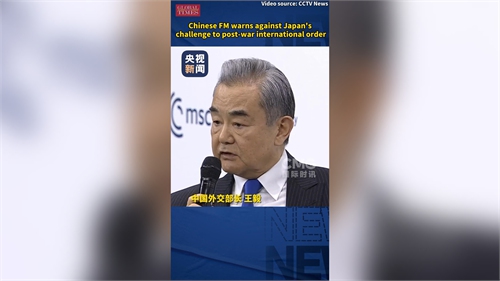
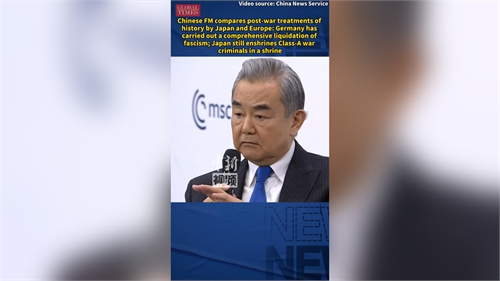
Chinese FM's call for major countries to practice multilateralism at Munich Security Conference draws intl attention; expert says speech reaffirms China’s commitment to global co-op
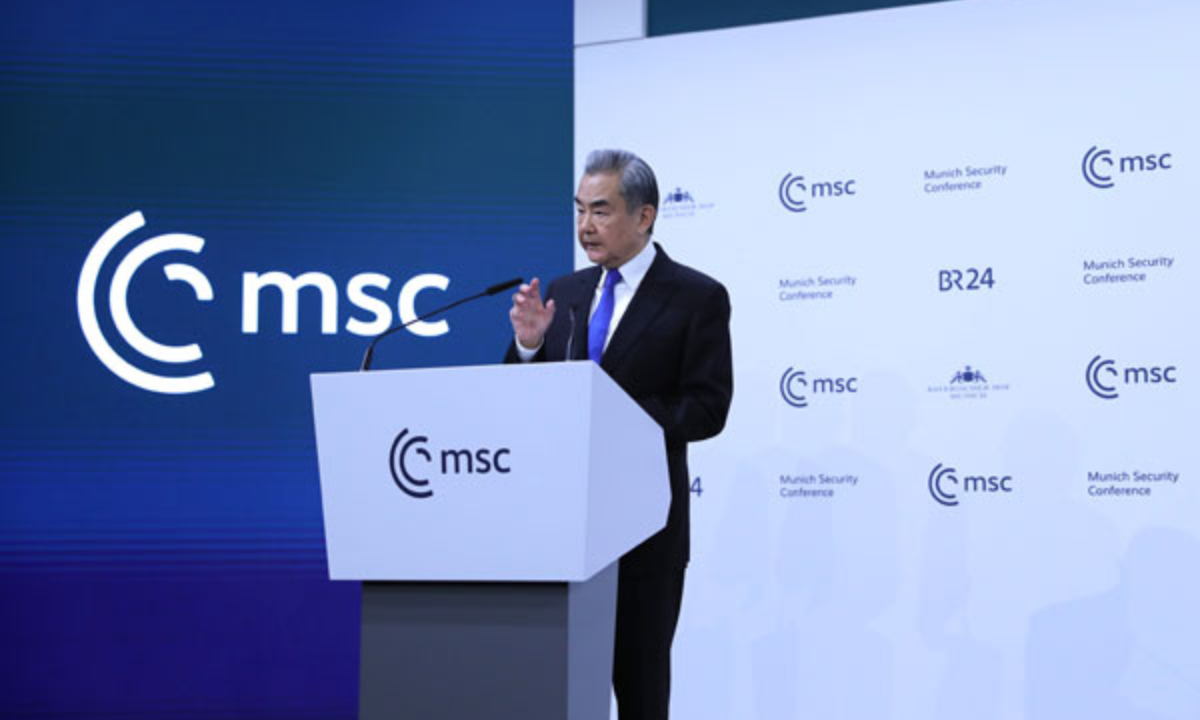
Chinese Foreign Minister Wang Yi, also a member of the Political Bureau of the Communist Party of China Central Committee, delivers a keynote speech during the “Conversation with China” session at the Munich Security Conference in Munich, Germany, on Feb. 14, 2026. Photo: China’s Ministry of Foreign Affairs
In reforming and improving global governance, multilateralism should always be upheld. The monopolization of global power by a small number of countries is unpopular. We live in a multipolar world and need to practice true multilateralism, Chinese Foreign Minister Wang Yi said in a keynote speech on Saturday at the Munich Security Conference, calling on major countries to practice multilateralism and lead by example.
Wang, also a member of the Political Bureau of the Communist Party of China Central Committee, made the remarks while delivering a keynote speech during the “Conversation with China” session at the conference, and further stressed that the priority is to revitalize the United Nations system, and that in reforming and improving global governance, the key lies in the collaboration and cooperation of all countries.
Wang said that major countries should take the lead in pursuing cooperation, instead of conflict or confrontation.
He noted that over the past year, the international landscape was marked by growing transformations and turbulence, and the law of the jungle and unilateralism went rampant. Humanity has come to a new crossroads in the cause of peace and development. The Global Governance Initiative (GGI) aligns with the progressive trend of the times, represents the biggest common ground of the world’s nations, and has thus received widespread response from the international community shortly after its announcement.
China’s approach to the world has always been consistent and clear, particularly amid profound global changes, Huang Ping, director of the Institute of European Studies at the Chinese Academy of Social Sciences, told the Global Times. Wang’s speech, he noted, was both timely and coherent, reaffirming China’s commitment to multilateralism, global cooperation and win-win outcomes in an increasingly volatile world.
The speech also drew international media attention, highlighting Wang’s emphasis on multilateralism and partnership with Europe.
Germany’s Deutsche Welle reported that Wang called for strengthening the United Nations’ central role and opposing unilateralism.
Reuters reported that Wang warned against "knee-jerk" calls for the US to distance itself from China. He called for a ‘positive and pragmatic’ policy from Washington, saying the best outcome would be cooperation.
Huang noted that a sense of multilateralism and cooperation ran throughout Wang’s speech and responses.
When responding to a question on China-Europe relations at the conference after the speech, Wang said China and Europe are partners, not rivals, and “certainly not ‘systemic rivals,’” according to a release of the Chinese Foreign Ministry.
He pointed out that China and Europe have engaged for more than half a century, with daily trade now exceeding $2 billion—more than the total annual trade volume before diplomatic ties were established—and hundreds of cooperation mechanisms operating smoothly. Labeling China a “systemic rival,” he said, reflects a negative mindset and a flawed perception that, if amplified, would interfere with the future of China-Europe relations.
Though Wang acknowledged differences between China and Europe in social systems, values and development models, he said these stem from their respective histories and cultures and reflect the choices of their peoples. Differences, he stressed, are not grounds for confrontation, according to the release.
In talks with German Chancellor Friedrich Merz, he said China’s commitment to high-level opening-up will continue to offer broad opportunities for German businesses, while expressing hope that Germany will provide a fair and non-discriminatory business environment for Chinese companies. He added that both sides should prepare for the next phase of high-level exchanges, expand practical cooperation and explore trilateral cooperation to elevate their comprehensive strategic partnership.
Merz said in response that China has achieved remarkable development and has become a major global power with a significant role in international affairs. He noted that Germany and China have close economic and trade ties, and both benefit from globalization. Merz emphasized the need to seize opportunities, deepen cooperation, and encouraged German companies to increase investment in China. He also reaffirmed Germany’s commitment to the one-China policy and looked forward to closer high-level exchanges and cooperation across various fields, according to the Chinese Foreign Ministry’s release
Wang did not shy away from acknowledging differences between China and Europe but placed them in historical and developmental context, Huang noted. He added that Europe is undergoing a process of rethinking—reassessing its relationship with China, reexamining internal dynamics among its member states, and recalibrating ties with the United States and across the Atlantic.
Facing new challenges in technology and trade, some European countries, including Germany, are beginning to adopt a more pragmatic view of China as a partner in sustainable, long-term cooperation.
This shift, Huang added, reflects a growing pragmatism in Europe—one that no longer treats China’s development simply as a threat, but is increasingly in favor of dialogue and stable trade ties. Such changes, he said, are in part a response to China’s consistent, responsible major-country diplomacy and its efforts to provide stability and constructive engagement in a changing world through the four global initiatives.
On the sidelines of the conference, Wang held meetings with several European leaders, including Serbian President Aleksandar Vucic, Austrian Foreign Minister Beate Meinl-Reisinger, British Foreign Secretary Yvette Cooper, German Foreign Minister Johann Wadephul and French Foreign Minister Jean-Noel Barrot, according to an official release from the Chinese Foreign Ministry.
RELATED ARTICLES