'Embarrassment': international media, netizens scrutinize Indian university’s false claim about Chinese robodog at AI summit
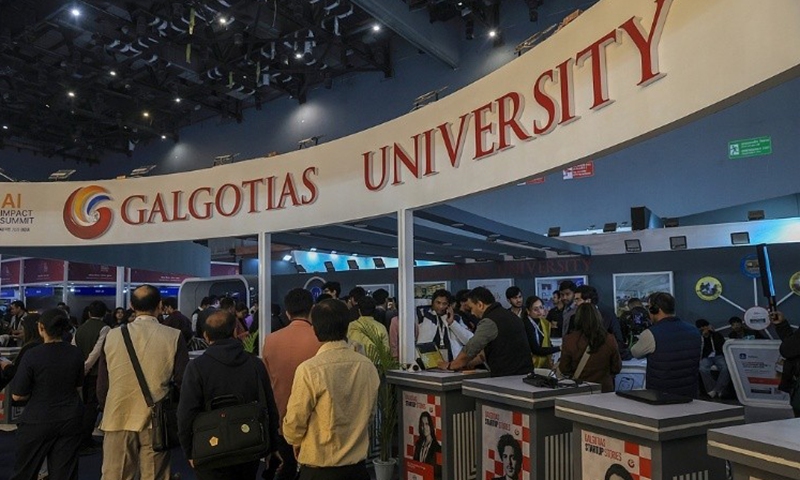
A view of Galgotias University's booth at the AI Impact Summit 2026 in New Delhi, India, on February 18, 2026. Photo: VCG
International and Indian media continue to scrutinize India's Galgotias University's reported false claim of a Chinese-made robotic dog as its own innovation at the India AI Impact Summit 2026, with some describing the episode as an "embarrassment" for the host country.
As the incident unfolds, Indian netizens have begun examining whether the Indian university had "borrowed" more innovation from other countries, further intensifying public discussion about academic accountability at high-profile government-backed events in India.
The incident was an embarrassment for host country India, the Associated Press (AP) reported Thursday (US time), citing two anonymous Indian government officials.
The embarrassment was amplified by IT Minister Ashwini Vaishnaw, who shared the video clip on his official social media account before the backlash. The post was later deleted, Reuters reported.
The Indian university was ordered to take down its stand at the top AI summit in New Delhi on Wednesday amid intensifying criticism, according to AP, citing two Indian government officials. Power supply to the pavilion of the university was reportedly cut before the team cleared the premises, according to Times of India.
Meanwhile, some media outlets and internet users are continuing to investigate whether other products displayed by the university were also manufactured by other countries, according to reports.
The criticism against the university intensified after their reported false claim about the Chinese robodog, as a soccer drone showcased by the university is under scanner, Hindustan Times reported, saying that several internet users noted that a drone showcased by the university looked similar to the soccer drone developed by South Korea's Helsel Group.
"First China, now [South] Korea. Galgotias is on a world tour of 'borrowed' innovation. They claimed to have built India's first Drone Soccer from scratch on campus, but it's actually just a Striker V3 ARF from Korea," the Indian Youth Congress posted on social media X.
These harsh commentary and scrutiny on the Indian university came after its professor of communications, Neha Singh, told Indian state-run broadcaster DD News that robotic dog Orion was developed by the Centre of Excellence at the university, but the robotic dog was quickly identified by online users as a commercially available Chinese-made robot, the Unitree Go2, with a starting price tag of $1,600, according to AP.
Under mounting pressure, Singh on Wednesday told reporters she never explicitly claimed the robodog was the university's own creation, but in a statement on Wednesday, the university apologized for the confusion and said Singh, its representative at the AI summit pavilion, was not authorized to talk to the media and was "ill-informed," Indian media out The Economic Times reported.
However, specifically, in a clip aired by DD News, Singh said the robot "has been developed by the Centre of Excellence at Galgotias University," and described its surveillance and monitoring capabilities, according to the Times of India.
Besides the apology statement, the university admitted in two previous statements on X that the recently acquired robodog from Unitree is one step in their endeavour to make students to learn AI and experimenting with it. The Sunday Guardian reported that the university said, "Let us be clear: Galgotias has not built this robodog, nor have we ever claimed to."
What the incident brought under pressure was not only the Indian university and professor, but also technology representation and academic accountability in India, according to media reports.
While the scrutiny continue, the incident has sparked debate not just about technology representation but also about academic accountability at high-profile government-backed events [in India], the Sunday Guardian reported.
AP noted that the incident underscores the high stakes for India as the country tries to cast itself as a global hub for AI and advanced manufacturing.
Indian opposition leader Rahul Gandhi described the summit as a "disorganized pr spectacle," questioning why Chinese products were being showcased at an event meant to project India's AI ambitions, the Times of India reported.
The annual summit is the fourth of its kind, with previous meetings being held in France, South Korea and the UK.
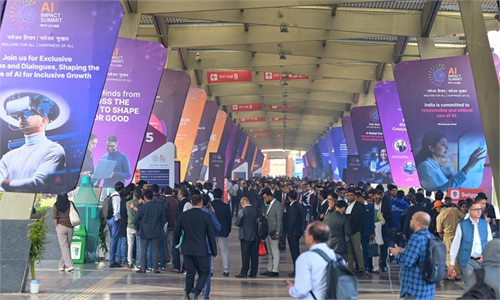
The summit started on Monday with some organizational hiccups as attendees and exhibitors reported long lines and delays at the venue. Some exhibitors also complained on social media that their personal belongings and products on display were stolen. Organizers later said the items were recovered and returned, according to the AP report.
Although Galgotias University on Tuesday said the it was "deeply pained," the university's apology and blame on the professor did little to ease scrutiny from Indian and international media. The incident was followed by "swift ridicule and political criticism," the Times of Indian reported, noting that critics have alleged that an imported Chinese product had been presented as an in-house innovation at a summit that is designed to spotlight India's domestic AI capability.
"It's very bad however it is clear that India can only import," a X user named Arun Gaur commented the Indian Youth Congress' post about the incident.
"Guess, it won't be wrong to call this 'International Chori (means 'theft' or 'stealing' in Hindi) Summit' or 'Make India the World's Laughingstock,'" an Indian netizen named OJJ commented.
Global Times
RELATED ARTICLES