Editor's Note:
This year marks the 105th anniversary of the founding of the Communist Party of China (CPC) and the opening year of the 15th Five-Year Plan (2026-30). A new year begins with new resolve and new momentum. The call to "fight for our dreams and our happiness, and turn our great vision into beautiful realities" continues to inspire actions across China.
In the column "New Year on the Frontlines," reporters from the People's Daily traveled to the grassroots to witness the vitality of a vast nation, see its mountains and rivers in motion and its fields in abundance, and listen to the stories of people finding fulfillment in both life and work.
Through these stories, the column seeks to present a vivid portrait of Chinese modernization.
Mist shrouds Baishanzu National Park in Lishui, East China's Zhejiang Province, as a fine drizzle falls.
"In weather like this, I have to check on those fir trees in person to put my mind at ease," says Lan Rongguang, head of the Baishanzu Protection Station at the Qingyuan Conservation Center within the Qianjiangyuan-Baishanzu National Park candidate site. He picks up his well-worn wooden walking stick, smooth from years of use, and heads into the forest.
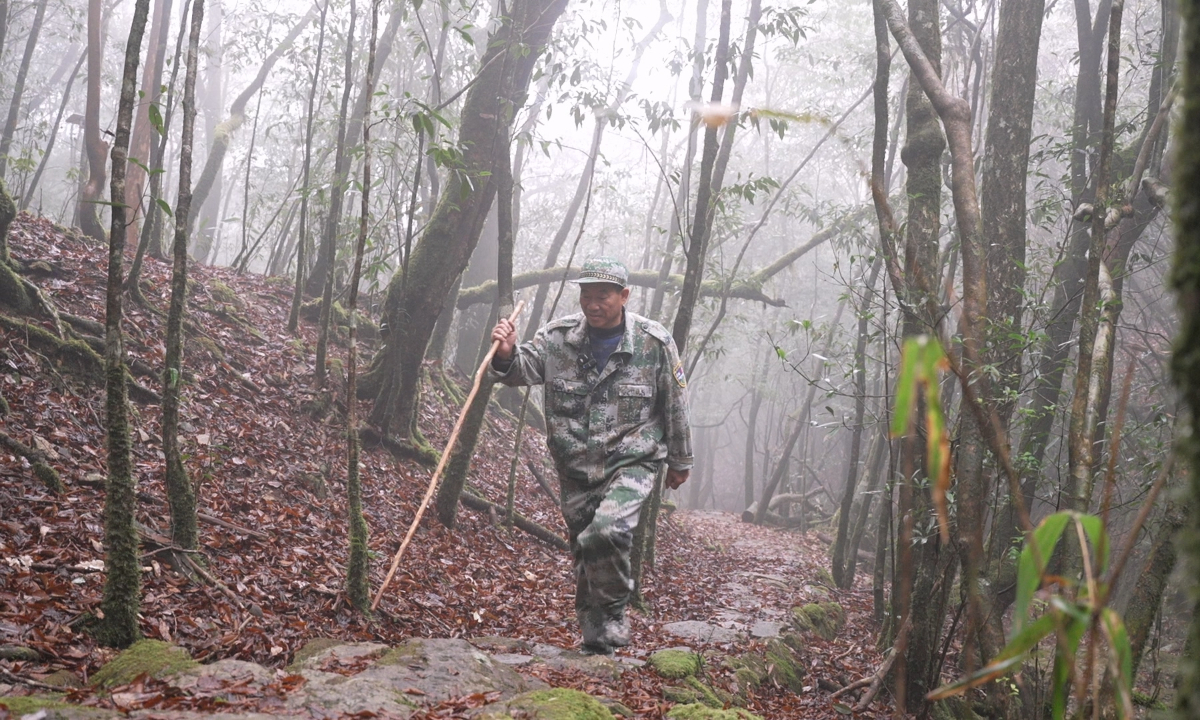
The mountain path to the firs' habitat is lined with stone steps perpetually covered in moss, making them treacherously slippery in the rain. Yet 56-year-old Lan moves with surprising agility.
He knows this patrol route like the back of his hand and goes through two or three pairs of rubber boots a year. Years of tramping through cold, damp mountain forests have left him with chronic rheumatism, and his joints ache when it rains or turns cloudy. Once, during a patrol, he slipped badly on the rocks and needed four stitches in his leg. Yet after just a few days of rest, he toughed it out and returned to the mountains.
For 56 years, two generations of the Lan family have walked this winding patrol route.
Lan's father was one of the first forest rangers at Baishanzu. In 1994, while escorting students down the mountain, an accident occurred and he sacrificed his life to save the students. That year, Lan Rongguang, just over 20, suppressed his grief and resolutely took up his father's work.
Deep in the dense forest at 1,755 meters, three Baishanzu firs, known as the "panda of the plant world," stand quietly. As a Quaternary glacial relict endemic to China and a national first-class protected wild plant, the Baishanzu fir, or Abies beshanzuensis, ranks among the world's most endangered rare species.
"When I first started this job, the smallest one was only six or seven meters tall. Now it's grown to 12 or 13 meters," Lan Rongguang said as he skillfully pulled weeds from around the roots and carefully recorded the growth of its branches and leaves. "Watching them grow day by day, these firs are just like my own children," he added.
Though the protection station has now been equipped with modern tools like drones and remote monitoring, Lan still insists, "Only by seeing them with my own eyes and touching them with my own hands can I truly feel at ease."
As night fell and a bitter wind howled outside, warmth filled the station. Lan held his young grandson in his arms, pointing to the firs on the monitor and telling him stories of the mountains. For this guardian of the trees, safeguarding the mountain forest and its rare firs is his most sincere and steadfast wish for the Chinese New Year.
Wu Mengfei contributed to this article
This year marks the 105th anniversary of the founding of the Communist Party of China (CPC) and the opening year of the 15th Five-Year Plan (2026-30). A new year begins with new resolve and new momentum. The call to "fight for our dreams and our happiness, and turn our great vision into beautiful realities" continues to inspire actions across China.
In the column "New Year on the Frontlines," reporters from the People's Daily traveled to the grassroots to witness the vitality of a vast nation, see its mountains and rivers in motion and its fields in abundance, and listen to the stories of people finding fulfillment in both life and work.
Through these stories, the column seeks to present a vivid portrait of Chinese modernization.
Mist shrouds Baishanzu National Park in Lishui, East China's Zhejiang Province, as a fine drizzle falls.
"In weather like this, I have to check on those fir trees in person to put my mind at ease," says Lan Rongguang, head of the Baishanzu Protection Station at the Qingyuan Conservation Center within the Qianjiangyuan-Baishanzu National Park candidate site. He picks up his well-worn wooden walking stick, smooth from years of use, and heads into the forest.
Lan Rongguang heads into the forest to check on fir trees. Photo: Courtesy of Wu Mengfei
The mountain path to the firs' habitat is lined with stone steps perpetually covered in moss, making them treacherously slippery in the rain. Yet 56-year-old Lan moves with surprising agility.
He knows this patrol route like the back of his hand and goes through two or three pairs of rubber boots a year. Years of tramping through cold, damp mountain forests have left him with chronic rheumatism, and his joints ache when it rains or turns cloudy. Once, during a patrol, he slipped badly on the rocks and needed four stitches in his leg. Yet after just a few days of rest, he toughed it out and returned to the mountains.
For 56 years, two generations of the Lan family have walked this winding patrol route.
Lan's father was one of the first forest rangers at Baishanzu. In 1994, while escorting students down the mountain, an accident occurred and he sacrificed his life to save the students. That year, Lan Rongguang, just over 20, suppressed his grief and resolutely took up his father's work.
Deep in the dense forest at 1,755 meters, three Baishanzu firs, known as the "panda of the plant world," stand quietly. As a Quaternary glacial relict endemic to China and a national first-class protected wild plant, the Baishanzu fir, or Abies beshanzuensis, ranks among the world's most endangered rare species.
"When I first started this job, the smallest one was only six or seven meters tall. Now it's grown to 12 or 13 meters," Lan Rongguang said as he skillfully pulled weeds from around the roots and carefully recorded the growth of its branches and leaves. "Watching them grow day by day, these firs are just like my own children," he added.
Though the protection station has now been equipped with modern tools like drones and remote monitoring, Lan still insists, "Only by seeing them with my own eyes and touching them with my own hands can I truly feel at ease."
As night fell and a bitter wind howled outside, warmth filled the station. Lan held his young grandson in his arms, pointing to the firs on the monitor and telling him stories of the mountains. For this guardian of the trees, safeguarding the mountain forest and its rare firs is his most sincere and steadfast wish for the Chinese New Year.
Wu Mengfei contributed to this article
RELATED ARTICLES