
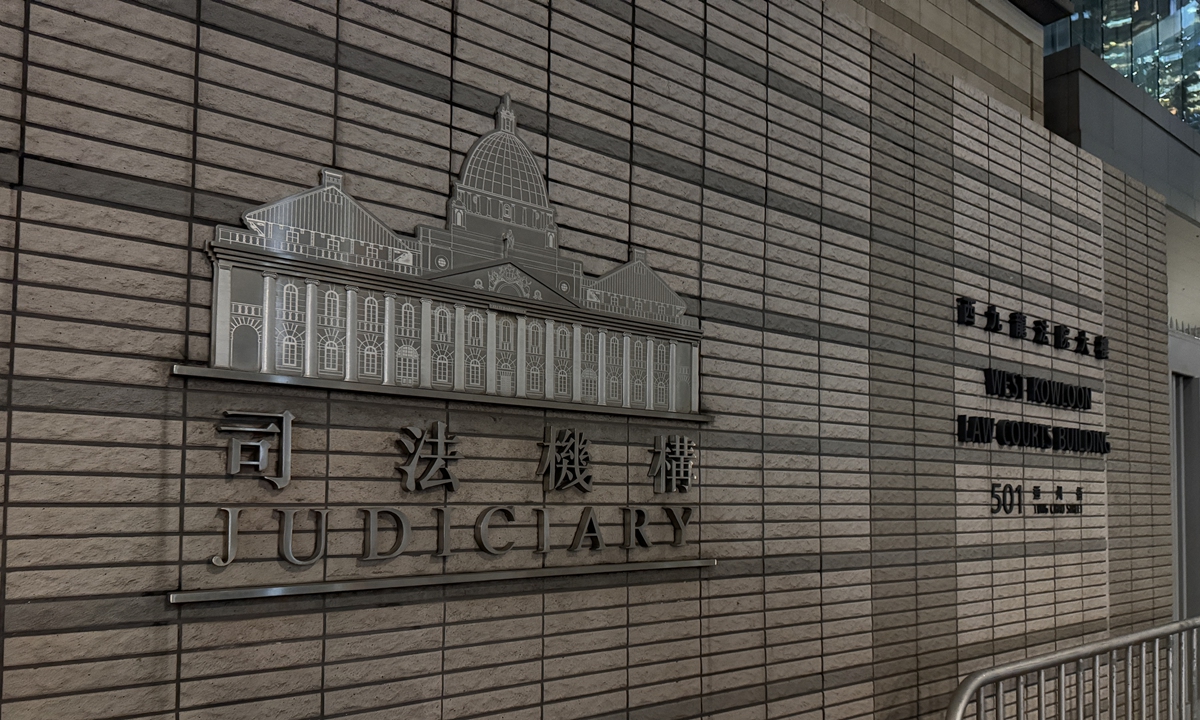
Hong Kong's West Kowloon Court Building Photo: VCG
Hong Kong Special Administrative Region (HKSAR)'s Court of Appeal on Monday morning dismissed the appeals by 12 defendants prosecuted in the high-profile case of conspiracy to subvert state power who sought to overturn their convictions or have their sentences reduced, multiple Hong Kong media outlets reported.
Concurrently, the appellate court on Monday also upheld the acquittal of one of 47 defendants prosecuted in the high-profile case of conspiracy to subvert state power, South China Morning Post (SCMP) reported. The Department of Justice's (DoJ) appeal regarding the acquittal of Barrister Lawrence Lau Wai-chung has been dismissed, thereby upholding his not-guilty verdict, Ming Pao reported.
Chinese experts reached by the Global Times on Monday commented that this outcome not only severely punishes acts that endanger national security but also firmly protects the legal rights of defendants, embodying the true spirit of the rule of law and judicial independence. This meticulous, rigorous, and fair judicial practice solidifies the cornerstone of the rule of law under "one country, two systems," demonstrating to the world that while upholding national security, Hong Kong's proud "golden brand" of the rule of law shines even brighter, experts said.
SCMP reported that former lawmakers Helena Wong Pik-wan, Lam Cheuk-ting, Raymond Chan Chi-chuen and "Long Hair" Leung Kwok-hung sought to overturn their convictions, as did ex-district councillors Clarisse Yeung Suet-ying, Kalvin Ho Kai-ming and Tat Cheng Tat-hung, and Gwyneth Ho Kwai-lam, Owen Chow Ka-shing, Winnie Yu Wai-ming and Gordon Ng Ching-hang. All but Gwyneth Ho also sought more lenient sentences if the convictions were upheld.
Also, Prince Wong Ji-yuet, who pleaded guilty, appealed against her 53-month sentence.
According to Mingpao.com, Lee Tsz-shun, another defendant who was acquitted in the same case, was also present.
According to the Xinhua News Agency, in January 2021, Hong Kong police arrested more than 50 people suspected of organizing or participating in the so-called "primary election" in 2020. They allegedly breached "conspiracy to subvert the state power" under the national security law in Hong Kong. Among them, 47 were prosecuted by the Department of Justice of the HKSAR government. They included Benny Tai, and former lawmakers such as Wu Chi-wai, Lam Cheuk-ting and Alvin Yeung. They were charged with one count of conspiracy to subvert the state power.
The case was first heard at the West Kowloon Magistrates' Courts from March 1 to 4, 2021, before being transferred to the High Court for further proceedings. During the trial, 31 individuals pleaded guilty, while 16 refused to plead guilty, Xinhua reported.
After continued hearings, on May 30, 2024, the court delivered its verdict on the 16 individuals who refused to plead guilty. Fourteen were found guilty and two were acquitted.
The High Court of HKSAR in November 2024 delivered sentences to the 45 individuals convicted of "conspiracy to subvert the state power" to imprisonment ranging from 50 months to 10 years, Xinhua reported.
"Today's ruling is a vivid and powerful manifestation of the rule of law in Hong Kong. The Court of Appeal dismissed the appeals by the 12 defendants in accordance with the law, which underscores the authority of the national security law for Hong Kong and the seriousness of the rule of law," Willy Fu, a law professor who is also the director of the Chinese Association of Hong Kong & Macao Studies, told the Global Times on Monday.
"At the same time, the court also dismissed the DOJ's appeal concerning Lau Wai-chung, upholding the principle that 'the benefit of the doubt goes to the defendant.' This outcome fully demonstrates that Hong Kong's judicial authorities adjudicate independently based entirely on facts and the law. They not only severely punish acts that endanger national security but also firmly protect the legal rights of defendants, embodying the true spirit of the rule of law and judicial independence," Willy Fu said.
Tian Feilong, a vice-dean of the Law School of Minzu University of China in Beijing and director of the Chinese Association of Hong Kong and Macao Studies, told the Global Times on Monday that this ruling aligns with the original intent of the national security law for Hong Kong, consolidates the institutional security of "one country, two systems," and further enriches and clarifies the criteria for precedents within Hong Kong's national security law system. It also contributes to a better understanding and confidence among Hong Kong society and the international community regarding the spirit of the rule of law, judicial independence, and legal standardization under the national security law for Hong Kong.
"This meticulous, rigorous, and fair judicial practice demonstrated to the world that while upholding national security, Hong Kong's judicial procedures remain open, transparent, and standardized, making Hong Kong's proud 'golden brand' of the rule of law shine even brighter," Willy Fu said.
Willy Fu added that a predictable, safe, and fair business environment can effectively stabilize market confidence, attract investors from around the world, and allow Hong Kong to focus its energies on "striving for economic development and improving people's livelihoods," better integrating into the country's overall development landscape.