Mexican drug lord killed in US-assisted raid, Chinese Embassy issues security advisory; eradicating drug cartels needs to address root issues, says expert
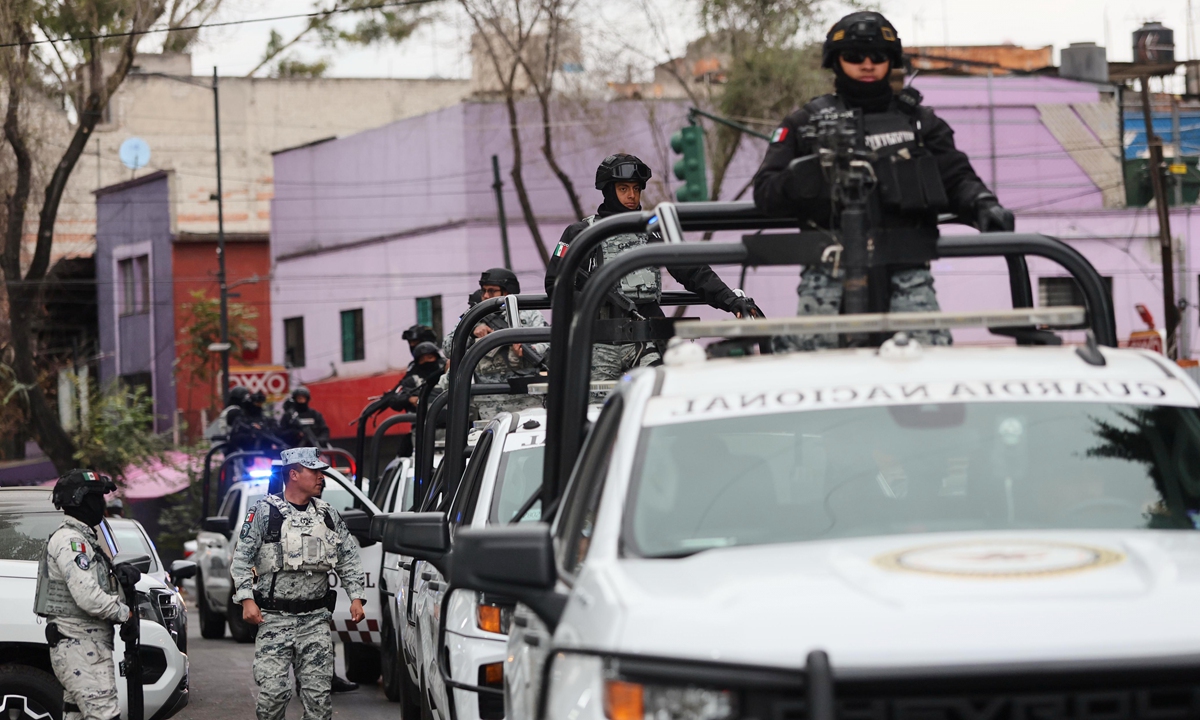
National Guards patrol the area outside of the General Prosecutor's headquarters in Mexico City, Sunday, Feb. 22, 2026, after authorities reported that the Mexican Army killed Jalisco New Generation Cartel leader Nemesio Oseguera Cervantes, known as "El Mencho." Photo: VCG
Chinese Embassy in Mexico reminded Chinese citizens in the country to stay alert to local security situation on Monday, following violent clashes erupting across Mexico after death of drug lord Nemesio Oseguera Cervantes, also known as "El Mencho," described by media outlets as the powerful and long-pursued head of the Jalisco New Generation Cartel and one of the world's most-wanted traffickers.
What made this operation special is that a new US-military-led task force specializing in intelligence collection on drug cartels played a role in the Mexican military raid on Sunday, according to a Reuters report.
Mexican authorities killed the drug lord during an operation designed to capture him in the western state of Jalisco. Mexico's Ministry of National Defense confirmed the operation in a statement on Sunday, stating it left seven cartel members dead. The military also arrested two more cartel members and seized armored vehicles and weapons, including rocket launchers, media reports said.
The Joint Interagency Task Force-Counter Cartel, which involves multiple US government agencies, was formally launched last month with the goal of mapping out networks of drug cartel members on both sides of the US-Mexico border, per Reuters.
This operation represents a concrete implementation under the US-Mexico bilateral security cooperation framework, Pan Deng, director of the Latin America and Caribbean Region Law Center at the China University of Political Science and Law, told the Global Times on Monday.
With the fentanyl crisis spiraling in the US, Washington has consistently treated Mexican cartels as a national security threat, and in the short term, this operation will push the Mexican government, with US backing, to launch targeted crackdowns against the drug group remnants and reinforce security in high-risk areas to contain retaliatory violence, said Pan.
Pan told the Global Times that the US participation enhanced the operation's immediate effectiveness. However, he noted that Washington's involvement in Mexico's internal security operations inevitably touches upon the sovereign autonomy of Latin American nations. It lays bare the persistent asymmetry in hemispheric security cooperation—a dynamic fundamentally at odds with the region's long-term need for equal consultation and independent governance.
The operation set off a wave of violence, with torched cars and gunmen blocking highways in more than half a dozen states, according to Reuters.
The Chinese embassy notice released on early Monday, read that on February 22, relatively serious public security incidents occurred in several Mexican states, including Jalisco, Michoacán, Nayarit, Guanajuato, Colima, Baja California, and Tamaulipas. Relevant state governments have issued red alerts or advisories, urging residents to stay indoors as much as possible and avoid going out. They have also announced the suspension of public transportation services and some public activities.
Mexico's Federal Ministry of Communications and Transportation has issued a warning advising the public to avoid traveling on federal highways in the affected states, and to drive with extreme caution if travel is absolutely necessary, the embassy said in the notice.
The Chinese Embassy and consulates in Mexico are closely monitoring the public security situation in the affected areas and remind Chinese citizens and institutions in Mexico to remain highly vigilant, pay close attention to notices and announcements issued by local government authorities, and strictly comply with them. In the event of an emergency, Chinese citizens are reminded to promptly call the local police and contact the Chinese Embassy or Consulate in Mexico as appropriate, the notice said.
As a result of the violence in Mexico, several airlines, including Delta Air Lines, Alaska Airlines, American Airlines and Air Canada, cancelled flights to Puerto Vallarta and Guadalajara, leaving some tourists temporarily stranded, a CNN report said.
During the military operation, Jalisco local governor urged residents to remain in their homes and said that public transportation services in Jalisco would be suspended "until the situation is under control."
The US State Department also warned US citizens in several Mexican states, including in the tourist destination Puerto Vallarta, to shelter in place, Forbes said in a report.
Killing a cartel leader may trigger internal power regroup, but not collapse, Pan added, noting that the deeper drivers including poverty, corruption, weak institutions, and America's huge drug demand remain untouched. Addressing it at its source requires focusing on fundamental problems such as uneven development and social welfare guarantees.
RELATED ARTICLES