Unitree showcases 49 humanoid robots performing synchronized martial arts demo at Temple of Heaven after Spring Festival Gala show
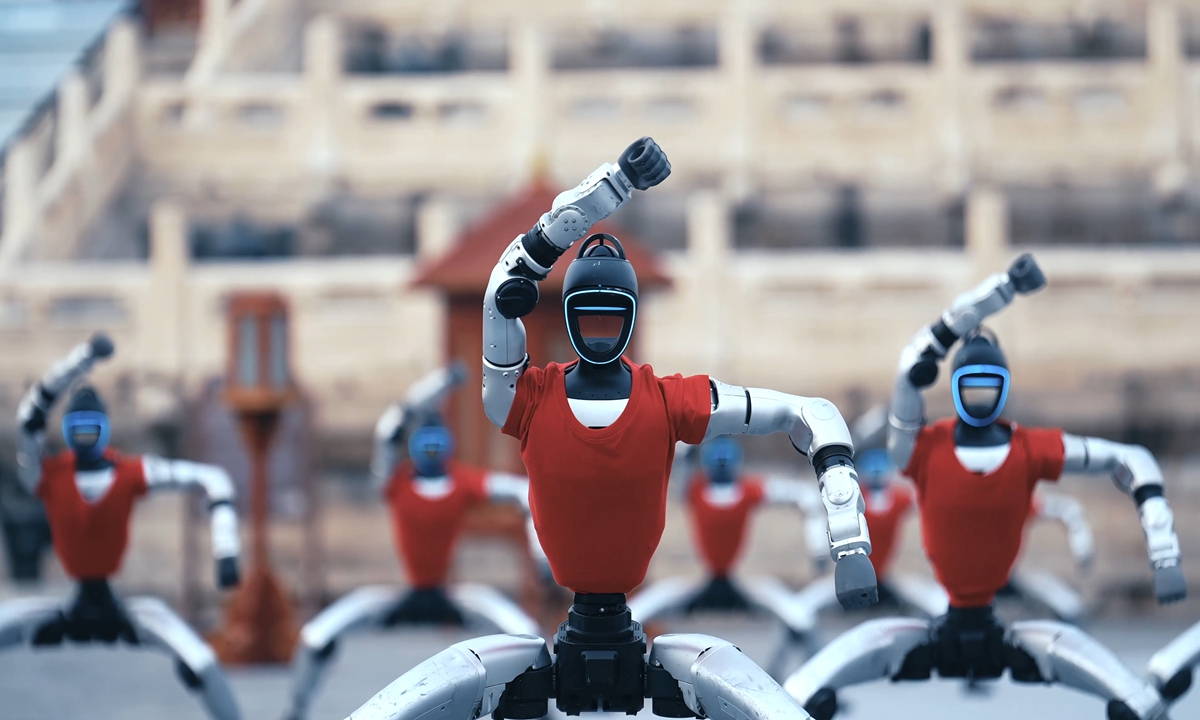
Unitree's G1 humanoid robots performe a synchronized martial arts demonstration in front of the Hall of Prayer for Good Harvests at the Temple of Heaven in Beijing. Photo: Screenshot of Unitree's video clip
Chinese humanoid robot company Unitree released a video on its official WeChat account on Monday, showing 49 G1 humanoid robots performing a synchronized martial arts demonstration in front of the Hall of Prayer for Good Harvests at the Temple of Heaven in Beijing.
The clip, titled "WuBot's Pray at the Temple of Heaven," represents another large-scale robotic performance following Unitree humanoid robots' appearance at the Spring Festival Gala on February 16.
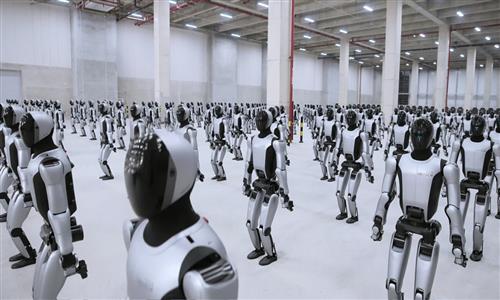
A Unitree representative told the Global Times that the performance used the same cluster control platform applied in the 2026 Spring Festival Gala show, which was independently developed by Unitree and enabled 49 robots to perform identical movements simultaneously.
According to staff members, the robots completed the full set of movements without remote manual control. Instead, the routines were executed through pre-programmed instructions. The robots were also capable of autonomous posture adjustment through onboard algorithms. For example, if a robot failed to land properly after a flip, the staff said "it could dynamically rebalance itself based on real-time status feedback."
In the 40-second video, the robots performed coordinated martial arts movements including punches, kicks, and high-difficulty flips. The video was also marked with the label "real shots, not AI-generated."

Unitree's G1 humanoid robots performe a synchronized martial arts demonstration in front of the Hall of Prayer for Good Harvests at the Temple of Heaven in Beijing. Photo: Screenshot of Unitree's video clip
As of press time, the video has been reposted for over 42,000 times and received over 50,000 "thumb ups" within about five hours on WeChat's short video platform.
A WeChat user commented that "the ancient builders who constructed the palace terraces could never have imagined the emergence of robots today, viewing the performance as a tribute to modern education and science." Another user noted that, following earlier demonstrations of drone swarms, Chinese company has now also developed robotic formations.
Unitree's official account on X also posted the video. X user named "@IntoTheFilter" praised the demonstration "Excellent coordination and camerawork. It's cool that humanoid robots are now a thing and not just in movies." Another X user "@OliverS88776242" said "This is less about kung fu and more about balance, latency, and control loops."
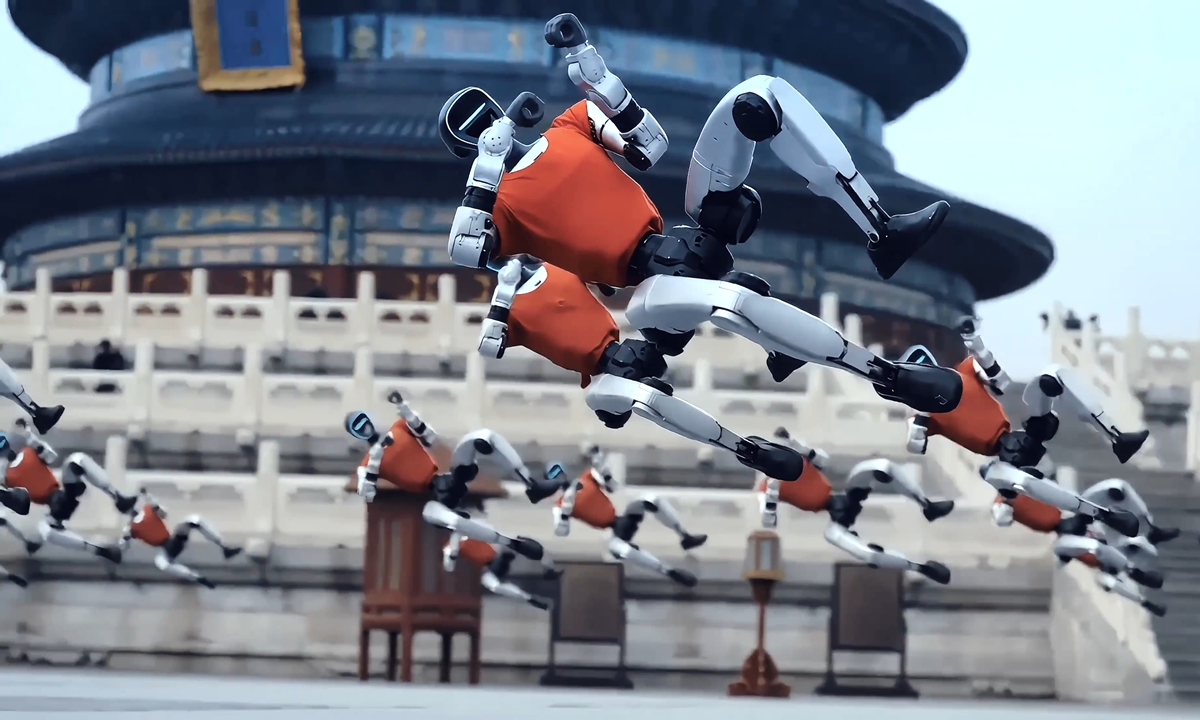
Unitree's G1 humanoid robots performe a synchronized martial arts demonstration in front of the Hall of Prayer for Good Harvests at the Temple of Heaven in Beijing. Photo: Screenshot of Unitree's video clip
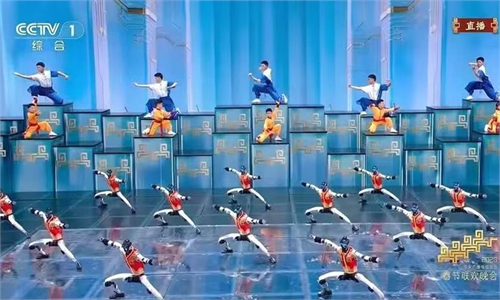
Unitree humanoid robots had previously made an appearance at the 2026 Spring Festival Gala on February 16, where they performed a dynamic routine featuring parkour, Drunken Fist movements, and nunchaku techniques, marking a significant upgrade from their 2025 Gala performance that showcased robotic Yangko dancing.
In a company statement sent to the Global Times, Unitree said the system allows each robot to conduct real-time stage scanning and localization using onboard 3D LiDAR sensors. A central control station distributes trajectories and movement sequences, while the robots autonomously execute motions and perform continuous self-monitoring. If a deviation occurs, the robot can automatically recover and rejoin the formation.
The statement noted that upgrading and validating the cluster control platform was identified as one of the key technical challenges. Coordinating dozens of robots simultaneously requires deep integration of networking, operating systems, embedded hardware, and software engineering. To address frequent stage layout changes, performer occlusion, prop interference, and intense robotic motion, the LiDAR-based localization algorithm was further optimized to improve accuracy and robustness.
Regarding potential real-world applications, the company said the technology could be used in multi-robot collaboration scenarios such as inspection and warehouse sorting. Compliant control under external forces could support precision assembly and heavy-load handling, while relative localization technology could enable navigation in complex environments.
RELATED ARTICLES