German Chancellor Merz to become latest European leader to visit China
Stabilizing China-Germany ties ‘helps Berlin manage relations with other global powers’
By Published: Feb 23, 2026 09:25 PM

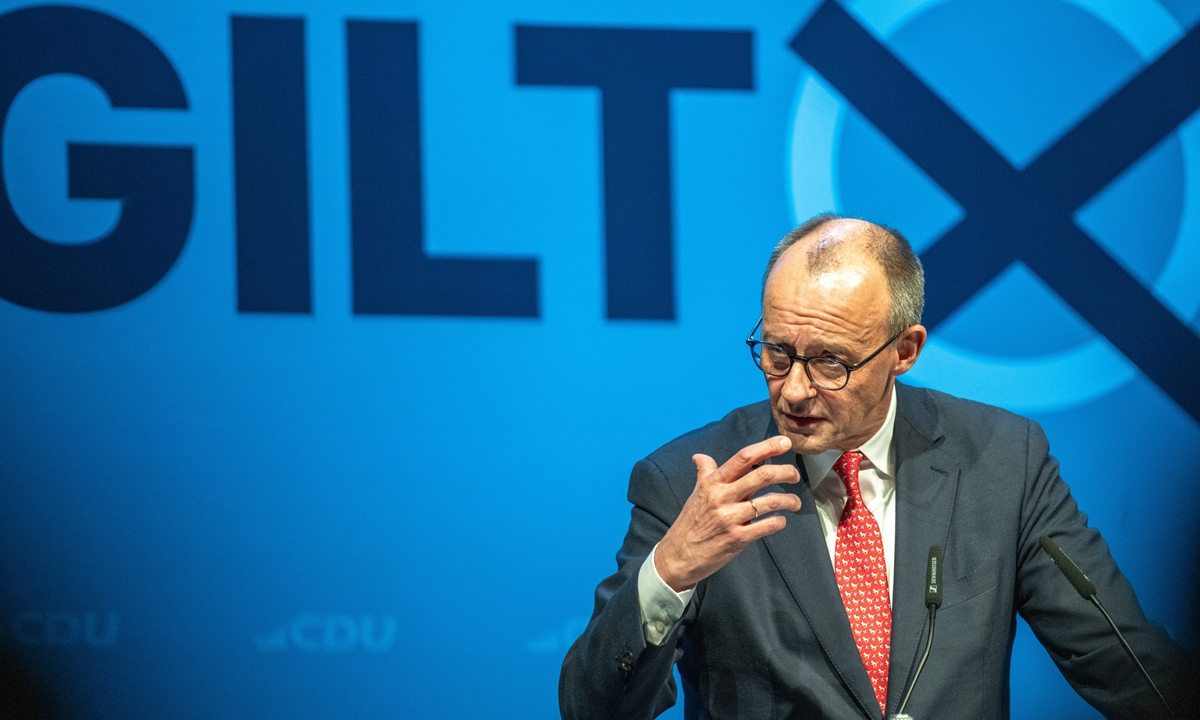
German Chancellor Friedrich Merz speaks at the Rhineland-Palatinate CDU's Political Ash on local time February 18, 2026. Photo: VCG
German Chancellor Friedrich Merz will pay an official visit to China from February 25 to 26 at the invitation of Chinese Premier Li Qiang, a Chinese foreign ministry spokesperson announced on Monday.
Merz will be accompanied by a 30-person delegation during his trip to China, where strategic action is required there for Germany, according to German news outlet taz.de.
Merz is set to become the latest European leader to visit China this year following British Prime Minister Keir Starmer, Finnish Prime Minister Petteri Orpo and Taoiseach of Ireland Michael Martin. In December 2025, French President Emmanuel Macron made a trip to China, soon after Spain's King Felipe. With Merz's arrival, the European Franco-German-British troika, the traditional driving force of Europe, will have all made high-level visits to China within a short span of time.
Explaining this phenomenon, Wolfram Elsner, a professor of economics at University of Bremen, Germany, told the Global Times that pushed by deteriorating geopolitical and geo-economic conditions within the collective West, leaders including France's Macron and UK's Starmer all had their motives and plans to strive for some win-win deal. And Merz would be the last one to follow suit, said the professor.
Belated yet still significant
"Friedrich Merz is not exactly known for his patience, but last Tuesday evening the Chancellor takes plenty of time to listen. He has invited a small, confidential group to dinner at the Chancellery. The topic is his inaugural visit to China," read Germany's Der Spiegel magazine in an article on February 19, illustrating the busy preparations for Merz's upcoming China visit.
DW News wrote in Chinese in a report on local time Saturday that this would be the German Chancellor's first official visit to China since taking office, and this "belated trip carries great significance still."
The belatedness of Merz's China trip can be attributed to two reasons, according to the DW report. First, after assuming office as Chancellor in May last year, he visited several countries, including India. Second, many other Western leaders - such as French President Macron, British Prime Minister Starmer, and Canadian Prime Minister Mark Carney - had already visited China ahead of him. They all share the same goal with Merz: gaining new room for maneuver in economic policy with China's help, after the US had previously narrowed that leeway through tariffs and trade pressures, read the report.
The visit to China would be of great significance for Merz to upgrade his personal understanding of China, Cui Hongjian, a professor at the Academy of Regional and Global Governance at Beijing Foreign Studies University, told the Global Times on Monday.
The ultimate direction Merz chooses - whether to let political and security considerations dominate bilateral relations or to prioritize pragmatic cooperation as the main thread - will be of crucial importance, Cui noted.
As his inaugural visit to China approaches, pressure on Merz is mounting. The Foreign Office is calling for a tougher stance toward China, while Economics Minister Reiche is warning precisely against that, Der Spiegel wrote in the February 19 story.
Figures released by Germany's Federal Statistical Office (Destatis) on the day showed that China has overtaken the US as Germany's top trade partner, reclaiming a position China held from 2016 to 2023.
The sum of exports and imports between the two countries last year totaled €251.8 billion ($296.6 billion), a 2.1 percent increase, according to Destatis.
While political and media elites are caught in a mental mode of hostility and war, its corporate economy, from big corporations down to even medium-sized enterprises, are investing more than ever abroad, and particularly so in China, Elsner also noted.
China is not only their largest single market, it is their production and R&D "gym," their technological future, the professor said. "They need the joint ventures with their Chinese partner firms, the abundant potentials of complete value chains, the advice, supplies, and services of the many young cutting-edge Chinese start-ups and unicorns, the high skills available, the modern, efficient, and cheap infrastructures, and the qualified private and public services."
Since taking office, Merz's foreign policy priorities have mainly centered on three major areas: the Germany-Russia relations triggered by the Ukraine crisis, intra-European relations, and transatlantic relations. However, recent changes in the international situation have gradually made Germany and the Merz government realize that it is necessary to further elevate the importance of relations with China, according to Cui.
Stabilizing and developing China-Germany relations well would provide significant support for Germany in managing its relations with other major powers and conducting effective diplomacy, the expert noted.
Merz's quest
Based on the official release on Friday by German federal government spokesperson Sebastian Hille, Merz will be accompanied on his trip by an economic delegation, and the focus of Merz's discussions with Chinese leaders will be on bilateral relations as well as economic and security policy issues.
"We need economic relations with the entire world, and that, of course, includes a country like China", he said on local time Wednesday at the congress of his conservative CDU party in Stuttgart, stressing he will be going with "a large business delegation," Euro News reported.
The report also said that Merz's visit will focus on "competition" and on "the right balance of cooperation", citing a government spokesperson.
On February 17 - the day that marked the start of the Chinese New Year - Merz wrote in his X post: "May the Year of the Horse bring strength and give new impetus to German-Chinese relations," while adding he is looking forward to travelling to China soon.
And soon after that, when speaking at his party CDU's Ash Wednesday event, Merz said he would seek "strategic partnerships" with China during a trip next week, as he looks to discuss future cooperation between Europe and the world's second-biggest economy while the US leans on tariffs, media outlets Reuters and POLITICO Europe reported. Merz also said at the event that foreign policy and economic policy could no longer be separated, Reuters reported.
According to the Bundesregierung release, Merz will visit Forbidden City and then the German car company Mercedes-Benz Group in Beijing on February 26 and after his arrival in Hangzhou in East China's Zhejiang Province, the Federal Chancellor will visit robotics company Unitree as well as German turbine-maker Siemens Energy.
Commenting on the schedule provided by the German side, Cui noted that the trip in Beijing is expected to help him gain a deeper understanding of China's policy objectives, their substance, and the underlying context, thereby forming a more objective and comprehensive view of China.
While in the Hangzhou itinerary, Merz's focus is expected to be on Chinese tech companies, an arrangement with considerable significance. By going deep into Chinese technology enterprises and visiting local areas during this trip, Merz's goal is clear, which is to comprehensively understand China's development experience and process, Cui said.
Xia Wenxin also contributed to the story
RELATED ARTICLES