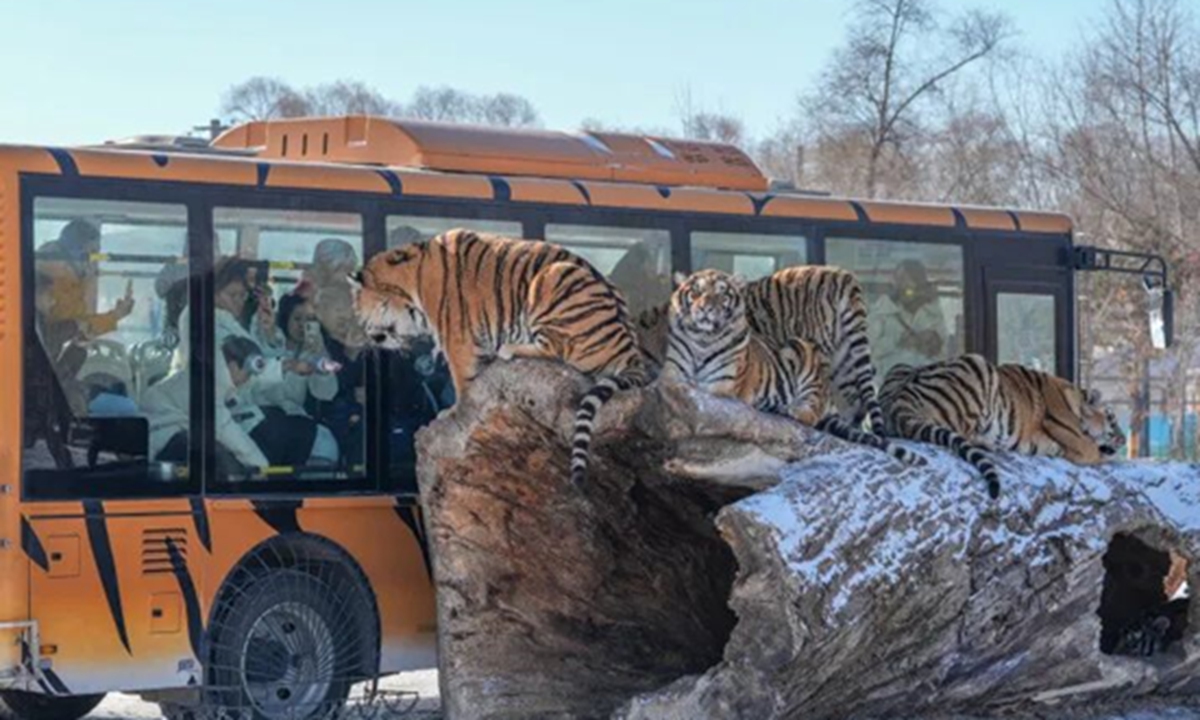
Tourists take photos of Siberian tigers from a sightseeing bus at the Siberia Tiger Park in Northeast China's Heilongjiang Province. Photo: Official WeChat account of Siberia Tiger Park
Nearly 200 Siberian tigers at the Siberia Tiger Park in Northeast China's Heilongjiang Province have been put on a rotational "intermittent fasting program" to improve their health, the park confirmed with the Global Times on Monday, as the tourist attraction witnessed a massive influx of visitors during the Spring Festival holidays with a corresponding surge in tiger feeding activity.
The public notice, which has been provided to the Global Times, states that the park is implementing a rotational "fasting program" to safeguard the health and welfare of its tigers.
According to the same notice, dated January 20 and posted at the park's entrance, the program will run from February 1 to March 31, covering 11 free-range enclosures within the park, with one designated enclosure placed on the official "fasting" list each day.
A staff member from the park told the Global Times that the measure was introduced as part of the scientific management of the Siberian tigers, as the park adjusts and optimizes the tigers' feeding regime with the corresponding surge in tiger feeding activity, while also ensuring visitors can enjoy the tiger feeding experience whenever they visit the park.
The notice clarified a ban on meat strip feeding in the day's designated fasting enclosures, required visitor compliance with park rules to protect the tigers' health, and noted that the program may be adjusted based on operational and feeding needs.
During China's Spring Festival holiday period, the park saw a steady uptrend in visitor traffic, marked by a prominent, record-breaking peak, a local media outlet in Harbin reported. The park received 7,708 visitor arrivals on February 17. On February 18, the scenic area officially hit its tourist peak, with daily visitor number surpassing 10,000, per the report.
The park spans an area of 800,000 square meters, is a national AAAA-level tourist attraction that integrates the breeding and rearing, scientific research and conservation, and popular science education of Siberian tigers, alongside tourism and sightseeing services.