Illustration: Chen Xia/GT
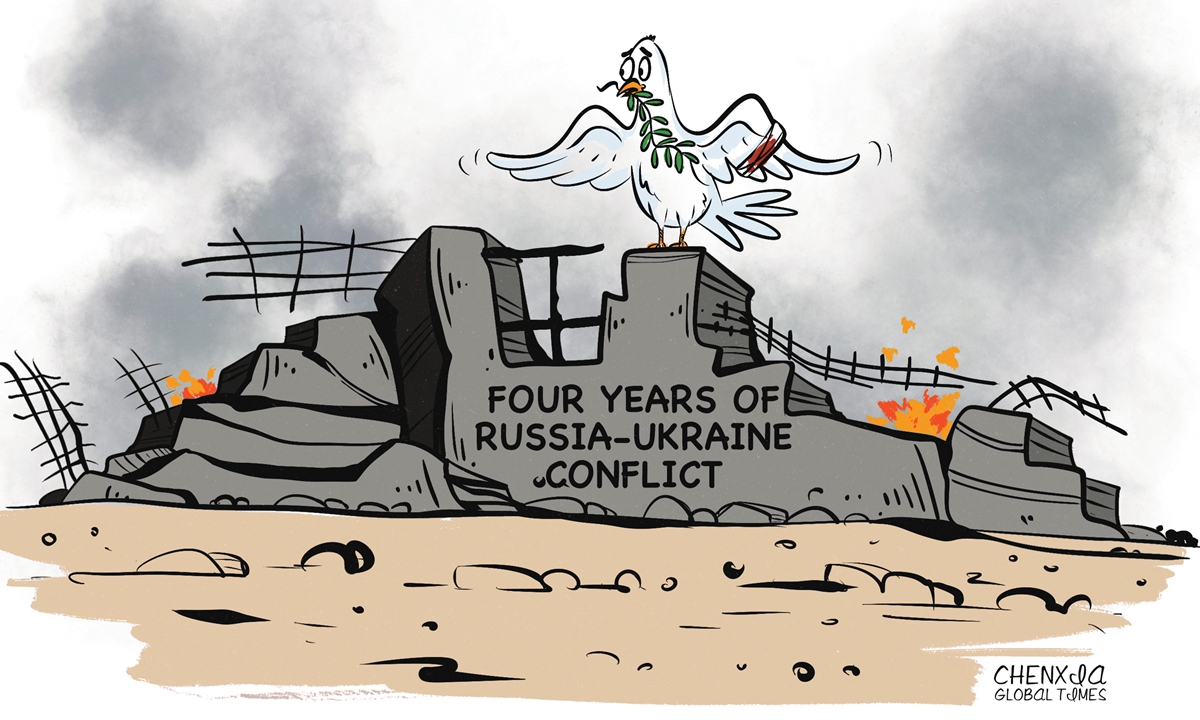
Four years ago, on February 24, large-scale conflict erupted in the European continent, delivering an unprecedented blow to the security order established after the Cold War. In retrospect, the Russia-Ukraine conflict transcends mere battlefield gains and losses; it challenges how the world interprets the future of security, power, and peace.
Recent tripartite talks among Russia, Ukraine, and the US in Geneva concluded without any breakthroughs on critical issues, while artillery fire continues to resonate across various regions. "The situation of the Russia-Ukraine conflict is unlikely to undergo fundamental changes in the short term," said Tian Dewen, a research fellow at the Institute of Russian, East European and Central Asian Studies at the Chinese Academy of Social Sciences. Despite multiple rounds of negotiations mediated by the US, both sides remain entrenched on key points such as territory and security guarantees, raising the risk of the conflict entering a prolonged phase of attrition.
Four years into the conflict, the dynamics have significantly reshaped strategic relations among major powers, including the US, Europe, and Russia, pushing the international system into a new structural phase. The US has leveraged the conflict to strengthen its influence over Europe, reinforcing NATO's role through narratives of security threats. This has made Europe increasingly dependent on Washington for security and compelled it to restructure its energy supplies, deepening its reliance on the US.
At the same time, Europe's pursuit of strategic autonomy has suffered severe setbacks. The energy crisis, rising military expenditures, and internal policy divisions have hindered Europe's ability to act as an independent strategic entity, significantly diminishing its role in major-power competition. Meanwhile, Russia, under comprehensive Western sanctions, has accelerated its pivot to the East, enhancing cooperation with non-Western nations.
The past four years of conflict have imparted profound lessons for the world. First, the war underscores that reliance on hegemonic logic cannot yield real security. Regardless of the occupant of the White House, Washington's strategic priority has remained consistent: to consolidate its global influence through external conflicts. This interest-driven approach complicates efforts to bring the conflict to a resolution.
Second, the current security predicament facing the Europe highlights that reliance on external powers is insufficient for genuine security. Heightened pressures have compelled many European leaders to reassess their strategies, prompting many nations to work toward developing independent military-industrial capabilities. Diplomatically, Europe is becoming increasingly pragmatic.
Third, the conflict's spillover effects warrant close attention. South Korea's participation in the NATO "PURL" initiative to allocate funds for Ukraine to purchase weapons only pushes back the prospects for resolving the Russia-Ukraine conflict, Russian Foreign Ministry spokesperson Maria Zakharova said on Saturday, adding that Russia, in response, will be forced to exercise its right to retaliate. "South Korea's consideration is inevitably influenced by US strategy. This also shows that the US does not oppose drawing Northeast Asia into the conflict to gain additional bargaining chips, which is highly dangerous for regional security," Tian said.
Fourth, the conflict has exposed the shortcomings of current international security frameworks. Multilateral institutions like the United Nations have played a limited role, highlighting the urgent need for improved global security governance. In this context, the relevance of the China-proposed Global Security Initiative and Global Governance Initiative becomes increasingly apparent. Effective crisis management will require facilitating collaboration between Europe and Global South countries, integrating multilateral mechanisms into major-power coordination.
Although China is not a party to the Ukraine crisis, it has actively engaged in seeking a resolution. China released a paper stating its position on the political settlement of the Ukraine crisis, providing a comprehensive and feasible roadmap for a political solution. On February 13, Member of the Political Bureau of the CPC Central Committee and Foreign Minister Wang Yi met with Ukrainian Foreign Minister Andrii Sybiha, stating that China's position has been consistent, always taking the four points proposed by the Chinese leader on what must be done as the fundamental guideline.
Four years into the Ukraine crisis serve as a stark reminder for the world: hegemonism, bloc politics, and confrontational alliances only lead to war, and conflicts produce no winners. Dialogue remains the only viable path toward resolving crises. As the smoke of war lingers, the world should reflect not on who prevails in battle but on how peace can be achieved.
RELATED ARTICLES