US hypes China’s nuclear arsenal buildup at Conference on Disarmament; experts call US tactic a pretext for own nuclear expansion
By Published: Feb 24, 2026 09:02 AM

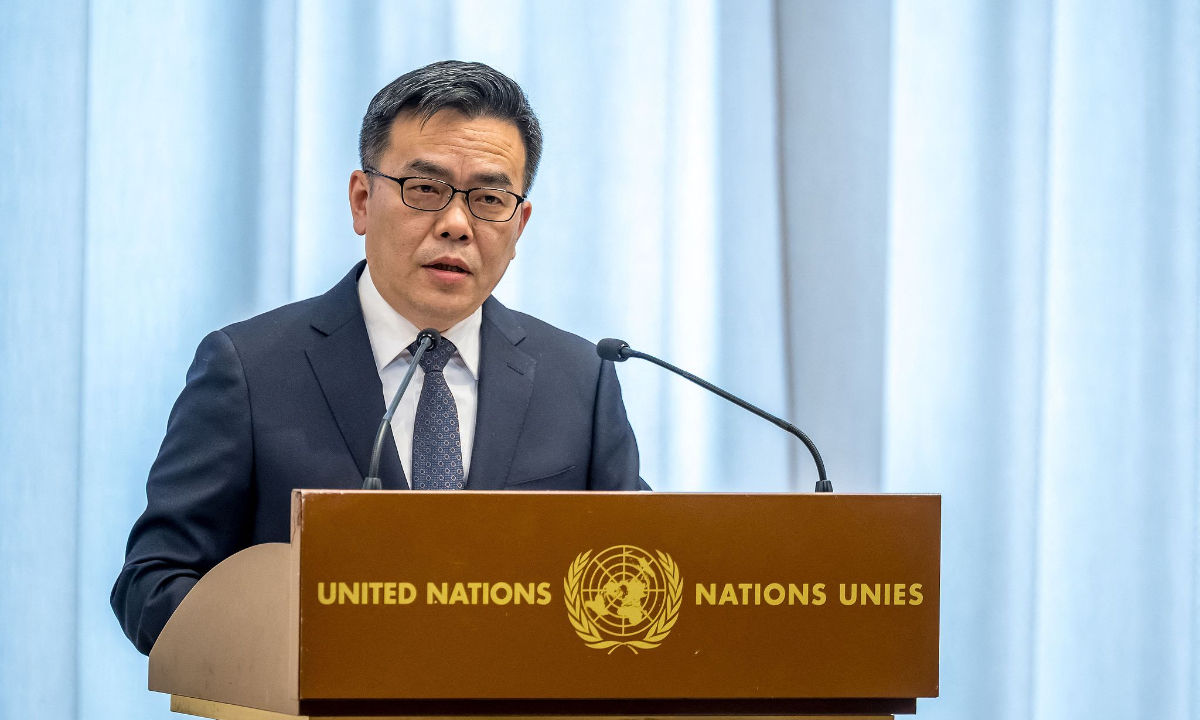
China's ambassador Shen Jian addresses the audience during the annual high-level debate of the United Nations Conference on Disarmament in Geneva, on February 23, 2026. Photo: VCG
"China firmly supports the purpose and objectives of the Comprehensive Nuclear-Test-Ban Treaty, and the US accusations that China is conducting nuclear explosive tests are entirely groundless and are merely an excuse fabricated to justify its own potential resumption of nuclear testing," Shen Jian, Chinese ambassador for disarmament affairs, said at a high-level meeting on disarmament in Geneva on Monday local time.
The US met a Russian delegation in Geneva on Monday and will meet a Chinese delegation on Tuesday for talks about forging a potential multilateral nuclear arms control treaty, a Reuters report said.
In response to a question that it is said China will hold talks with the US on arms control in Geneva on Tuesday local time, the Chinese Foreign Ministry spokesperson Mao Ning said at a press conference on Tuesday that while the Conference on Disarmament High Level Segment takes place in Geneva, the Chinese delegation stands ready to maintain communication with delegations from all participating countries and exchange views on issues including the work of the Conference on Disarmament and the Review Conference of the Parties to the Treaty on the Non-Proliferation of Nuclear Weapons.
Before the reported meeting, the US side has resorted to a typical smearing tactic with US officials hyping again so-called Chinese nuclear buildup and US media colluding to support the related rhetoric.
It is against the backdrop that the Conference on Disarmament is taking place this week in Geneva, just weeks after the New START arms control agreement - the Strategic Arms Reduction Treaty between Russia and the US expired earlier this month.
The 2026 session of the UN-backed Conference on Disarmament is divided into three parts, running from January to September, according to the UN website, and the high-level segment of the conference is scheduled from February 23 to 27.
During a session of the conference on Monday, Christopher Yeaw, US Assistant Secretary of State for the Bureau of Arms Control and Nonproliferation, claimed that "perhaps its greatest flaw was that New START did not account for the unprecedented, deliberate, rapid and opaque nuclear weapons buildup by China," according to NBC News.
He also claimed that China "has deliberately, and without constraint, massively expanded its nuclear arsenal," NBC News said.
Shen, the Chinese envoy on the issue firmly rejected the claim. China urges the US to reaffirm the commitment of the five nuclear-weapon states to a moratorium on nuclear testing and to uphold the global consensus on banning nuclear tests, Shen said.
Like its other smearing tactic, the US media colluded with US officials in creating the momentum.
CNN, citing US intelligence agencies, claimed on Saturday that China is developing a new generation of nuclear weapons and has conducted at least one covert explosive test in recent years "as part of a broader push to completely transform its nuclear arsenal into the world's most technologically advanced."
An international monitor has previously debunked US' similar hype, saying said it has seen no evidence to support the claim by a senior US official who accused China of carrying out a series of clandestine nuclear tests in 2020 and concealing activities that violated nuclear test ban treaties, the Al Jazeera reported on February 7.
Some Chinese experts said that the US' hype about China's nuclear arsenal and claims that China should join nuclear disarmament negotiations are in fact a pretext for expanding its own nuclear stockpile and developing more advanced nuclear weapons.
Why the US is so eager?
The New START, which was signed in 2010 and known as the last nuclear weapons control treaty between the US and Russia, expired on February 5, triggering fears of a new arms race.
The UN secretary general, António Guterres, has urged the US and Russia to quickly sign a new nuclear arms control deal, as the existing treaty expired in what he called a "grave moment for international peace and security," the Guardian said on that day.
The agreement prevented the uncontrolled build-up of nuclear weapons and provided the two countries, which possess the largest nuclear arsenals, with transparency measures to avoid misjudging each other's intentions, BBC said.
In the follow-up development, the US side however has attempted to bind China to multilateral nuclear arms control negotiations.
US President Donald Trump has called for a fresh arms control treaty with Russia, but both he and US Secretary of State Marco Rubio have claimed any new round of nuclear talks should include China, Bloomberg said.
The US is eager to push for China to join the negotiations with an aim to constrain China's limited nuclear forces, which are maintained solely for self-defense, while creating a pretext to withdraw from or weaken international mechanisms such as the Treaty on the Non-Proliferation of Nuclear Weapons, so that the US can continue to modernize and expand its own nuclear arsenal, said Zhang Junshe, a military affairs expert.
"Under the current conditions of profound asymmetry in nuclear force levels, calls for China to join nuclear disarmament talks between the US and Russia lack both a realistic foundation and moral justification," Zhang said.
As a country possessing a large nuclear arsenal, the US should fulfill its special and primary responsibility for nuclear disarmament, which is a consensus of the international community. China hopes that the US will meet the expectations of the international community, resume strategic stability dialogue with Russia, and discuss follow-up arrangements to the New START, Mao said.
In terms of nuclear warheads, China possesses only a fraction of the arsenals held by the US and Russia. This fundamental disparity means that China is not in a position to participate in strategic nuclear arms control negotiations with the two countries, Song Zhongping, a military affairs expert, told the Global Times on Tuesday.
Only when the US and Russia reduce their nuclear arsenals to a level comparable to China's, or when China's nuclear capabilities reach parity with those of the US and Russia, will there be a logical basis for discussing multilateral nuclear disarmament, some Chinese experts said.
"Before that point, the US has neither the standing nor sufficient justification to demand that China join its nuclear arms control arrangements with Russia," Zhang said.
RELATED ARTICLES