Application scenarios, more details of China's first unmanned cargo aircraft 'Tianma-1000' unveiled
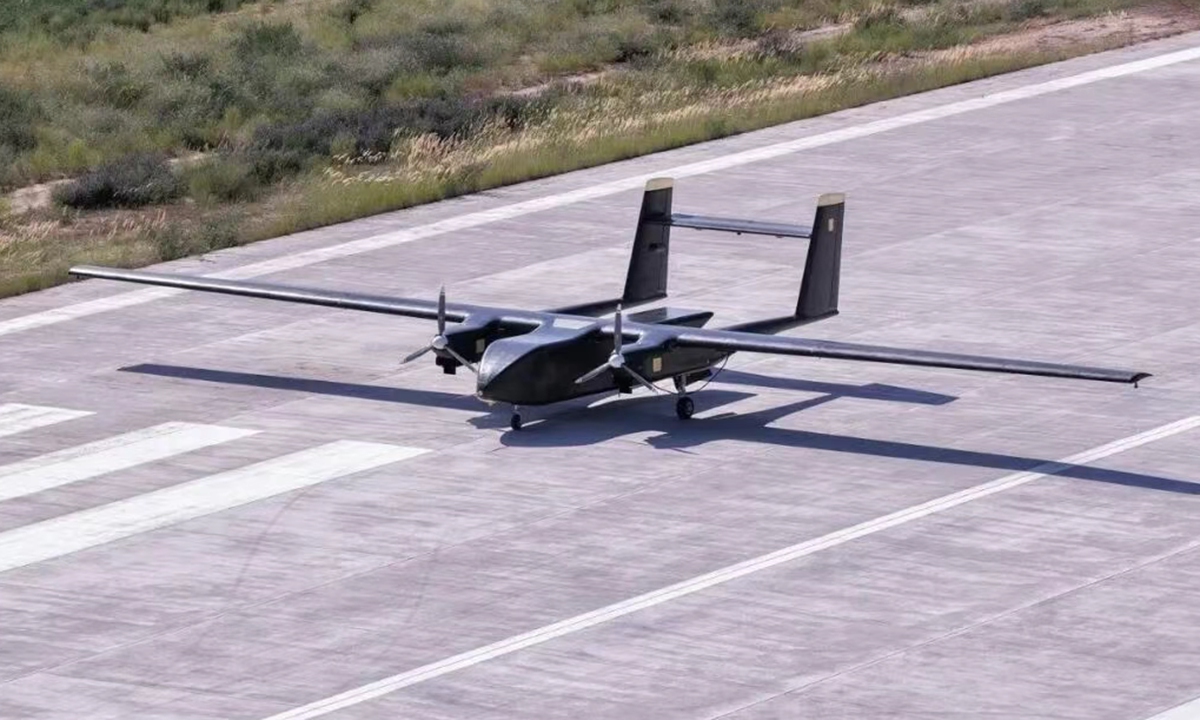
China's first unmanned cargo aircraft "Tianma-1000" Photo: China Central Television
China Central Television unveiled application scenarios and released more details of China's first unmanned cargo aircraft - the "Tianma-1000" on Tuesday, noting that the aircraft is capable of adapting to high-altitude complex terrain, achieving ultra-short takeoff and landing, and swiftly switching between cargo transport and airdrop mode.
The "Tianma-1000" unmanned transport aircraft had finished its maiden flight on January 11.
The "Tianma-1000" has a service ceiling of 8,000 meters, a maximum range of 1,800 kilometers, and a maximum payload of 1 ton, enabling it to transport large quantities of supplies in a single trip, per CCTV report.
In scenarios such as resupplying remote areas, emergency rescue, and urgent material transport, the "Tianma-1000" can deliver critical supplies like food, medicine, and equipment that meet the demand for several days in a single sortie. This capability can solve the logistical challenges of transporting materials to special geographical regions.
In situations such as natural disasters and emergency rescues, it can deliver ton-level supplies directly to areas unreachable by road or rail within half a day without the need for transfers, greatly enhancing emergency response speed, Sun Zhiwei, chief project engineer of the Xi'an ASN Technology Group Co., Ltd. under China North Industries Group Corporation, told CCTV.
One of the most important features is that it is deeply integrated with artificial intelligence. The "Tianma-1000" has achieved full-process automation - from mission planning and cargo loading to flight execution.
According to Sun, the "Tianma-1000" intelligent loading and unloading system can autonomously complete the handling of ton-level supplies within five minutes, significantly saving time and manpower costs.
During flight and mission execution, the "Tianma-1000" is able to independently identify and evade various obstacles such as mountains and buildings. It can automatically plan safe and cost-effective flight paths in unfamiliar airspace and complex terrain, according to Sun.
Notably, the "Tianma-1000" has extremely low requirements for conditions of takeoff and landing sites, enabling it to safely operate on non-hardened surfaces such as grasslands and dirt roads, and to take off and land within a 200-meter roll. This allows for rapid deployment in temporary locations such as wild areas and villages, establishing a flexible supply station.
Ma Chunhao, the program chief engineer, told CCTV that the "Tianma-1000" adopts a "plug-and-play" standardized interface, enabling quick switch between multi-scenario missions such as material transport, cluster delivery, and emergency rescue without the need for complex modifications.
Global Times
RELATED ARTICLES