US tariff ruling and new hikes fuel concerns in Taiwan; DPP authorities under intense backlash for ‘selling out’ island
By Published: Feb 24, 2026 10:14 PM

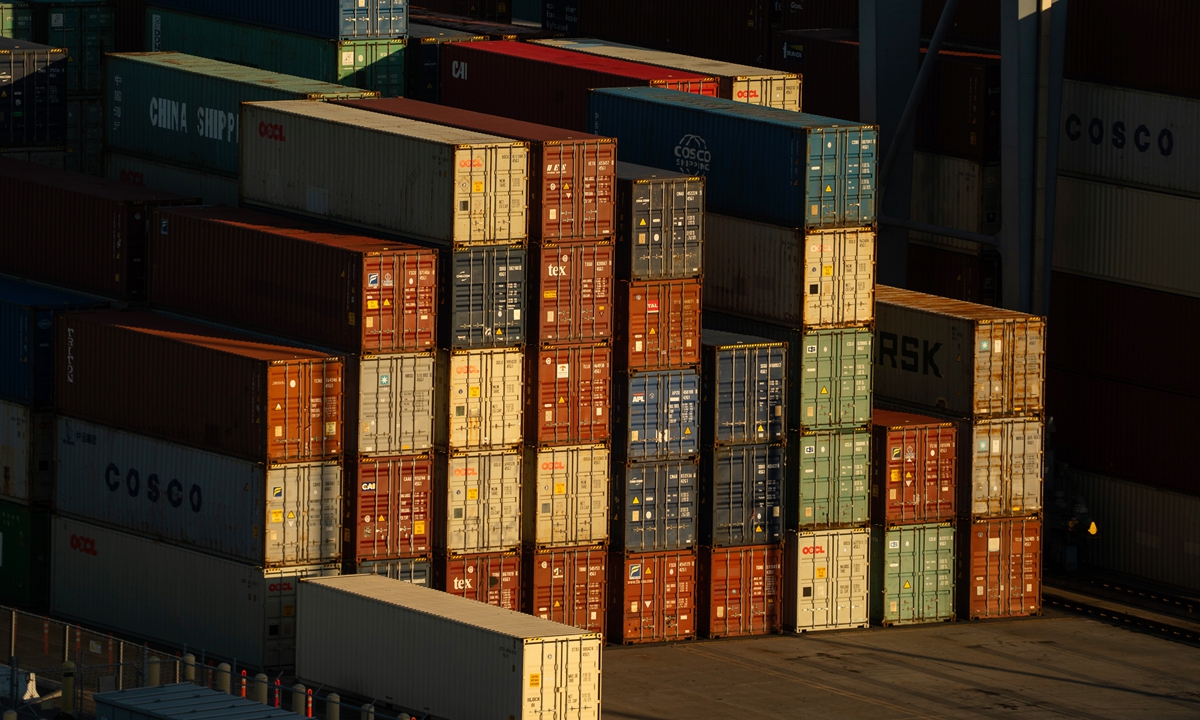
Shipping containers at the Port of Long Beach in Long Beach, California, US, on February 20, 2026. Photo: VCG
The Democratic Progressive Party (DPP) authorities in Taiwan island have come under intense public backlash after US President Donald Trump's tariff measures were ruled illegal by the US Supreme Court and he subsequently announced a new 15-percent tariff hike on imports, sparking growing anxiety on the island over whether the much-touted talks with the US had been "for nothing." As uncertainty over US tariff policy deepens, Taiwan businesses are increasingly worried about rising costs, shrinking profit margins and potential supply-chain disruptions, with some netizens warning that blindly following Washington could ultimately sell out the island.
At a press conference on Tuesday, Taiwan regional official Cheng Li-chiun, who led tariff-related talks with the US, claimed that the island does not plan to restart tariff negotiations with the US, but will instead maintain communication with Washington based on the results of previous talks to ensure that the "beneficial terms" already agreed upon remain unchanged. She was referring to last month's "Agreement on Reciprocal Trade" (ART), according to a report by United Daily News in Taiwan island.
Trump said Saturday that he would raise his new global tariff to 15 percent, The New York Times reported. The move came a day after the US Supreme Court ruled that the Trump administration's sweeping tariffs under a law meant for national emergencies were illegal.
Previously, the Taiwan region has struck two deals with the US to lower the tariffs on its exports to the US to 15 percent from 20 percent. Under the deal, Taiwan companies will invest $250 billion to boost production of semiconductors, energy and artificial intelligence in the US, while Taiwan will also guarantee an additional $250 billion in credit to facilitate further investment. The second deal confirms the tariff cut to 15 percent, "commits" Taiwan to a schedule for eliminating or lowering tariffs on nearly all US goods and to significantly boosting purchases of US goods like natural gas, according to Reuters.
Responding to media queries on whether the ART arrangement guaranteeing a non-stacking 15 percent tariff rate can be preserved going forward, Cheng claimed that maintaining the preferential treatment would be a goal for future efforts.
The US' latest changes to its tariff policy have fueled growing concerns in the Taiwan island over whether the previously reached agreement and earlier talks may ultimately prove meaningless, with many also highlighting the steep costs associated with securing the deal. Many Taiwan media outlets, including China Times, have set up dedicated sections on their websites to compile reports on US tariff developments and the regional authorities' responses.
While the DPP authorities are eager to play down concerns over a blow to Taiwan's industries and tout the so-called advantages they claim to have gained from previous talks, more voices are warning that these gains are illusory.
A report published by United Daily News on Tuesday noted that just before the Chinese New Year, the Taiwan authorities announced the "good news" that it had signed the ART, but uncertainties emerged immediately after the holiday, with the "shelf life" lasting less than two weeks. "For businesses, the biggest killer is high uncertainty. As long as the outcome of this tariff storm remains unclear, it will be a disaster for industry, and there is currently no end in sight," the article said.
Lin Chia-hsin, a vegetable farmer and public commentator, was quoted by udn.com as criticizing the Taiwan authorities for "turning a funeral into a celebration" and staging a high-profile announcement to portray the deal as a major negotiating breakthrough. He said that despite repeated concessions of Taiwan that allowed the US to "win big" in previous tariff talks, Taiwan was still accused of "stealing America's chip industry." Lin said Taiwan has already "lost so badly it doesn't even have its pants left."
Also on Tuesday, the Taiwan People's Party (TPP) caucus in the "Legislative Yuan" held a press conference, questioning whether what the island authorities had touted as a "diplomatic breakthrough" has turned into nothing more than a false propaganda narrative. The caucus warned that under the US' stacking of tariffs, Taiwan's industrial competitiveness could face a serious threat.
Public frustration has also spilled onto social media, with some users on X denouncing the agreement as a "sellout." One user, @r690805, accused the DPP authorities of "kowtowing to the US" while receiving only "tariffs and humiliation" in return. Meanwhile, @Owen05080215 criticized what he described as Taiwan regional leader Lai Ching-te's claim of "best treatment," arguing that tariffs have increased rather than decreased and that large-scale investment commitments have yielded little tangible benefit.
On the same day, several civic groups in Taiwan staged a protest outside the "Legislative Yuan," criticizing Lai Ching-te and the DPP authorities for pushing to advance legislation related to the ART agreement and arms sales with the US. The protesters urged lawmakers not to turn the legislature into what they described as a "cash machine" for the US, according to a release sent to the Global Times by the organizers.
Tsai Yu-jung, secretary-general of the Taiwan political victim's mutual assistance association, who also attended the Tuesday activity, criticized the DPP for disregarding public opinion and adopting a confrontational approach toward the mainland, which he said has contributed to worsening livelihoods in the island.
The latest developments once again lay bare that Washington prioritizes its own interests, while the DPP authorities continue to cling to political calculations at the expense of the island's industrial competitiveness and economic security, said Zheng Jian, a professor at the Taiwan Research Institute of Xiamen University.
The DPP authorities previously rushed to sign an agreement with the US while remaining vague about the price Taiwan has paid to secure the deal, disregarding public concerns. They are selling out the island for their own political interests, a reality that more people in Taiwan are beginning to recognize.
RELATED ARTICLES